Artwork
Untitled
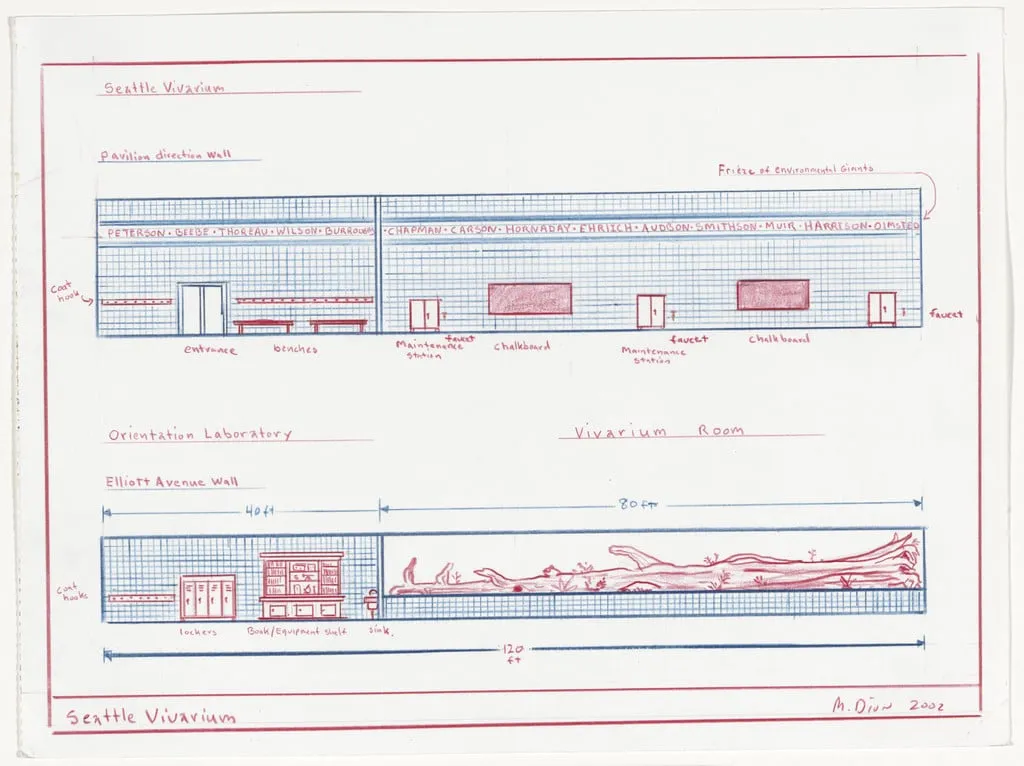
Untitled is a graphite drawing by Mark Dion. It dates from 2002 and is held in the collection of the Museum of Modern Art.
About this work
Names like Peterson, Carson, and Muir are written along the top wall, and there’s a wavy red line that looks like a river or some kind of path.
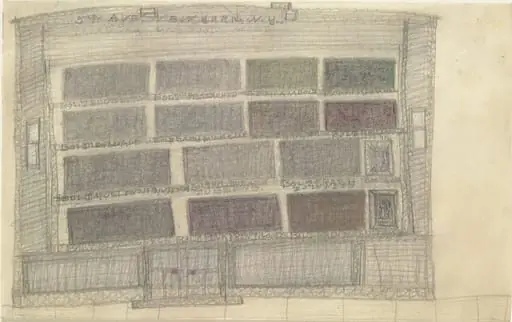
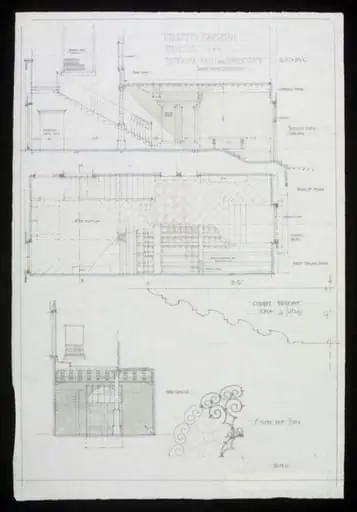
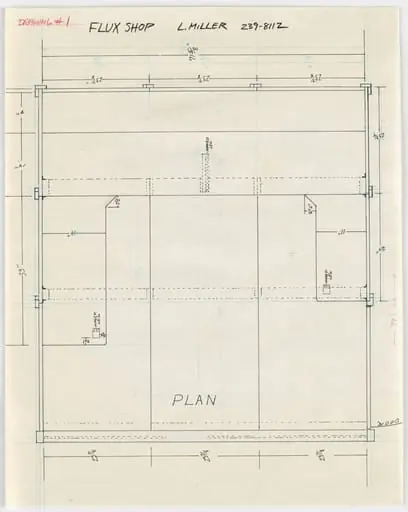
This drawing shows a floor plan of a place called the Seattle Vivarium. It’s made with colored pencil on grid paper, with red lines marking walls and furniture like benches and lockers. Names like Peterson, Carson, and Muir are written along the top wall, and there’s a wavy red line that looks like a river or some kind of path.
The artist labeled it “Seattle Vivarium” and dated it 2002. The bottom part shows a long room with a winding red shape that might be a stream or a path through the space.
Look up Mark Dion to see more of his work.
Overview
Mark Dion created this 2002 drawing using colored pencil on six sheets of grid paper. The work presents a detailed floor plan of the Seattle Vivarium, a former facility for live animal displays. Unlike traditional architectural renderings, the drawing blends cartographic precision with personal annotation, reflecting Dion’s interest in how institutional spaces encode cultural narratives about nature and knowledge.
Subject & Meaning
The drawing depicts the layout of the Seattle Vivarium, including walls, benches, lockers, and a winding red line suggesting a stream or pathway. Names like Peterson, Carson, and Muir—figures associated with natural history and conservation—are inscribed along the top edge. These labels subtly critique the romanticization of nature by linking institutional spaces to the cultural figures who shaped their ideological foundations.
Technique & Style
Dion employed colored pencil on ruled grid paper to construct a schematic floor plan with clinical clarity. Red lines delineate architectural features and the central water feature, while handwritten labels introduce subjective elements into an otherwise objective format. The use of grid paper reinforces the illusion of scientific neutrality, even as the content reveals the constructed nature of institutional knowledge.
History & Provenance
The Seattle Vivarium was a public aquarium and educational exhibit that operated from the 1930s until its closure in the 1990s. Dion’s drawing, dated 2002, responds to the site’s legacy after its decommissioning. By documenting its layout, he preserves a record of a space once used to mediate public understanding of wildlife, transforming it into a relic of shifting cultural attitudes toward nature and display.
Context
Dion’s work emerges from a broader artistic practice that examines museums, scientific collections, and natural history institutions as sites of power and interpretation. This drawing aligns with his investigations into how taxonomy, curation, and spatial organization shape public perception. The Vivarium, once a tool for education, becomes a case study in the mediation of nature through institutional frameworks.
Legacy
This drawing contributes to Dion’s ongoing project of revealing the biases embedded in scientific and educational institutions. By rendering the Vivarium’s layout with the precision of a surveyor but the subjectivity of a historian, he invites viewers to question how spaces designed to convey truth often reflect cultural assumptions instead. The work remains a quiet but persistent critique of authority in natural history representation.
Artist & collection
Artist
Mark Dion (born August 28, 1961) is an American conceptual artist best known for his use of scientific presentations in his installations.

![The Erectheum, West Elevation [left half], by John Russell Pope](https://artifactworldgallery.com/img/john-russell-pope--the-erectheum-west-elevation-left-half--10b9b48e87f30a0f-w320.webp)