Artwork
Apple Blossoms
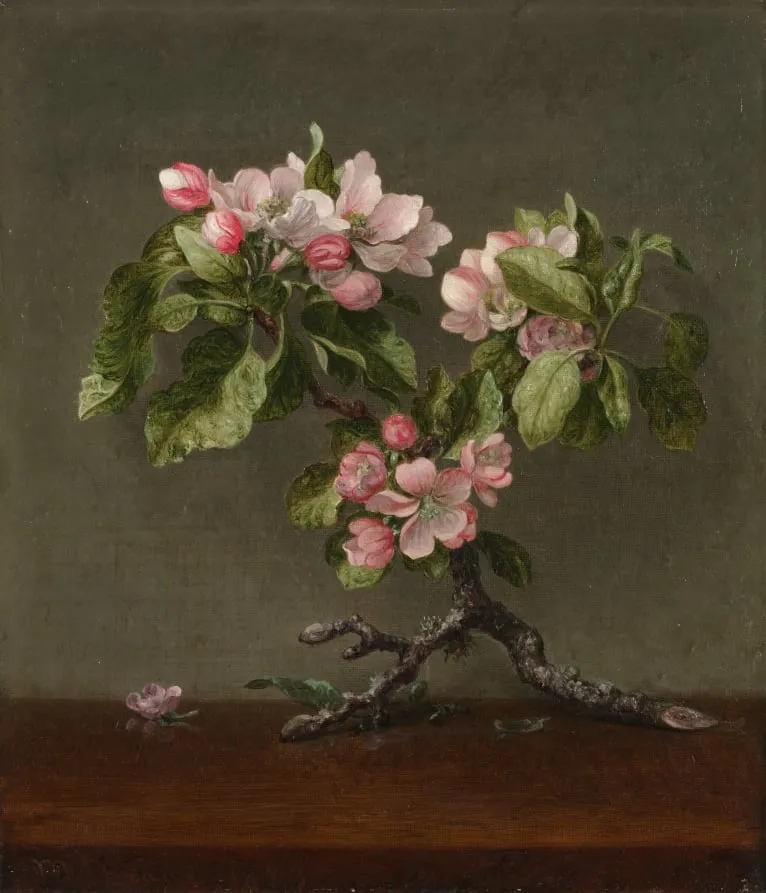
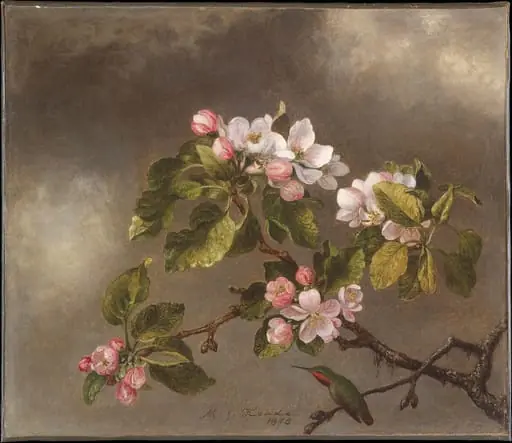
Apple Blossoms is an unspecified painting by the American Impressionist artist Martin Johnson Heade. It dates from 1873 and is held in the collection of the Cleveland Museum of Art.
About this work
Overview
This particular canvas presents a solitary branch of apple blossoms arranged on a tabletop, its simple composition framed by an unadorned wall.
Martin Johnson Heade’s work includes a substantial series of floral still lifes, numbering around one hundred and fifty. This particular canvas presents a solitary branch of apple blossoms arranged on a tabletop, its simple composition framed by an unadorned wall. The arrangement is restrained, allowing the delicate pink flowers and their slender, dark stems to dominate the visual field, while a muted shadow grounds the scene.
Subject & Meaning
The painting isolates a single branch of apple blossoms, emphasizing the transient beauty of the bloom without the distraction of additional objects such as vases or surrounding décor. By limiting the setting to a plain wall and a modest tabletop, Heade invites contemplation of the flowers’ form and color, suggesting a quiet meditation on nature’s fleeting moments.
Technique & Style
Heade employs a restrained palette, rendering the petals in soft pink tones against the darker, linear stems. The brushwork captures the delicate texture of the blossoms, while the subtle gradations of light create a gentle shadow on the table, reinforcing the three‑dimensional presence of the branch. The overall effect is one of calm realism, characteristic of his later still‑life approach.
History & Provenance
Created during Heade’s extensive period of flower painting, this work reflects his mature style in the latter half of his career. Though specific acquisition details are not provided here, the piece is part of a broader body of work that has been exhibited in major American collections, illustrating Heade’s sustained interest in botanical subjects.
Context
In the broader context of 19th‑century American art, Heade’s still lifes diverge from the more elaborate, narrative compositions of his contemporaries. By focusing on a single botanical element, he aligns with a growing appreciation for natural observation and the quiet study of ordinary subjects, a trend that would later influence American realism.
Legacy
Heade’s dedication to floral subjects contributed to the recognition of still life as a serious genre in American painting. Works like this one, with their minimalist composition and careful observation, continue to inform discussions of how artists balance simplicity and detail to convey the essence of a fleeting natural phenomenon.
Artist & collection