Artwork
A Lady Reading as Mary Magdalene
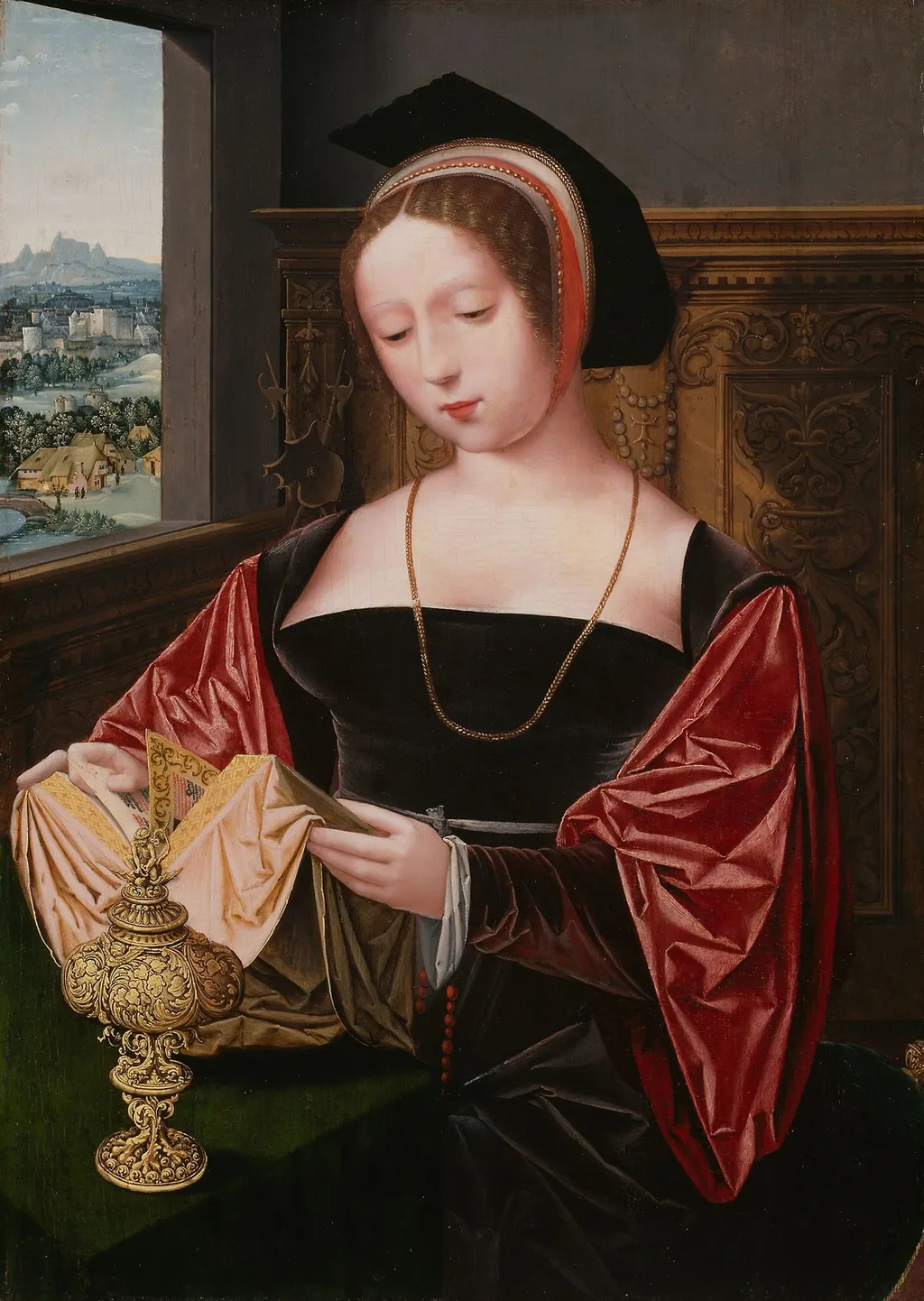
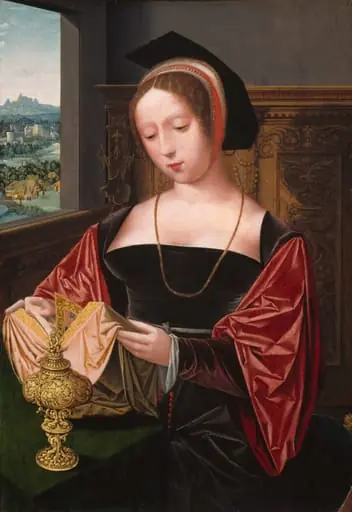
A Lady Reading as Mary Magdalene is an oil painting by the Northern Renaissance artist Master of the Female Half-Lengths. It dates from 1525 and is held in the collection of the Art Institute of Chicago.
About this work
Overview
The composition balances the rich textures of her attire and the gleaming vessel against the muted tones of the background.
A Lady Reading as Mary Magdalene, executed circa 1525 by the Master of the Female Half-Lengths, is a characteristic example of mid-16th-century Flemish Renaissance panel painting. The work depicts the saint in a contemporary domestic setting rather than a traditional desert landscape, reflecting the Northern Renaissance tendency to localize biblical narratives. The figure is presented in a half-length format, seated before a window that frames a detailed, atmospheric landscape with architectural elements and rolling hills. She wears a dark gown with distinctive red sleeves, a black headdress, and a necklace of red beads, while her hands hold an open book and a golden ointment jar, the latter serving as her primary iconographic attribute. The composition balances the rich textures of her attire and the gleaming vessel against the muted tones of the background. This painting exemplifies the anonymous workshop's specialization in female half-length figures, blending religious devotion with the era's fascination for portraiture and material detail. The work stands as a significant document of how Flemish artists adapted traditional hagiography to appeal to a burgeoning urban merchant class during the early 16th century.
Subject & Meaning
The figure is rendered as a contemplative Magdalene, holding a small book and a gilded cup that suggest piety and devotion. Her attire—a dark, richly textured dress with red sleeves—and the modest jewelry reinforce the solemn, introspective tone of the scene.
Technique & Style
The painter employs a subtle chiaroscuro, allowing light to illuminate the sitter’s skin while the surrounding drapery recedes into shadow. Smooth, layered brushwork creates a soft, almost luminous surface, particularly evident in the delicate rendering of the hair beneath a black hat.
Context
Behind the figure, a modest landscape unfolds through an open window, showing distant buildings and rolling hills. This background situates the portrait within a tranquil, domestic space, a common compositional device in early‑Sixteenth‑century Northern European portraiture.
Own this work as a print
Artist & collection
Artist
Master of the Female Half-Lengths
The Master of the Female Half-Lengths is a notname coined by the German art historian Max J.