Artwork
Photographie Lunaire: Copernic-Képler-Aristarique
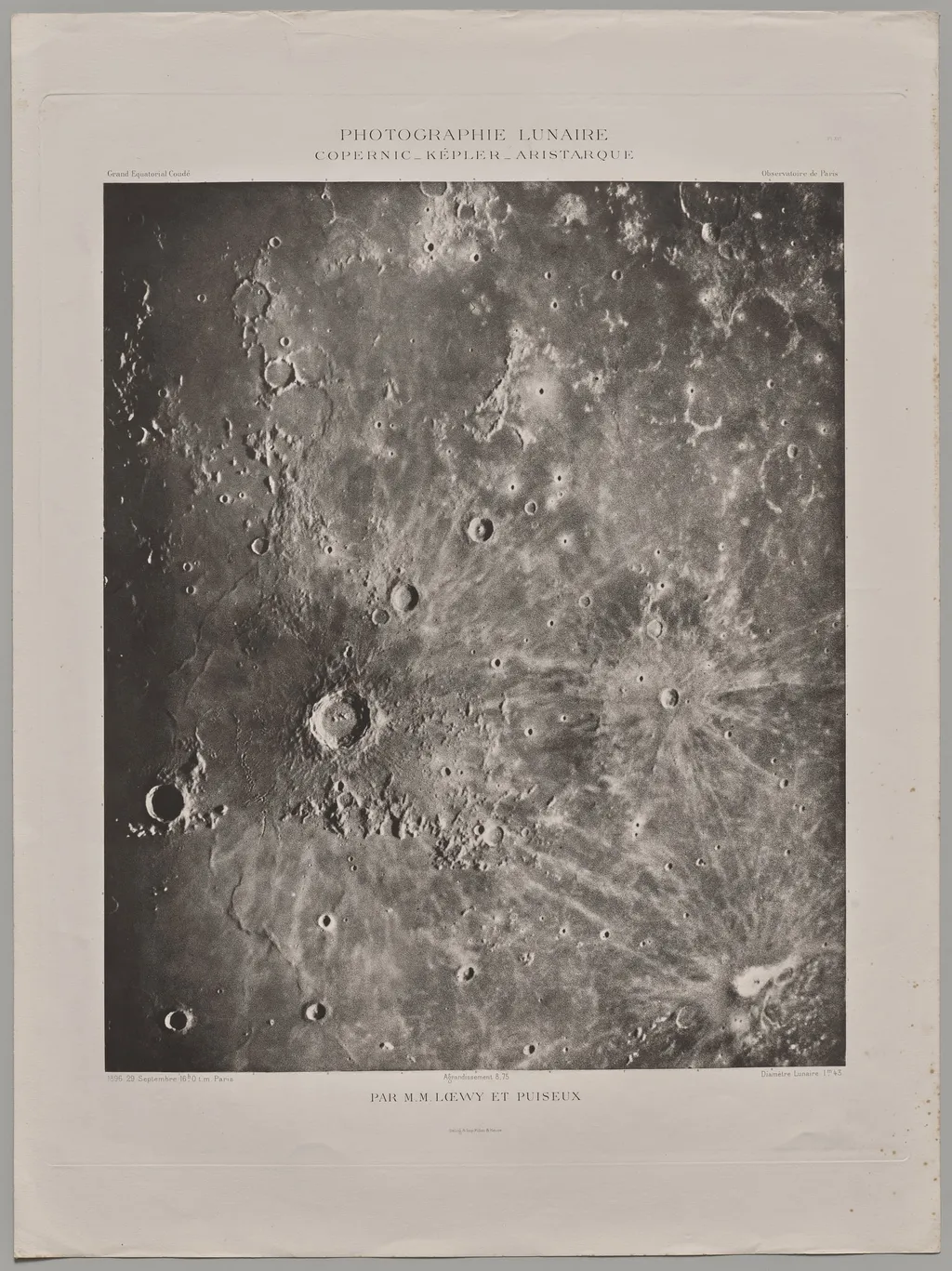
Photographie Lunaire: Copernic-Képler-Aristarique is a photography by the Impressionist artist Maurice Loewy. It dates from 1896 and is held in the collection of the Cleveland Museum of Art.
About this work
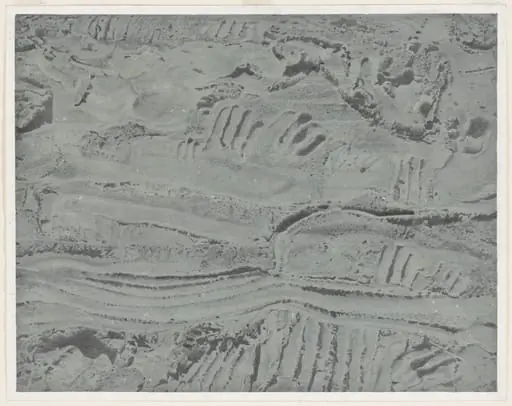
This gray photo plate shows the moon’s battered surface near craters named Copernicus and Kepler.
This gray photo plate shows the moon’s battered surface near craters named Copernicus and Kepler. It looks like a rough map, full of dots and streaks. The image isn’t a painting—it was made with a telescope Loewy built himself. He added a tracker so the camera could follow the moon’s slow crawl across the sky.
Back in the 1890s, clear photos of the moon were rare. Bad weather meant only about fifty nights each year actually worked for shooting. Still, Loewy and his partner took thousands of plates. Their atlas stayed the best moon guide until rockets flew past in the 1960s.
Want to see more like this? Look up Maurice Loewy (French, 1833–1907) at The Cleveland Museum of Art.
Overview
This photogravure is part of a fifteen-year project by astronomers Maurice Loewy and Pierre Henri Puiseaux to document the lunar surface with unprecedented precision. Produced at the Paris Observatory between the 1880s and 1890s, the work formed a twelve-volume atlas containing nearly one hundred large-format images. Each plate resulted from meticulous long-exposure photography, made possible by a custom-built telescope with a mechanical tracker that compensated for the Moon’s motion across the sky.
Subject & Meaning
The image captures a section of the Moon’s near side centered on the craters Copernicus and Kepler, two of its most prominent features. The surface appears as a textured field of shadows and elevations, rendered in fine tonal gradations. Rather than idealized or artistic interpretation, the plate presents a topographical record—intended as a scientific reference for lunar geography, not aesthetic appreciation.
Technique & Style
Loewy designed a specialized telescope fitted with a clockwork drive to follow the Moon’s trajectory during exposures, minimizing blur from Earth’s rotation. Using photographic plates and the photogravure printing process, the team translated glass negatives into high-fidelity prints. The resulting images exhibit fine detail and subtle contrast, achieved through long exposures on only the clearest nights—roughly fifty to sixty per year—making each plate the product of patient, repeated effort.
History & Provenance
The atlas was completed in 1910, after fifteen years of intermittent work constrained by weather and technical limitations. It was published as a luxury scientific edition, distributed to observatories and academic institutions. The original plates and negatives were preserved at the Paris Observatory. Later, selected prints entered museum collections, including The Cleveland Museum of Art, where they are held as significant artifacts of pre-space-age astronomical documentation.
Context
In the late 19th century, lunar observation relied on hand-drawn sketches, which often introduced subjective interpretation. Loewy and Puiseaux’s photographic approach offered an objective, reproducible record. Their work represented the pinnacle of ground-based lunar imaging, surpassing earlier efforts in clarity and scale. It remained the definitive visual reference until NASA’s lunar orbiters provided higher-resolution imagery in the 1960s.
Legacy
The atlas established a new standard for planetary photography, influencing both astronomy and scientific illustration. Its methodical approach demonstrated the value of long-term, systematic observation. Though superseded by space-based imaging, the plates remain valued for their historical significance and technical achievement—testaments to the precision possible with 19th-century instrumentation and dedication.
Artist & collection