Artwork
Peisaj
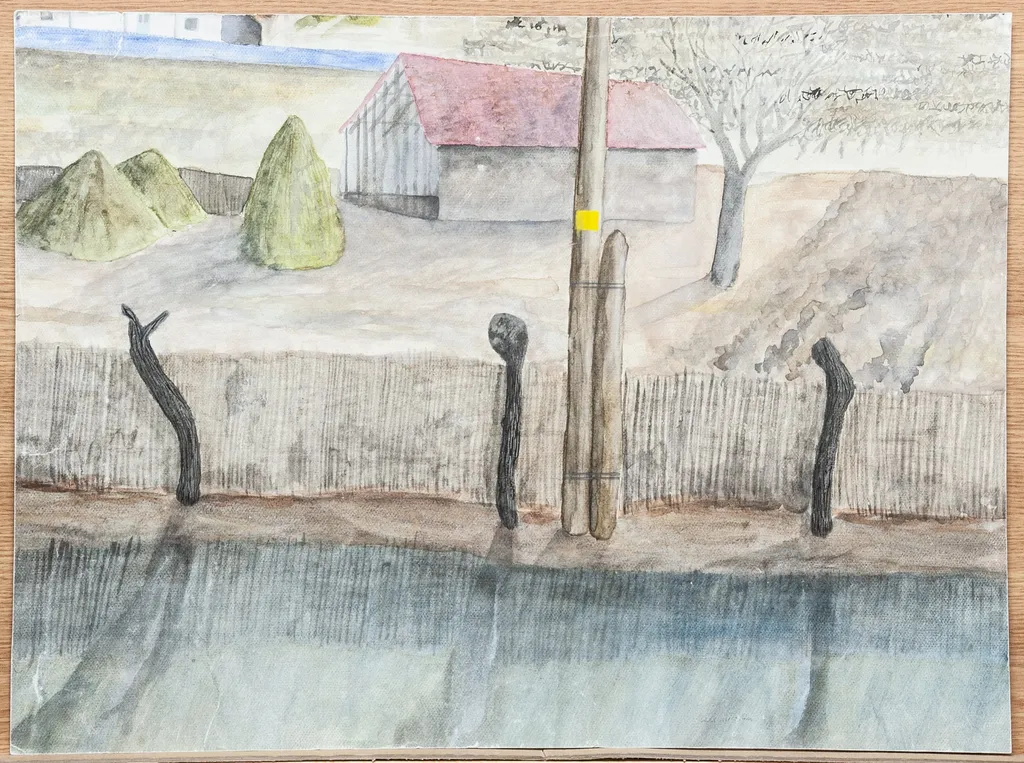
Peisaj is an unspecified painting by Vlad Micodin. It dates from 1950 and is held in the collection of the Gavrila Simion Eco-Museum Research Institute Tulcea.
About this work
Overview
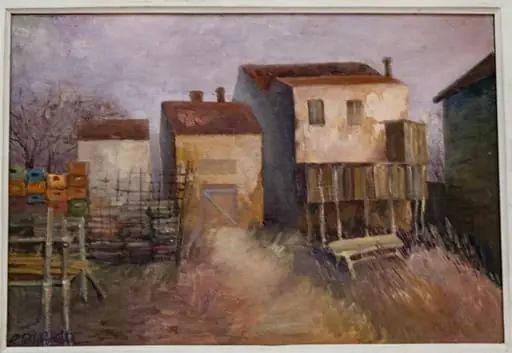
Created around 1950 by Romanian artist Vlad Micodin, Peisaj is an oil painting that depicts a tranquil countryside tableau. The work is part of the collection of the Museum of Ethnography, where it is displayed among other representations of rural life.
Subject & Meaning
The composition centers on a modest wooden fence bordering a field of haystacks, beyond which a small red‑roofed house rests. A leafless tree and additional structures appear in the distance, while a dark, still waterway runs along the lower edge, suggesting a quiet, self‑sufficient agrarian setting.
Technique & Style
Micodin employs a restrained palette of earthy, muted tones, rendering the scene with soft washes that emphasize atmosphere over detail. The fence posts are rendered with careful, linear precision, lending the work a rustic, almost documentary quality while maintaining a subtle sense of depth.
History & Provenance
The painting entered the Museum of Ethnography’s holdings shortly after its creation, becoming a reference point for mid‑twentieth‑century depictions of Romanian rural environments. Its provenance has remained stable, with no recorded changes of ownership beyond the museum acquisition.
Context
Peisaj belongs to a period when Romanian artists were increasingly documenting traditional landscapes and village life, responding to rapid social changes after World War II. Micodin’s focus on everyday agrarian scenes aligns with contemporary ethnographic interests in preserving cultural heritage.
Artist & collection
Artist
Vlad Micodin’s small body of work brings late-19th-century Romanian village life onto paper and canvas.
Museum
Gavrila Simion Eco-Museum Research Institute Tulcea
Continue through works from the same source collection.
![The Bridge at Grez [verso], by Childe Hassam](https://artifactworldgallery.com/img/childe-hassam--the-bridge-at-grez-verso--b226c0cf2b212983-w320.webp)