Artwork
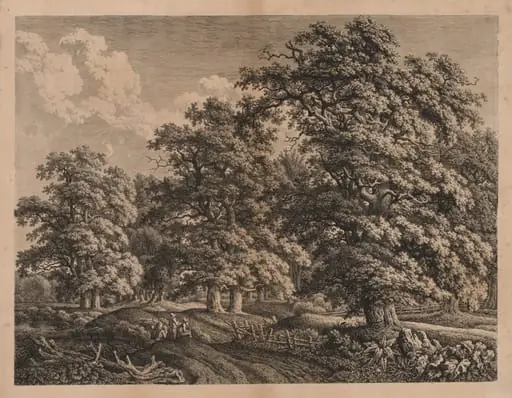
Forest with Travelers by a Road
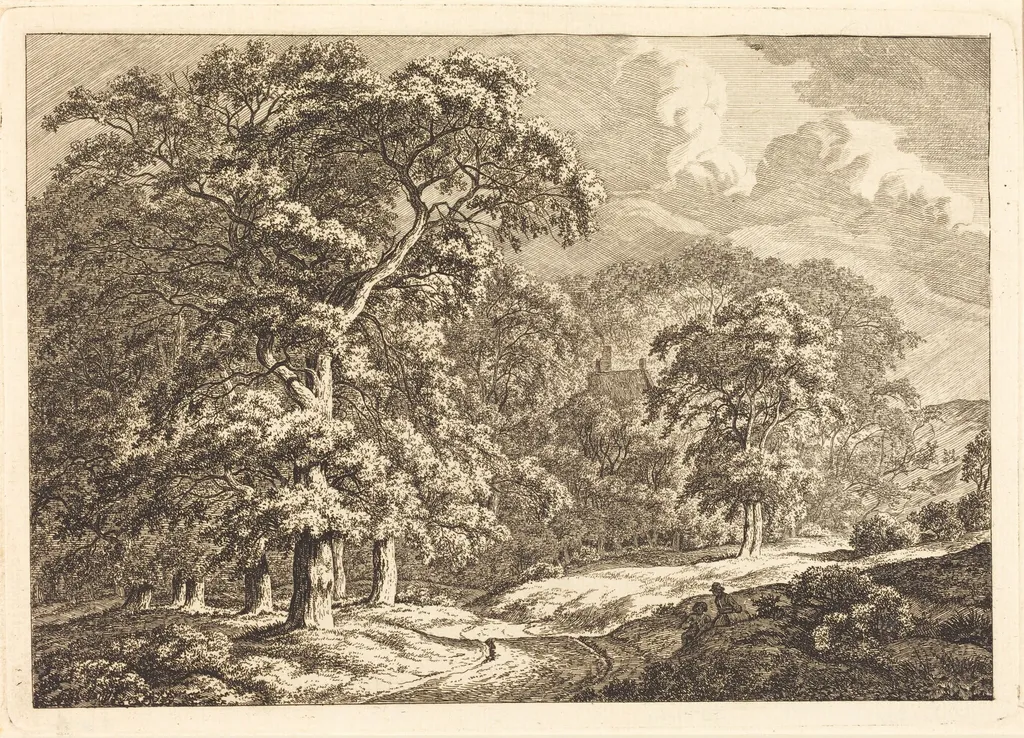
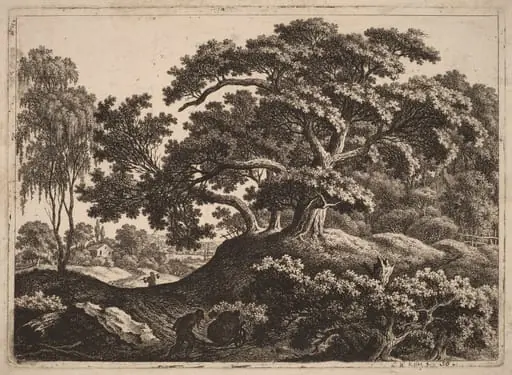
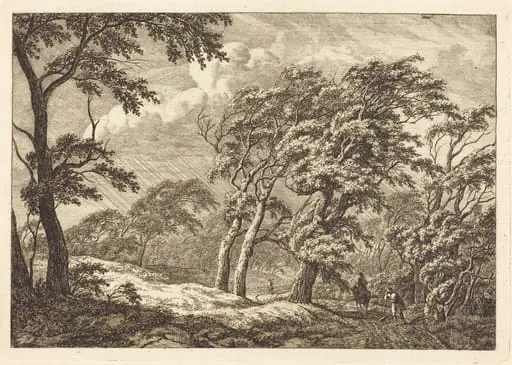
Forest with Travelers by a Road is an ink print by the Romanticist artist Franciscus A. Milatz. It dates from 1786 and is held in the collection of the National Gallery of Art.
About this work
Overview
The composition emphasizes spatial depth and a contemplative mood, characteristic of Milatz’s interest in landscape and human movement within nature.
Forest with Travelers by a Road is an etching produced by Franciscus A. Milatz in 1786. Executed on laid paper, the work belongs to the printmaking tradition of the late 18th century. It depicts a quiet woodland path where figures move along a winding route, their presence subtle against the dense natural surroundings. The composition emphasizes spatial depth and a contemplative mood, characteristic of Milatz’s interest in landscape and human movement within nature.
Subject & Meaning
The scene portrays a group of travelers journeying along a forest road, their forms small and unobtrusive amid towering trees and undergrowth. The road recedes into the distance, suggesting movement and passage without narrative closure. The absence of dramatic action invites reflection on solitude, transit, and the quiet persistence of human presence within wilder landscapes. The figures serve less as individuals than as symbols of transient experience.
Technique & Style
Milatz employed etching to achieve fine linear detail and subtle tonal gradations. The use of delicate hatching and varied line weight models the forms of trees and terrain, while soft contrasts between light and shadow suggest atmospheric depth. The paper’s laid texture contributes to the work’s tactile quality, enhancing the sense of naturalism. The style avoids theatricality, favoring restrained observation over emotional intensity.
History & Provenance
Created in 1786, the etching emerged during a period when landscape prints gained popularity among collectors interested in serene, intimate scenes. Milatz, active in the Dutch Republic, produced numerous works in this vein, often circulated through print dealers. While specific early ownership records are sparse, the piece aligns with regional print traditions that valued quiet naturalism over grand historical themes.
Context
In the late 18th century, European artists increasingly turned to landscapes as subjects worthy of independent study, moving away from religious or mythological narratives. Milatz’s work reflects this shift, aligning with a broader interest in the emotional resonance of nature. Though not formally part of Romanticism, his etching shares its sensitivity to mood and the sublime in ordinary settings, resonating with contemporary aesthetic trends.
Legacy
Milatz’s etching remains a modest but representative example of Dutch landscape printmaking from the late Enlightenment. It contributes to the historical record of how artists captured the quiet rhythms of nature and human transit without idealization. While not widely known today, the work continues to be studied for its technical precision and understated poetic tone within the context of 18th-century print culture.
Own this work as a print
Artist & collection