Artwork
Couple in a Clearing
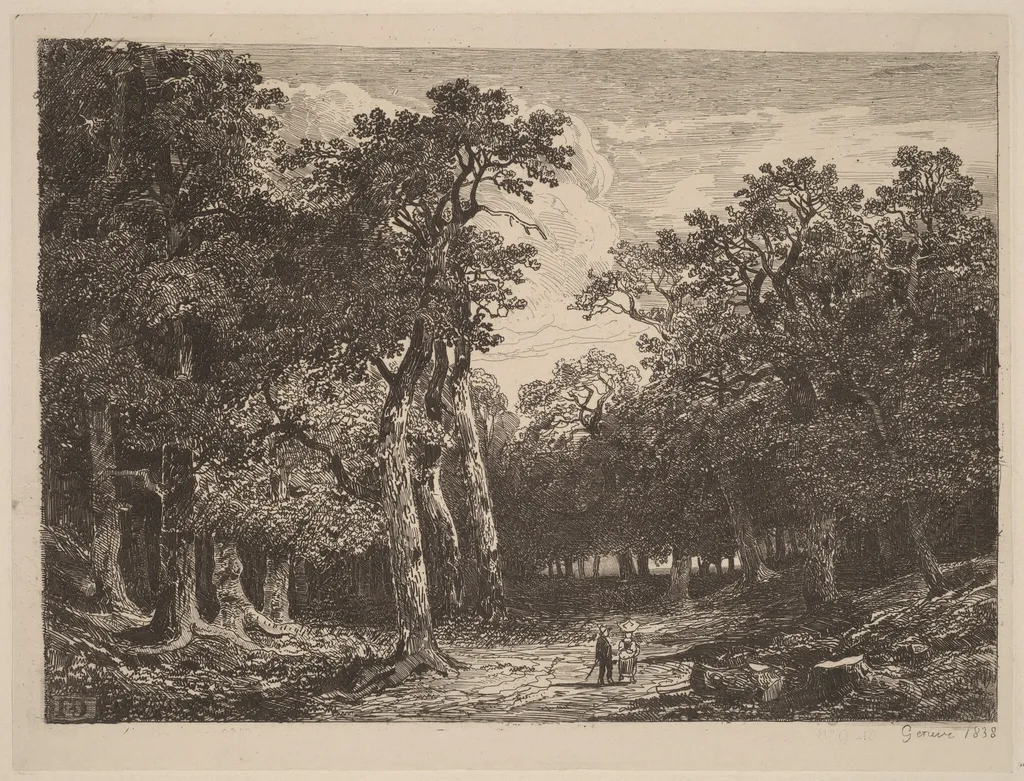
Couple in a Clearing is an ink print by the Romanticist artist Alexandre Calame. It dates from 1838 and is held in the collection of the National Gallery of Art.
About this work
Overview
Alexandre Calame’s 1838 print Couple in a Clearing presents an intimate woodland tableau rendered as an etching on chine collé. The composition captures a narrow path beside a shallow stream, flanked by densely packed trees whose tangled branches dominate the background. The couple, rendered in diminutive scale, walks quietly through the scene, emphasizing the vastness of the forest environment.
Subject & Meaning
The work depicts two figures moving along a forest trail, suggesting a moment of leisurely travel or contemplation within nature. By placing the human presence as a minor element amid towering trunks and rugged ground, Calame underscores the humility of mankind before the natural world, inviting viewers to consider the relationship between people and the untamed landscape.
Technique & Style
Executed as an etching on chine collé, the print utilizes fine, intersecting lines to convey texture: the bark of the trees, the ripple of water, and the irregularity of roots and stones. The chine collé support adds a thin, paper-like layer that enhances the delicacy of the lines while providing a subtle tonal depth characteristic of early‑19th‑century landscape prints.
History & Provenance
Created in 1838, the piece belongs to Calame’s early period when he focused on Alpine and forest scenery. While specific ownership records are limited, the print has been catalogued among the artist’s prints that were circulated in European art markets of the 1830s, reflecting the period’s growing interest in detailed, reproducible landscape imagery.
Own this work as a print
Artist & collection

 Forest with Travelers by a Road
 Flooding in the Forest of the Ile Séguin
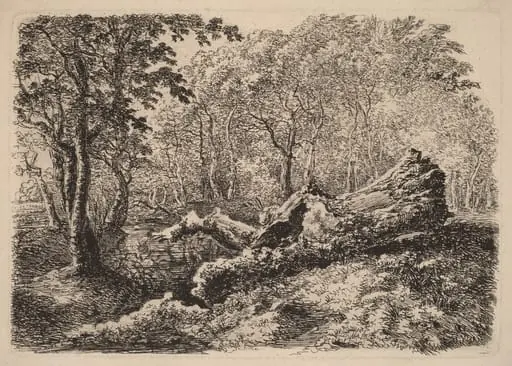 Mouldering Tree Trunk
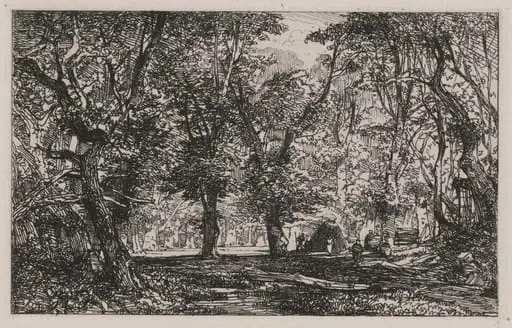 View from a Forest Stream Into a Clearing
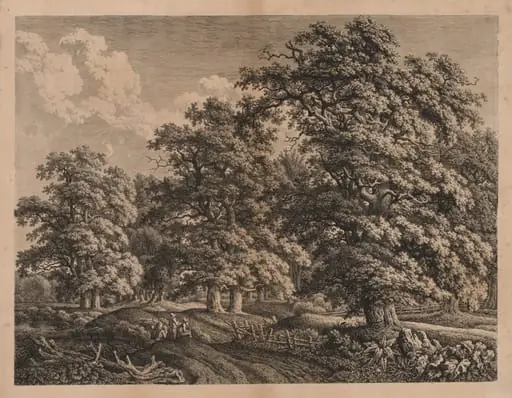 Landscape and Three Figures
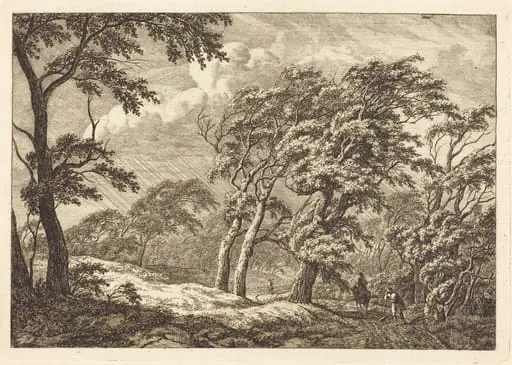 Travelers on a Forest Road in a Storm
 At Colney
 A Forest Marsh with Travelers on a Bank (The Travelers)
 Brook in the Val Mondois
 Landscape with Figures