Artwork
The Breadth and Flatness of the Frontal Bone
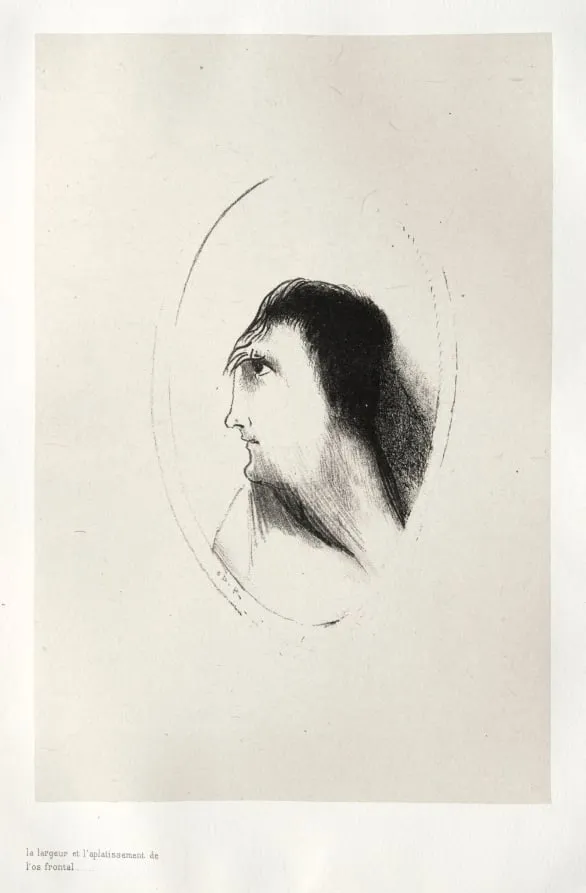
The Breadth and Flatness of the Frontal Bone is a print by the Impressionist artist Odilon Redon. It dates from 1896 and is held in the collection of the Cleveland Museum of Art.
About this work
Overview
Redon translated the novel’s atmospheric unease into abstracted, dreamlike forms, avoiding literal narrative in favor of psychological suggestion.
This lithograph is part of a series by Odilon Redon inspired by Edward Bulwer-Lytton’s 1859 supernatural tale, The Haunted and the Haunters. Redon translated the novel’s atmospheric unease into abstracted, dreamlike forms, avoiding literal narrative in favor of psychological suggestion. The image centers on a solitary, pale frontal bone suspended in darkness, its luminous surface emerging from deep shadows through refined printmaking techniques.
Subject & Meaning
The isolated forehead evokes an unseen presence—neither fully human nor entirely spectral. It suggests the lingering trace of thought or memory, aligning with the novel’s themes of invisible forces and psychological haunting. Redon avoids depiction, instead offering a fragment that implies something beyond perception, inviting contemplation rather than explanation.
Technique & Style
Working with master printer Auguste Clot, Redon exploited lithography’s tonal potential by rotating his crayon, layering strokes, and incising the stone. These methods produced a soft, smoky gradation that gives the bone an internal glow. The contrast between the pale form and the near-black background heightens its ethereal presence, blurring the line between drawing and shadow.
History & Provenance
Created in the 1880s, this print belongs to Redon’s mature period, when he had fully embraced lithography as a medium for introspective expression. The collaboration with Clot was pivotal, enabling technical precision that matched Redon’s poetic vision. The series was not widely exhibited at the time but gained recognition among Symbolist circles for its emotional resonance.
Context
Redon’s work emerged alongside Symbolist literary movements that favored suggestion over realism. Influenced by writers like Baudelaire and Poe, he sought to visualize the intangible—dreams, fears, the subconscious. This print reflects a broader cultural turn toward interiority, where the supernatural became a metaphor for psychological states rather than literal ghosts.
Legacy
The print’s quiet intensity influenced later artists exploring abstraction and psychological depth. Its use of tone and ambiguity prefigured approaches in 20th-century printmaking and Surrealism. Though not overtly political or narrative, its emotional resonance endures as a quiet meditation on perception, memory, and the unseen.
Artist & collection
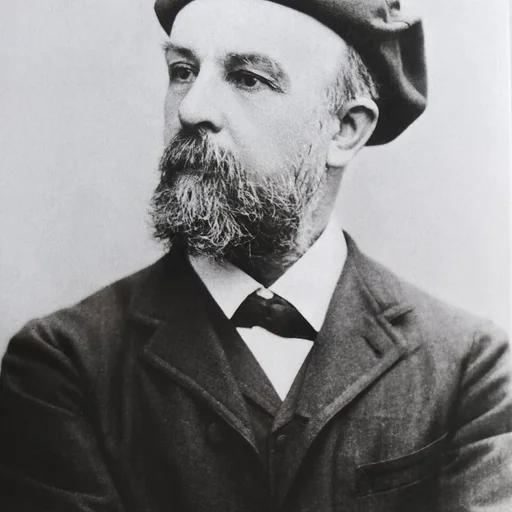
Artist
Born Bertrand-Jean Redon on 20 April 1840 in Bordeaux, the artist adopted the name Odilon from his mother, Marie-Odile.