Artwork
Fishing on the Havel River
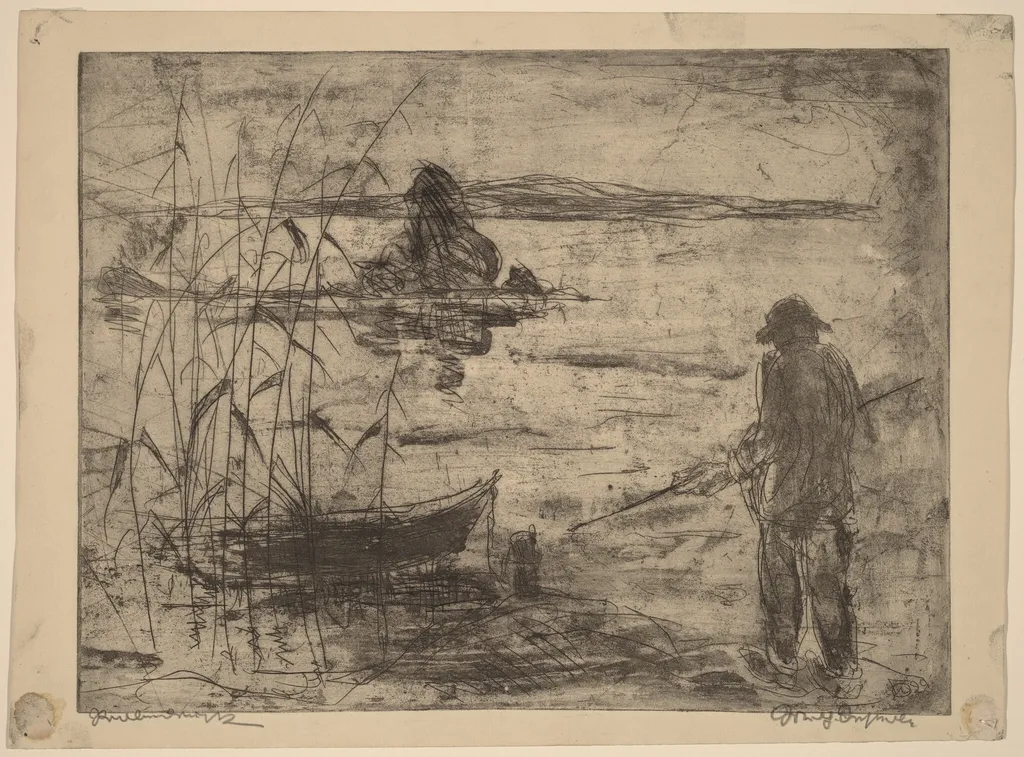
Fishing on the Havel River is an ink print by Wilhelm Oesterle. It dates from 1922 and is held in the collection of the National Gallery of Art.
About this work
Overview
Fishing on the Havel River is a 1922 print by Wilhelm Oesterle, executed in etching, aquatint, and open-bite on thick wove paper. The work captures a quiet moment on the river near Berlin, rendered with subtle tonal gradations and a restrained palette. Its intimate scale and quiet composition reflect Oesterle’s interest in everyday rural labor and the subdued rhythms of provincial life.
Subject & Meaning
The stillness of the water and the muted landscape suggest a contemplative pause, grounding the image in the quiet persistence of working-class life.
Two figures in modest attire—overalls and caps—occupy a small rowboat on the Havel River. One rows with steady motion, the other leans to cast a line, their actions unhurried and synchronized. The scene avoids drama or symbolism, instead emphasizing the dignity of routine labor. The stillness of the water and the muted landscape suggest a contemplative pause, grounding the image in the quiet persistence of working-class life.
Technique & Style
Oesterle employed aquatint to create a granular texture across the water’s surface, evoking subtle reflections without sharp highlights. Open-bite techniques added soft, atmospheric depth to the background trees and sky, while fine etched lines defined the boat and figures with precision. The paper’s heavy weight holds the ink densely, enhancing the tactile quality of the scene and reinforcing its sense of quiet realism.
History & Provenance
Created in 1922, the print emerged during a period of economic and social instability in Weimar Germany. Oesterle, based in Berlin, frequently depicted regional landscapes and laborers, often circulating his works among local collectors and print societies. This piece likely circulated in small editions, preserved in private collections and regional museums, though its exact provenance remains undocumented beyond its creation date.
Context
The Havel River, a key waterway near Berlin, was a common subject for artists seeking to portray the transition between urban and rural life. In the early 1920s, such scenes offered a counterpoint to industrial modernity, emphasizing continuity and quiet resilience. Oesterle’s approach aligns with regional printmakers who favored understated realism over expressionist intensity, reflecting a broader cultural yearning for stability.
Legacy
Though not widely exhibited outside Germany, Fishing on the Havel River exemplifies Oesterle’s commitment to documenting ordinary life through precise, tactile printmaking. His work, including this piece, contributed to a modest but enduring tradition of German regionalist prints that valued observation over spectacle. Later scholars have noted its quiet technical mastery as representative of interwar print culture beyond major artistic movements.
Own this work as a print
Artist & collection


 Thames Fishermen
 Un Vieux Chantier à Rochester (The Old Dock-yard at Rochester)
 Landscape with Boat, 1st plate (Le paysage au bateau)
 Fisherman with a Hoop-net (La peche a la truble)
 Fishing Boats on the Beach at Étretat
 The Lido
 Chelsea Bridge and Church
 Oceano Nox
 Sappho (Sapho)
 Dünenlandschaft (Landscape with Dunes)
 Le Pêcheur à la Ligne
 Fishing-Boat