Artwork
Dancing
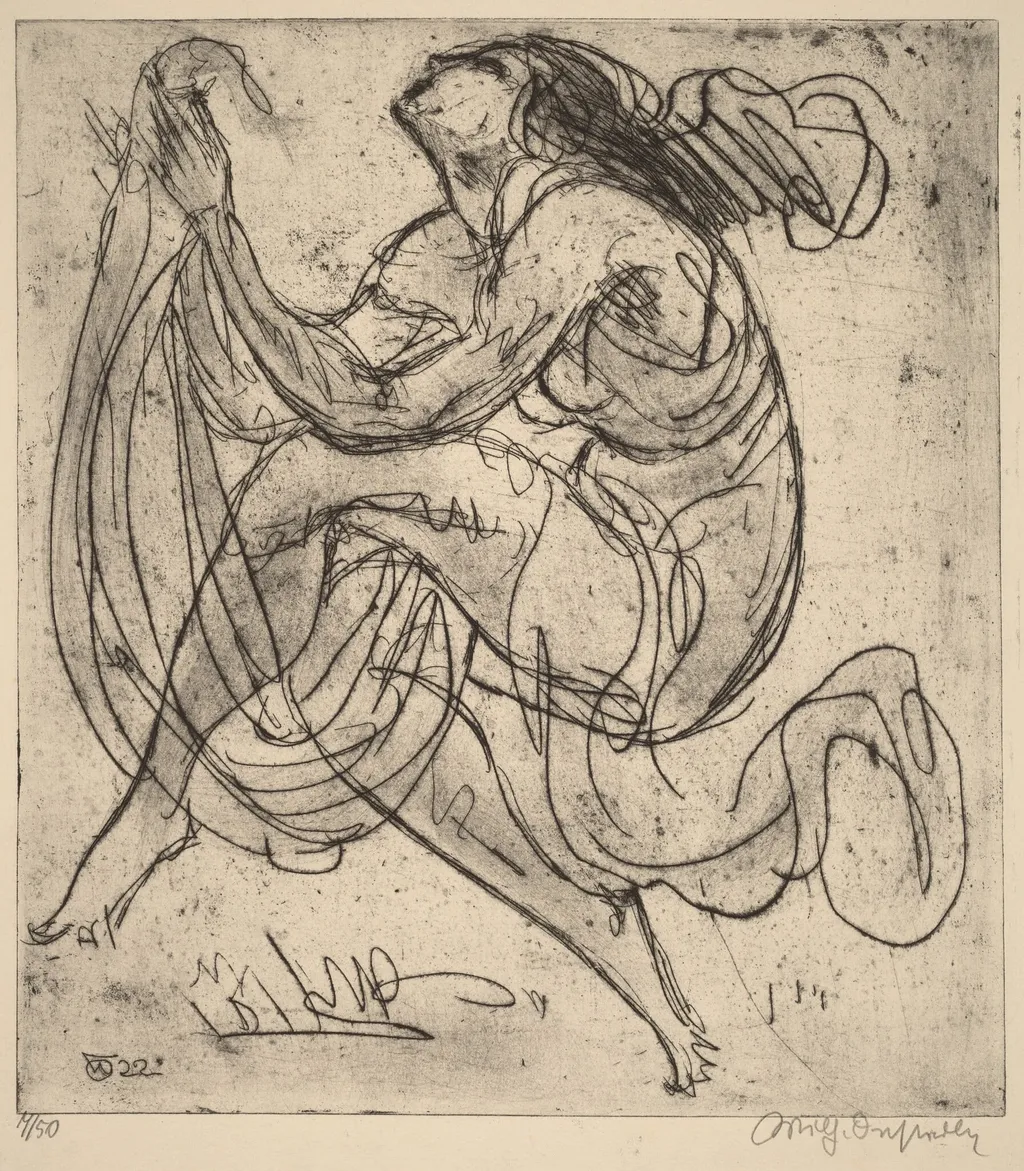
Dancing is an ink print by Wilhelm Oesterle. It dates from 1922 and is held in the collection of the National Gallery of Art.
About this work
Overview
Wilhelm Oesterle’s 1922 dry‑point print titled *Dancing* presents a single figure caught in a moment of motion. Executed on wove cream paper, the work relies on the plate’s tonal qualities to render a light‑brown ground that frames the dancer’s energetic pose.
Subject & Meaning
The composition depicts a lone dancer whose torso twists, arms lifted, and legs bent, suggesting a spontaneous, rhythmic gesture. The exaggerated line work conveys a sense of vitality and freedom, inviting viewers to feel the momentum of the movement rather than a specific narrative.
Technique & Style
Oesterle employed dry‑point, a intaglio method in which a sharp needle incises lines directly into the copper plate. The resulting burr creates soft, velvety strokes that, combined with the plate tone, give the figure a fluid, sketch‑like quality. The loose, expressive lines align the work with early twentieth‑century modernist explorations of gesture.
History & Provenance
Created in the post‑World War I period, *Dancing* reflects Oesterle’s interest in capturing contemporary life through simplified forms. The print has remained within private collections since its initial issue, with few exhibition records, underscoring its relatively modest circulation among his broader oeuvre.
Own this work as a print
Artist & collection


 Akt mit hochgehobenem Hemd (Woman Undressing)
 Cameo, No. 1 (Mother and Child)
 Cameo, No.I
 Dodo Arranging Her Hair
 Woman's Dream (Der Traum des Weibes)
 Cameo, No. 1 (Mother and Child)
 The Dancer, No. 1
 Adhba die Kamelin (Adhba the Camel)
 Untitled
 Dancing Woman with a Tambourine
 Untitled
 Large Resurrection (Grosse Auferstehung)