Artwork
Woman in Green
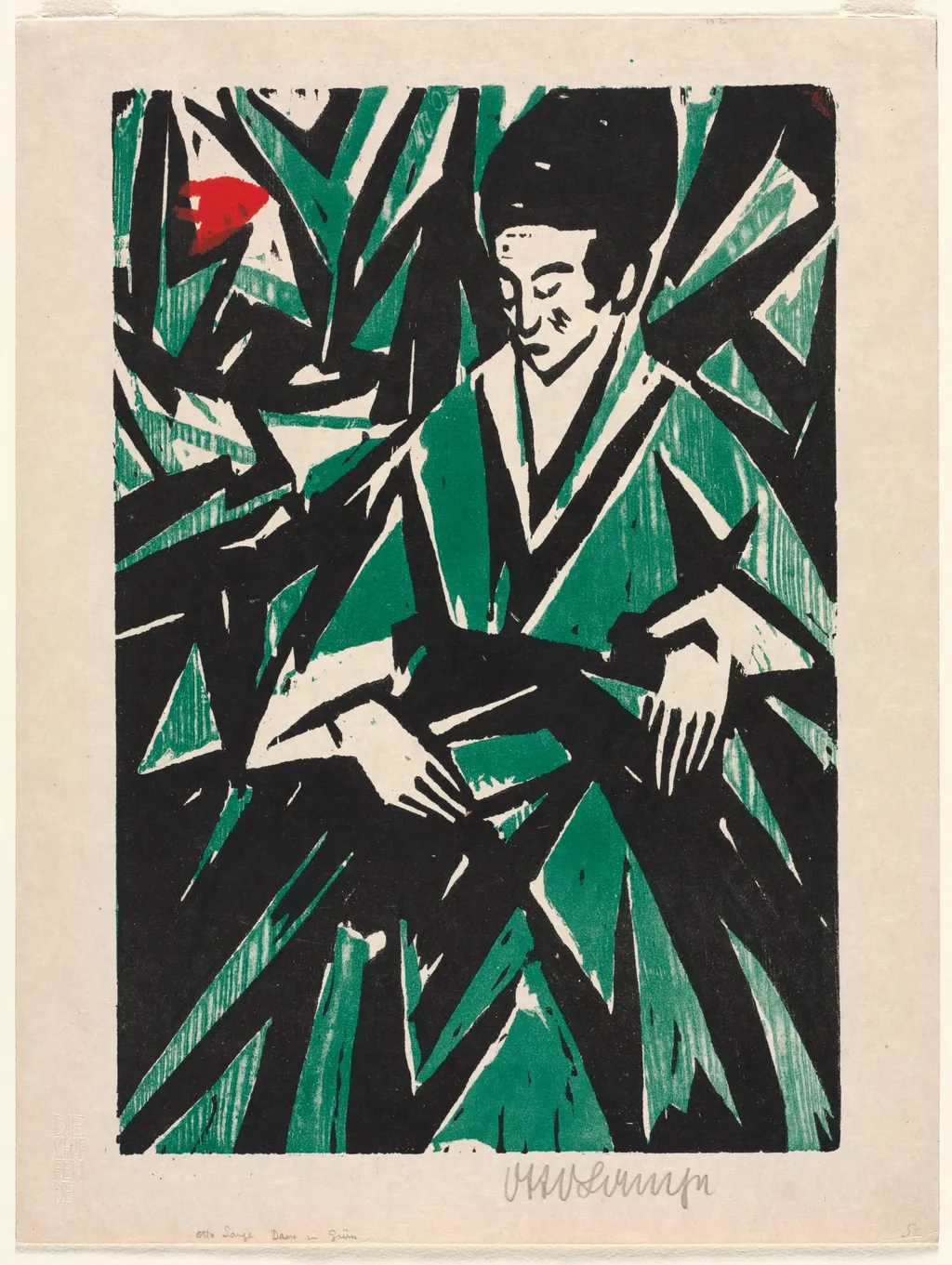
Woman in Green is a print by Otto Lange. It dates from 1916 and is held in the collection of the Cleveland Museum of Art.
About this work
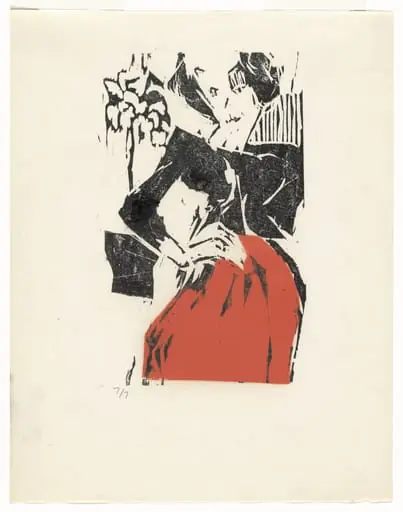
Behind her, black and white shapes look like leaves or branches, with a bright red dot floating above her head.
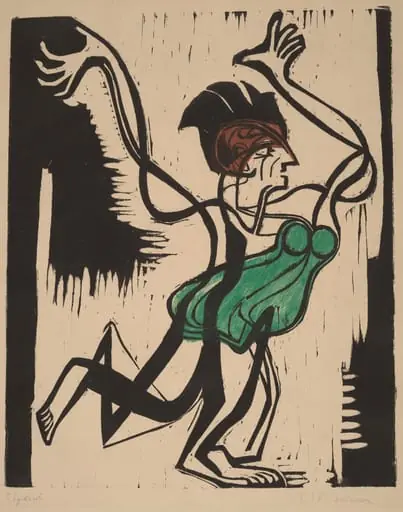
This print shows a woman in a green dress with sharp, angular lines around her. Her face is simple but expressive, and her hands hold something small. Behind her, black and white shapes look like leaves or branches, with a bright red dot floating above her head.
The artist used bold colors and strong contrasts to make the image stand out. The red dot is the only bright color, drawing your eye.
Next, look up Otto Lange (German, 1879–1944) to see more of his work.
Overview
Otto Lange, a German artist active in the early 20th century, produced *Woman in Green* in 1916 as a print reflecting the emotional intensity of Expressionism. Trained in decorative arts and fine art in Dresden, he later helped establish the Dresdner Sezession, a collective advocating for artistic renewal. This work exemplifies his engagement with modernist printmaking, using simplified forms and heightened color to convey psychological presence rather than realistic detail.
Subject & Meaning
The figure is a solitary woman, rendered with minimal facial features yet charged with emotional weight. Her green dress and clasped hands suggest quiet introspection or ritual. The floating red dot above her head introduces an enigmatic symbol—possibly representing thought, energy, or an inner state—unmoored from literal interpretation. The composition avoids narrative, instead inviting contemplation of inner life through abstraction and restraint.
Technique & Style
Lange employed bold, angular lines and stark contrasts to define form and space. The woman’s silhouette is outlined with sharp edges, while the background features abstracted black-and-white shapes resembling foliage, creating a sense of enclosure. The only saturated color, a vivid red dot, breaks the monochrome backdrop, directing focus and introducing symbolic tension. The print’s flat planes and limited palette align with Expressionist priorities over naturalism.
History & Provenance
Created during World War I, the print emerged from a period of intense artistic experimentation in Dresden. Lange’s involvement with the Dresdner Sezession, founded shortly after this work, positioned him among artists seeking to redefine art’s role in society. While specific ownership history is not documented, the piece is consistent with the group’s output—intimate, politically aware, and rooted in print media’s accessibility.
Context
In 1916, Germany was embroiled in war, and artists like Lange turned inward, using art to explore psychological and social fragmentation. Expressionism rejected academic conventions, favoring emotional truth over visual accuracy. The Dresdner Sezession, though formally established in 1919, had roots in earlier gatherings of artists disillusioned with traditional institutions, making *Woman in Green* a precursor to their collective mission.
Legacy
Lange’s work, including *Woman in Green*, contributed to the broader German Expressionist print movement, influencing later generations interested in emotional abstraction and social commentary. Though less widely known than contemporaries like Dix or Kirchner, his prints remain significant for their restrained intensity and innovative use of color and form within the medium of woodcut and linocut.
Own this work as a print
Artist & collection
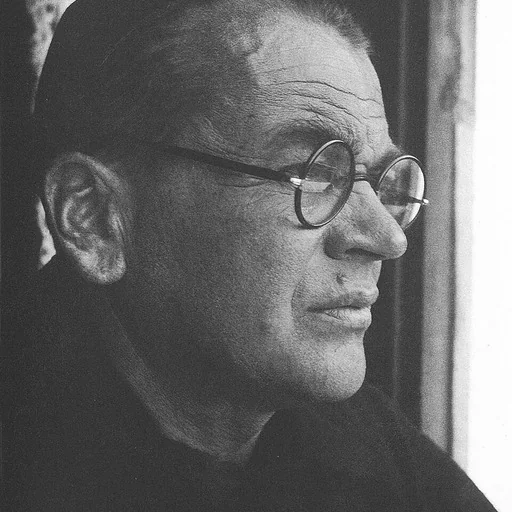
Artist
Otto Lange (29 October 1879 in Dresden – 19 December 1944 in Dresden) was a German Expressionist painter and graphic artist.