Artwork
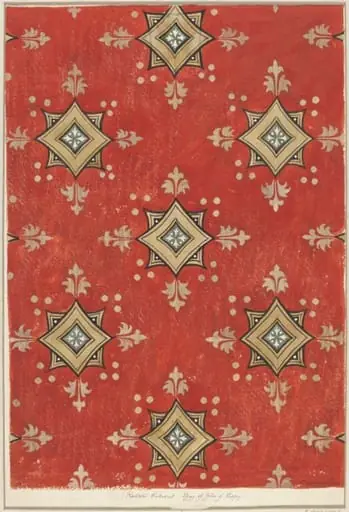
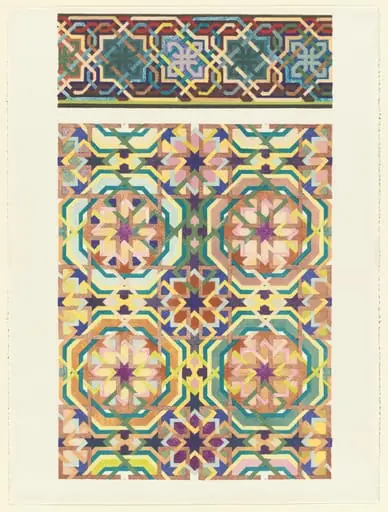
Copy of the decoration of the painted wood ceiling in the court of the Mosque of the Sultan Murad II
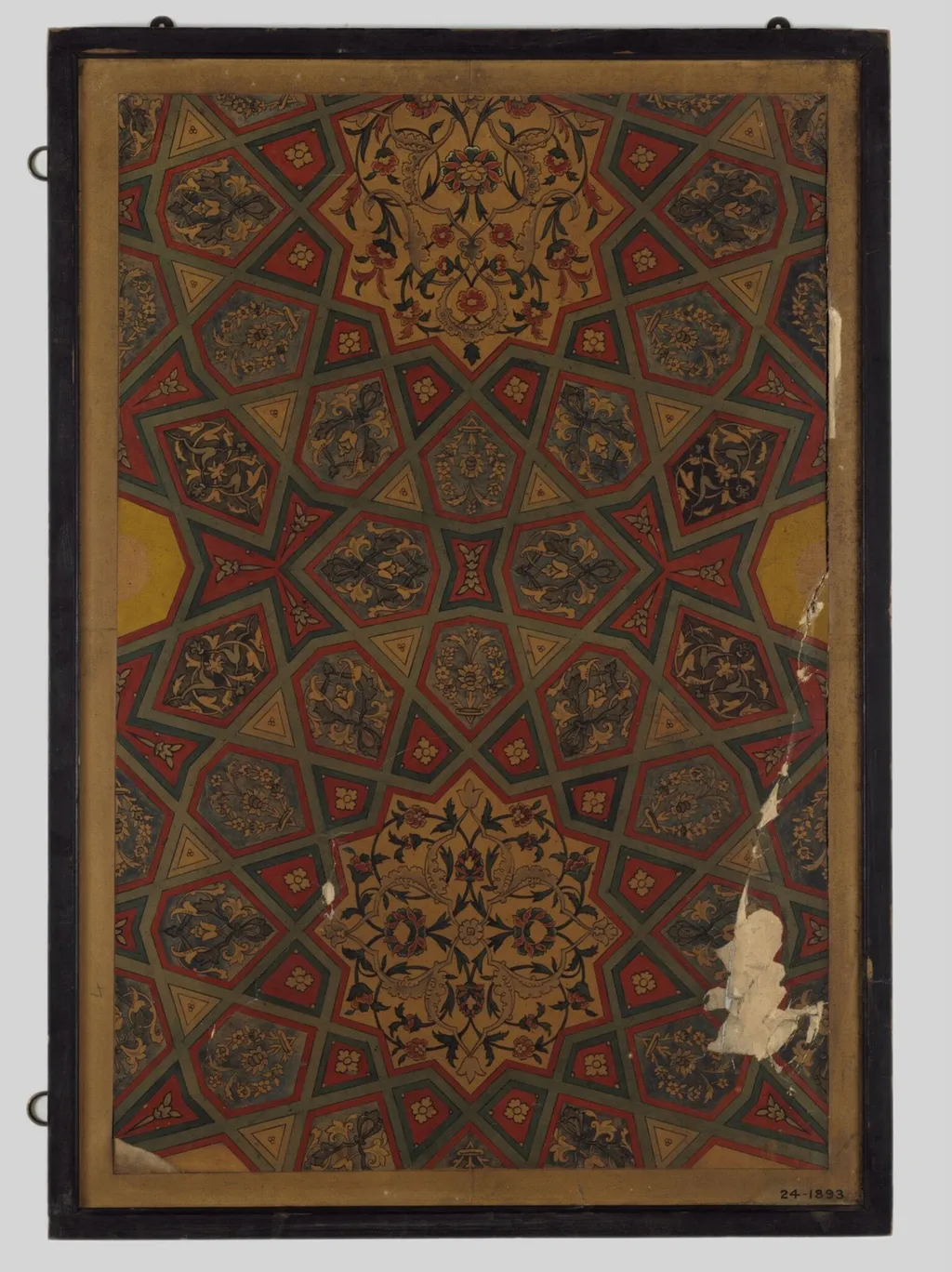
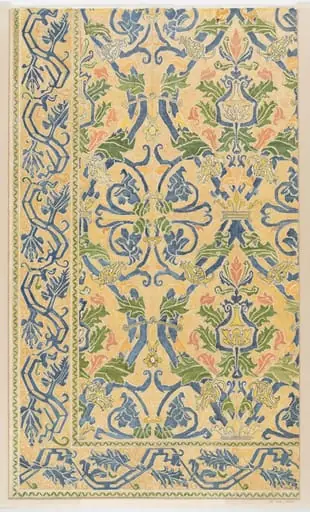
Copy of the decoration of the painted wood ceiling in the court of the Mosque of the Sultan Murad II is a watercolor work on paper by Léon Parvillée. It dates from 1850 and is held in the collection of the Victoria and Albert Museum.
About this work
Overview
This watercolour on paper reproduces the ceiling decoration from the courtyard of the Muradiyeh Mosque in Bursa, commissioned during Sultan Murad II’s rule.
This watercolour on paper reproduces the ceiling decoration from the courtyard of the Muradiyeh Mosque in Bursa, commissioned during Sultan Murad II’s rule. The original wooden ceiling, created between 1421 and 1451, was rendered in paint and later copied in pigment on paper, mounted on a wooden frame. The copy preserves the intricate pattern without attempting perspective or depth, reflecting a documentary intent rather than artistic interpretation.
Subject & Meaning
The design consists of a repeating geometric lattice of squares and diamonds, each filled with stylized floral and leaf motifs. These arabesques, common in Islamic architectural ornament, symbolize the infinite and the divine through their endless repetition. The absence of figural imagery aligns with religious conventions, emphasizing abstraction and harmony as expressions of spiritual order.
Technique & Style
Executed in watercolour, the copy employs flat, unmodulated tones of brown, red, and gold, mimicking the original’s painted wood surface. Lines are crisp and precise, with no shading or gradation, preserving the two-dimensional quality of the architectural source. The technique prioritizes accuracy over expressive variation, suggesting the work was made for study or archival purposes rather than aesthetic display.
History & Provenance
The original ceiling, dating to the early 15th century, was part of the Muradiyeh Mosque complex in Bursa, a center of early Ottoman architecture. The watercolour copy was likely produced in the 19th century, during a period of increased European interest in Islamic art. It entered the Victoria and Albert Museum’s collection as part of broader efforts to document and preserve non-Western decorative traditions.
Context
In the Ottoman Empire, intricate ceiling decorations like this one were integral to mosque architecture, blending craftsmanship with spiritual symbolism. The use of geometric patterns and vegetal motifs reflected both regional artistic traditions and the broader Islamic emphasis on aniconic design. Such ceilings served not only as ornament but as visual meditations on divine unity and cosmic order.
Legacy
This watercolour remains a valuable record of a once-vibrant wooden ceiling, parts of which may have deteriorated or been lost over time. As a faithful transcription, it aids scholars in reconstructing the visual language of early Ottoman interiors. Its preservation in a major museum underscores its role in the historical documentation of Islamic art for Western audiences.
Artist & collection
Artist