Artwork
Saint Anthony the Abbot Burying Saint Paul the Hermit
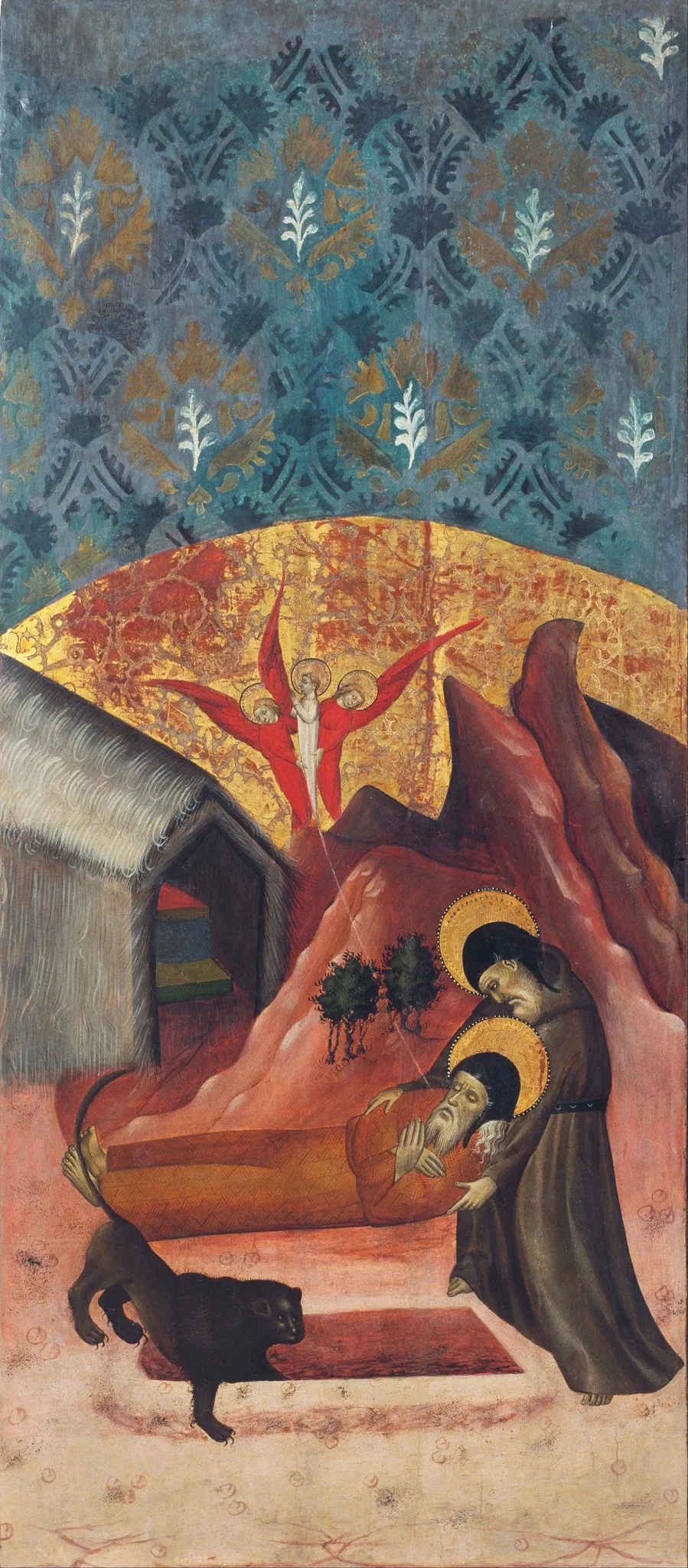
Saint Anthony the Abbot Burying Saint Paul the Hermit is an unspecified painting by Pasqual Ortoneda. It dates from 1437 and is held in the collection of the Museu Nacional d'Art de Catalunya.
About this work
Overview
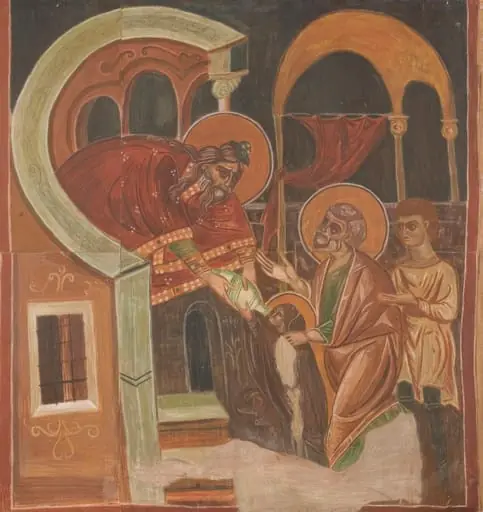
Pasqual Ortoneda’s 1437 panel presents a quiet desert tableau in which Saint Anthony the Great leans over the lifeless figure of Saint Paul the Hermit. The composition is set against a muted horizon punctuated by a modest structure and sparse foliage, while a dark animal, perhaps a panther, rests in the foreground. The work is part of the collection of the Museu Nacional d’Art de Catalunya.
Subject & Meaning
The painting illustrates the moment when Anthony, revered as the father of monasticism, prepares to inter Saint Paul, traditionally regarded as the first Christian hermit of the Egyptian desert. By juxtaposing the two ascetics, the image underscores themes of spiritual succession and the continuity of eremitic devotion within early Christian tradition.
Technique & Style
Ortoneda employs a restrained palette of earth tones—orange and brown robes against a blue sky—to model the figures through subtle gradations of light and shadow. The use of chiaroscuro creates a modest sense of volume, while the shallow perspective, suggested by the distant building and trees, imparts depth without overwhelming the intimate scene.
History & Provenance
Executed in the mid‑15th century, the panel has remained in the Catalan region and is now housed in Barcelona’s Museu Nacional d’Art de Catalunya. Its attribution to Ortoneda rests on stylistic analysis and documentary evidence linking the work to the artist’s known output during the early Renaissance period in Spain.
Artist & collection
Artist
Pasqual Ortoneda painted the quiet drama of late medieval Spain. In 1437 he showed Saint Anthony lowering Paul the Hermit into the earth, the two figures half-lost in the brown earth of Valencia. The scene belongs to…