Artwork
Girard Street
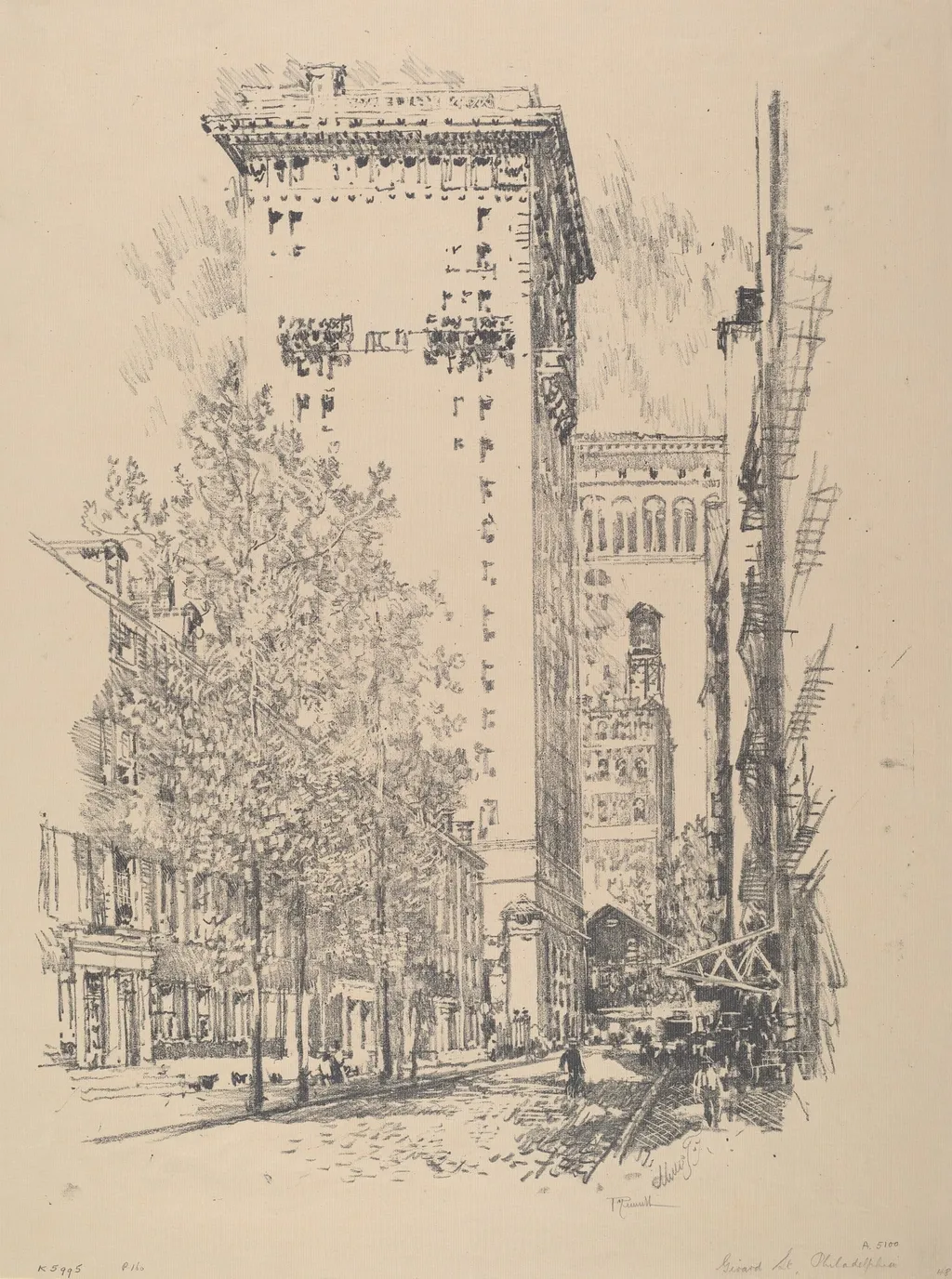
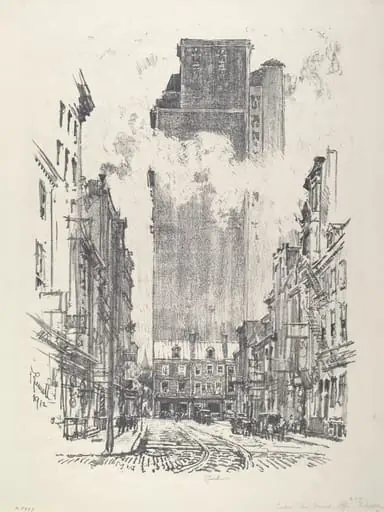
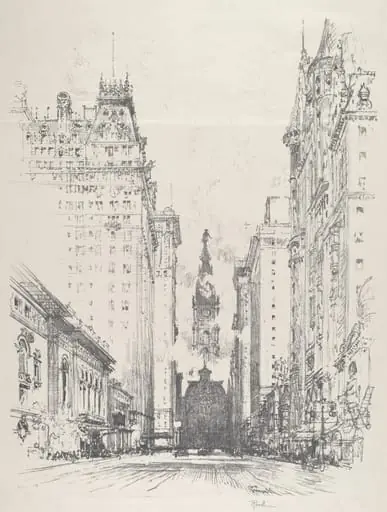
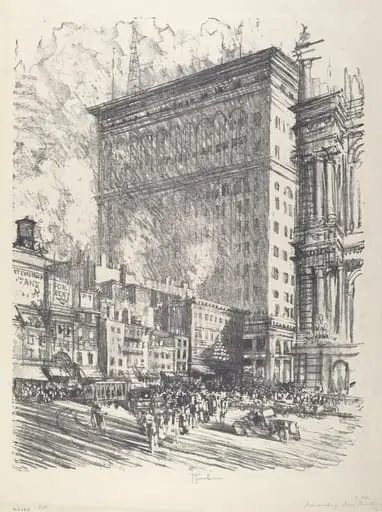
Girard Street is an ink print by Joseph Pennell. It dates from 1912 and is held in the collection of the National Gallery of Art.
About this work
Overview
Though he spent much of his career in Europe, Pennell remained engaged with American subjects, drawing from his training under James Lambdin and Thomas Eakins.
Joseph Pennell produced *Girard Street* in 1912 as a lithograph, capturing a modest urban thoroughfare in Philadelphia. Though he spent much of his career in Europe, Pennell remained engaged with American subjects, drawing from his training under James Lambdin and Thomas Eakins. This work exemplifies his sustained interest in the textures of everyday city life, rendered with the immediacy of a sketch rather than the formality of a finished composition.
Subject & Meaning
The scene depicts a quiet residential street lined with modest multi-story buildings, their balconies and awnings suggesting domestic life. A streetcar moves along the center, while pedestrians and small groups linger near storefronts. Pennell avoids dramatic or monumental themes, instead emphasizing the rhythm of ordinary routines. The absence of grandeur underscores his focus on the unnoticed rhythms of urban existence in early 20th-century America.
Technique & Style
Pennell employed lithography to achieve a loose, spontaneous line quality, mimicking the speed of a sketchbook drawing. His use of fluid, uneven strokes conveys movement and texture without heavy shading or detail. The composition is deliberately unpolished, with figures and architecture rendered in suggestive rather than precise forms. This approach aligns with contemporary printmaking trends that valued expressive immediacy over technical finish.
History & Provenance
Created during Pennell’s mature period, *Girard Street* emerged from his ongoing documentation of American and European urban environments. Though he lived abroad for decades, he returned frequently to the U.S., maintaining connections with Philadelphia’s artistic community. The print likely originated from direct observation, consistent with his practice of working on-site. Its survival in institutional collections reflects its role as a representative example of early modern American lithography.
Context
In the early 1900s, American artists increasingly turned to urban scenes as subjects, responding to rapid industrialization and shifting social landscapes. Pennell’s work fits within this movement, alongside contemporaries who documented infrastructure, transit, and street life. Unlike idealized cityscapes, his prints present unembellished views—reflecting a broader cultural interest in realism and the authenticity of the everyday environment.
Legacy
Pennell’s *Girard Street* contributes to a body of work that redefined printmaking as a medium for observational realism rather than decorative illustration. His emphasis on transient moments and unheroic settings influenced later generations of urban documentarians. While not widely celebrated in his time, his prints are now recognized for their quiet precision and their role in expanding the thematic scope of American graphic art.
Artist & collection
Artist
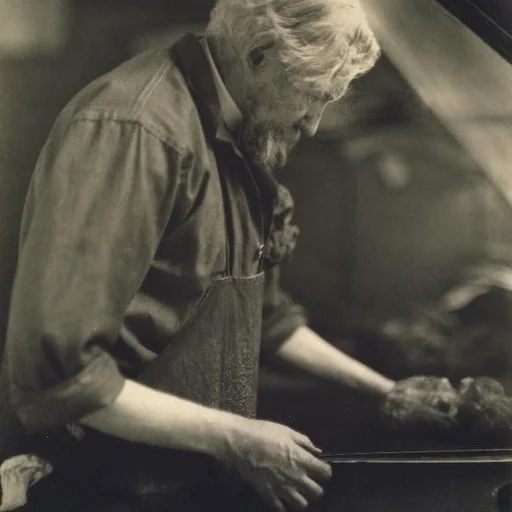
Joseph Pennell (July 4, 1857 – April 23, 1926) was an American draftsman, etcher, lithographer, and illustrator for books and magazines.