Artwork
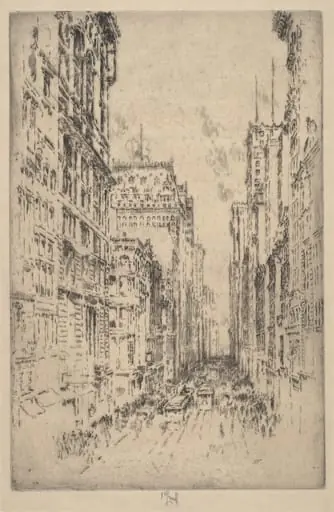
Looking up Broad Street from Spruce Street
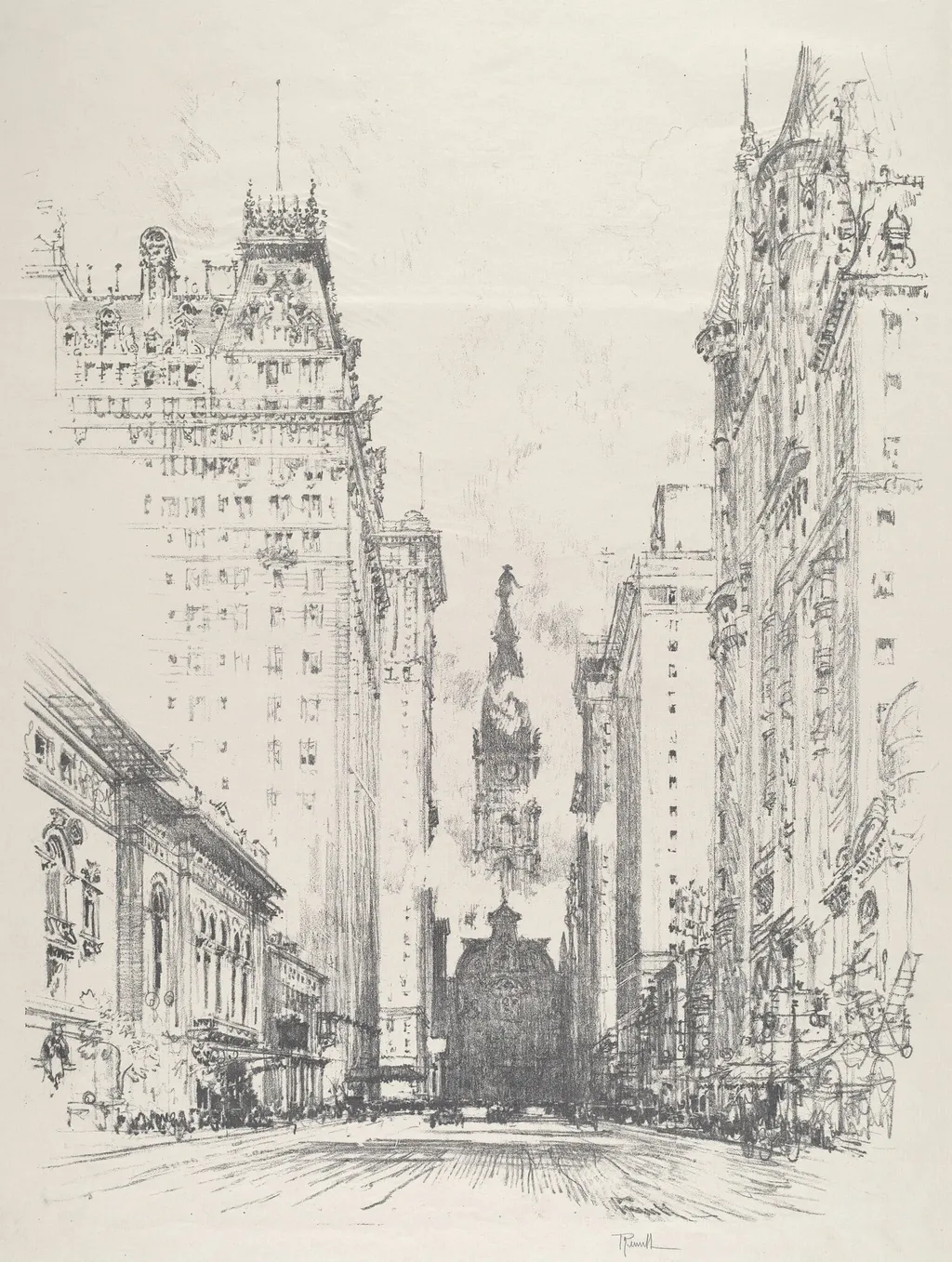
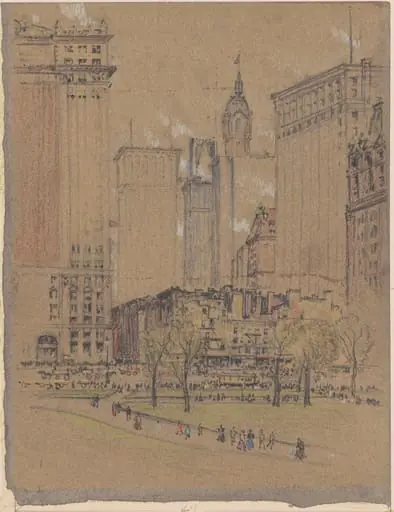
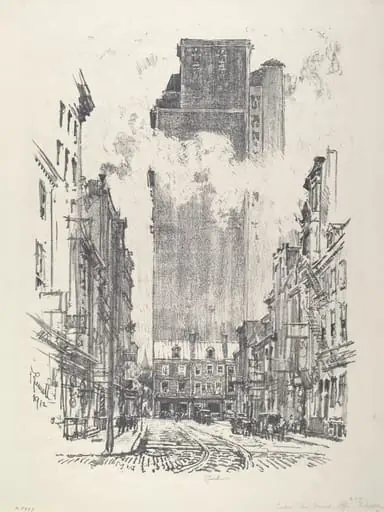
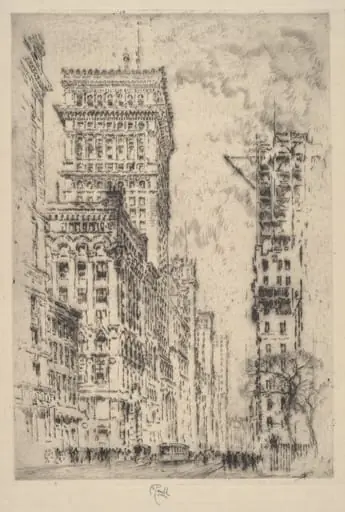
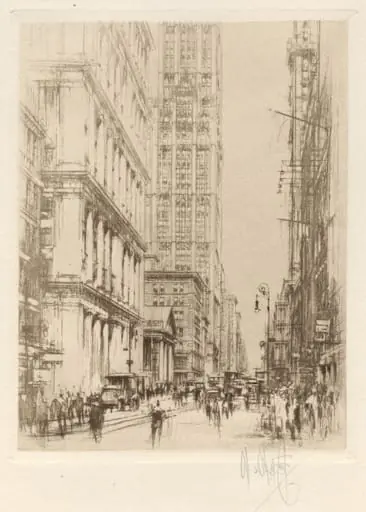
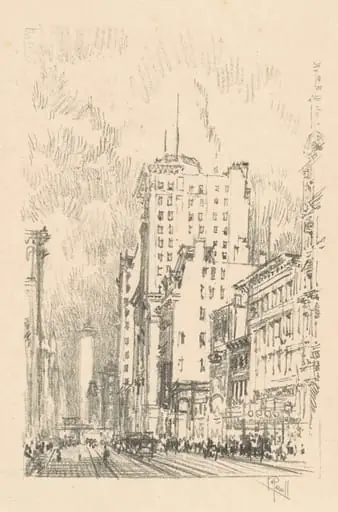
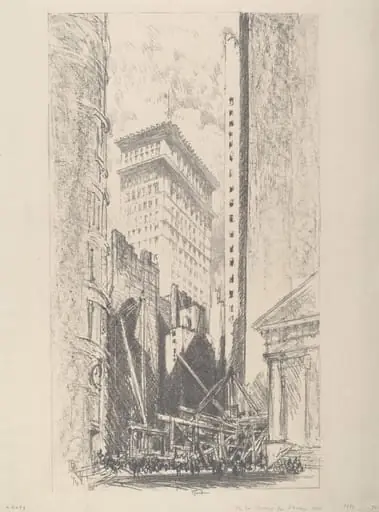
Looking up Broad Street from Spruce Street is an ink print by Joseph Pennell. It dates from 1912 and is held in the collection of the National Gallery of Art.
About this work
Overview
The print emphasizes architectural density over human presence, reflecting his fascination with the structural character of modern cities.
Joseph Pennell’s 1912 lithograph captures a narrow urban vista in Philadelphia, viewing Broad Street upward from Spruce Street. Rendered in ink on paper, the work belongs to a series of cityscapes Pennell produced during a period when he balanced European residence with deep ties to his American roots. The print emphasizes architectural density over human presence, reflecting his fascination with the structural character of modern cities.
Subject & Meaning
The scene presents a canyon-like corridor of commercial buildings, their facades stacked vertically with minimal sky visible. The absence of people and the flattened perspective suggest a focus on the built environment as an autonomous force. Pennell conveys the weight and rhythm of urban architecture, not as a celebration of progress, but as a quiet observation of how structures dominate and define public space.
Technique & Style
Pennell employed lithography to achieve a fluid, sketch-like quality, using loose, rapid lines to suggest form rather than define it. The lithographic stone allowed for expressive, almost spontaneous mark-making, emphasizing texture over detail. Windows, cornices, and spires are rendered with minimal strokes, creating a sense of immediacy. The lack of tonal variation and the absence of shading reinforce the drawing’s graphic, linear character.
History & Provenance
Created during Pennell’s mature period, the work emerged from his sustained engagement with American urban subjects despite his long residence in Europe. He maintained connections to Philadelphia through his early training under James Lambdin and Thomas Eakins. The print was likely produced for private circulation or publication, consistent with his practice of releasing lithographs through art journals and limited editions.
Context
In the early 20th century, American artists increasingly turned to the city as a subject, moving beyond pastoral ideals. Pennell’s work aligns with a broader interest in industrial and architectural modernity, influenced by European printmakers and Whistler’s tonal aesthetics. Unlike contemporaries who romanticized urban life, Pennell presented the city as a structural phenomenon — impersonal, layered, and quietly imposing.
Legacy
Pennell’s lithographs, including this one, contributed to the recognition of printmaking as a legitimate medium for urban documentation. His emphasis on architectural form over narrative influenced later generations of American realists and cityscape artists. Though less widely known today, his work remains a significant record of early modern American urban perception through the lens of print.
Own this work as a print
Artist & collection
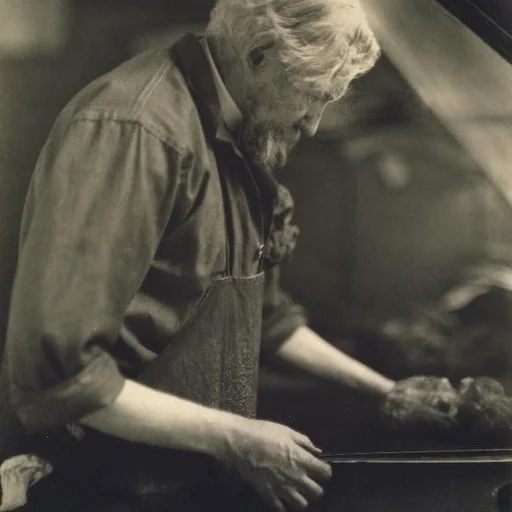
Artist
Joseph Pennell (July 4, 1857 – April 23, 1926) was an American draftsman, etcher, lithographer, and illustrator for books and magazines.