Artwork
Table and Chair, Signers' Room, Independence Hall
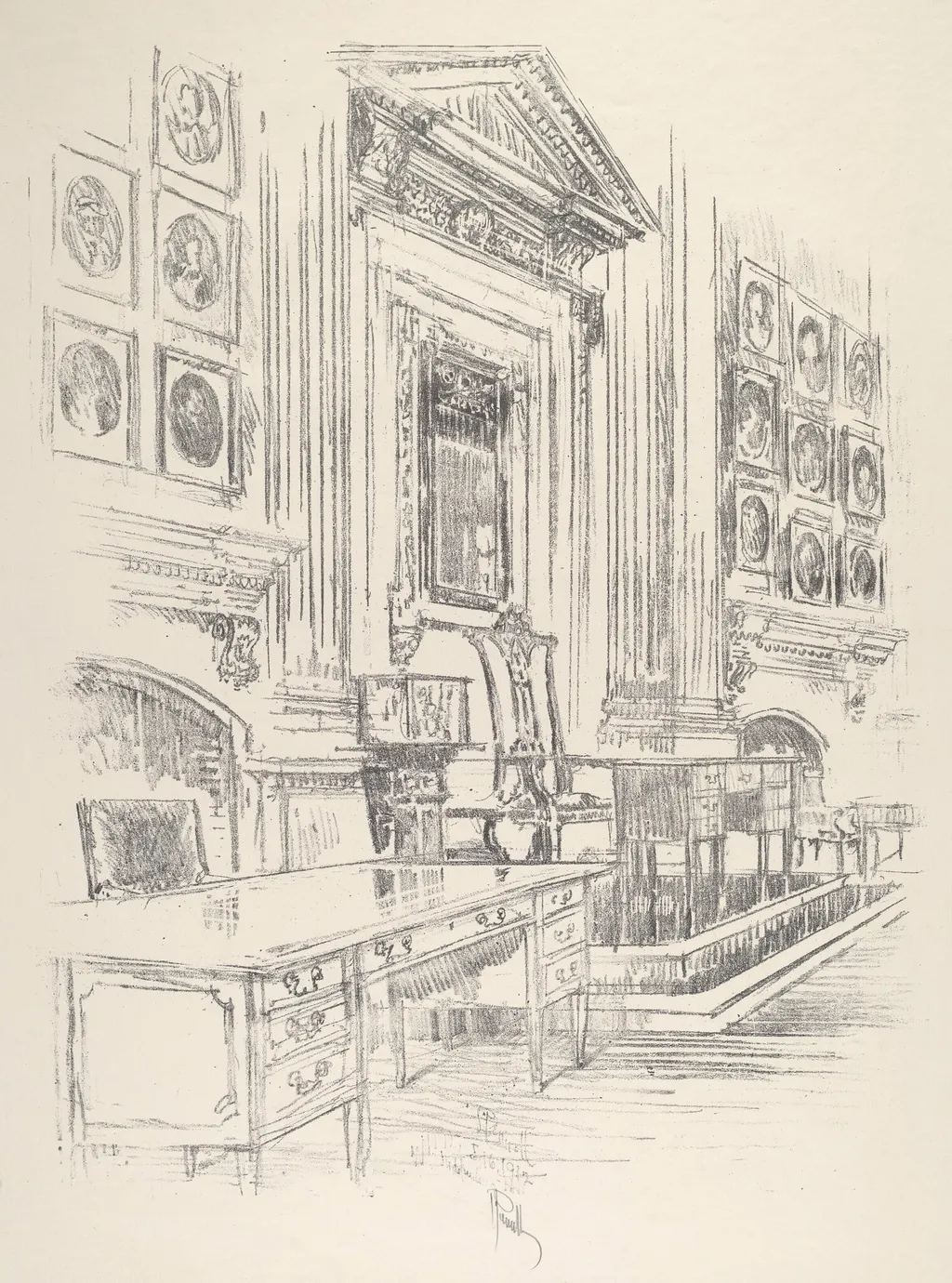
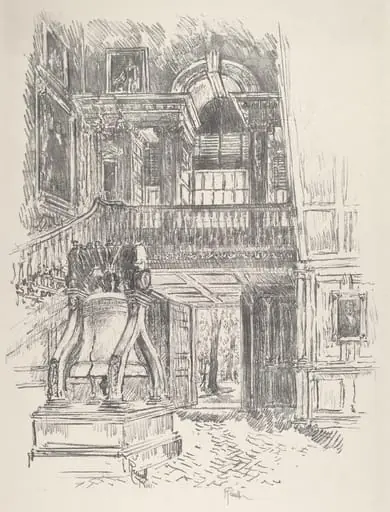
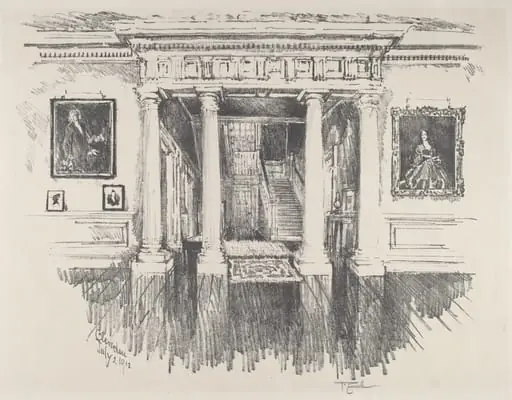
Table and Chair, Signers' Room, Independence Hall is an ink print by Joseph Pennell. It dates from 1912 and is held in the collection of the National Gallery of Art.
About this work
The artist focused on the details of the room’s furniture and architecture, making it feel real.
This sketch shows a room with tall windows and heavy curtains. Wooden furniture—chairs, tables, and cabinets—fills the space, looking old and ornate. The walls have framed portraits, and the floor is polished but slightly worn. A desk sits near the front, with a few papers or books on it.
The artist focused on the details of the room’s furniture and architecture, making it feel real. This was drawn in 1912 as a record of a historic space.
Next, check out lithography to see how this print was made.
Overview
Created in 1912, this lithograph by Joseph Pennell captures the interior of the Signers' Room in Independence Hall, where the Declaration of Independence was adopted. Pennell, an American printmaker with deep ties to both U.S. and European artistic circles, used the medium to document architectural spaces with precision. The work serves as a quiet record of a site steeped in national memory, rendered not as a celebration but as an observed reality.
Subject & Meaning
The scene centers on the room’s furnishings—worn wooden chairs, a heavy desk, and ornate cabinets—arranged with quiet dignity. Framed portraits line the walls, hinting at the individuals who once occupied the space. The absence of people emphasizes the weight of history embedded in the objects. Pennell’s focus on stillness and decay suggests a meditation on time’s passage through the relics of revolution.
Technique & Style
Pennell employed lithography to achieve subtle tonal gradations and fine linear detail, reflecting his training under Thomas Eakins and influence from Whistler’s tonalism. The rendering of wood grain, fabric folds, and polished floorboards demonstrates meticulous observation. His use of light and shadow enhances the room’s spatial depth without dramatic contrast, favoring a restrained, almost documentary realism.
History & Provenance
Pennell produced this print during a period when he was documenting American historical sites, even while living abroad. The work was likely made as part of a broader effort to preserve visual records of national landmarks. It entered public collections soon after its creation, valued for its accuracy and historical resonance rather than its novelty.
Context
In 1912, American interest in revolutionary heritage was growing, spurred by upcoming centennial commemorations. Pennell’s image aligns with a trend of artists and historians seeking to anchor national identity in physical spaces. Unlike celebratory depictions of founding figures, this work turns attention to the room itself, treating architecture as a silent witness to history.
Legacy
The lithograph remains a reference for historians and conservators studying the original furnishings of Independence Hall. Pennell’s approach—attentive to texture, wear, and spatial arrangement—set a standard for architectural documentation in print. Though not widely exhibited today, it endures as a quiet testament to the power of ordinary objects to carry collective memory.
Artist & collection
Artist
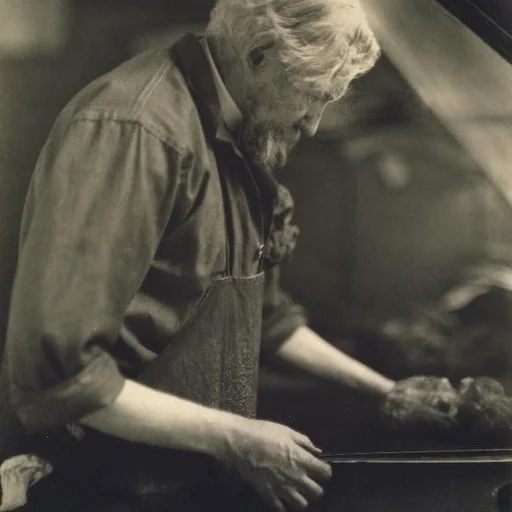
Joseph Pennell (July 4, 1857 – April 23, 1926) was an American draftsman, etcher, lithographer, and illustrator for books and magazines.