Artwork
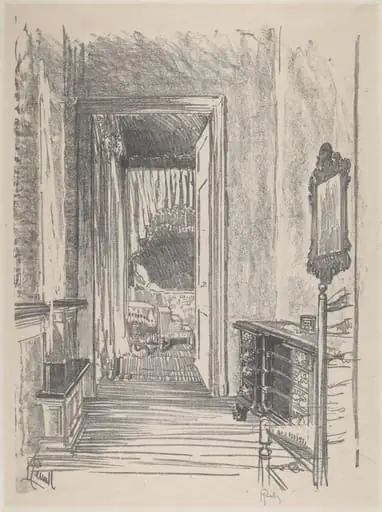
The Hall at Cliveden
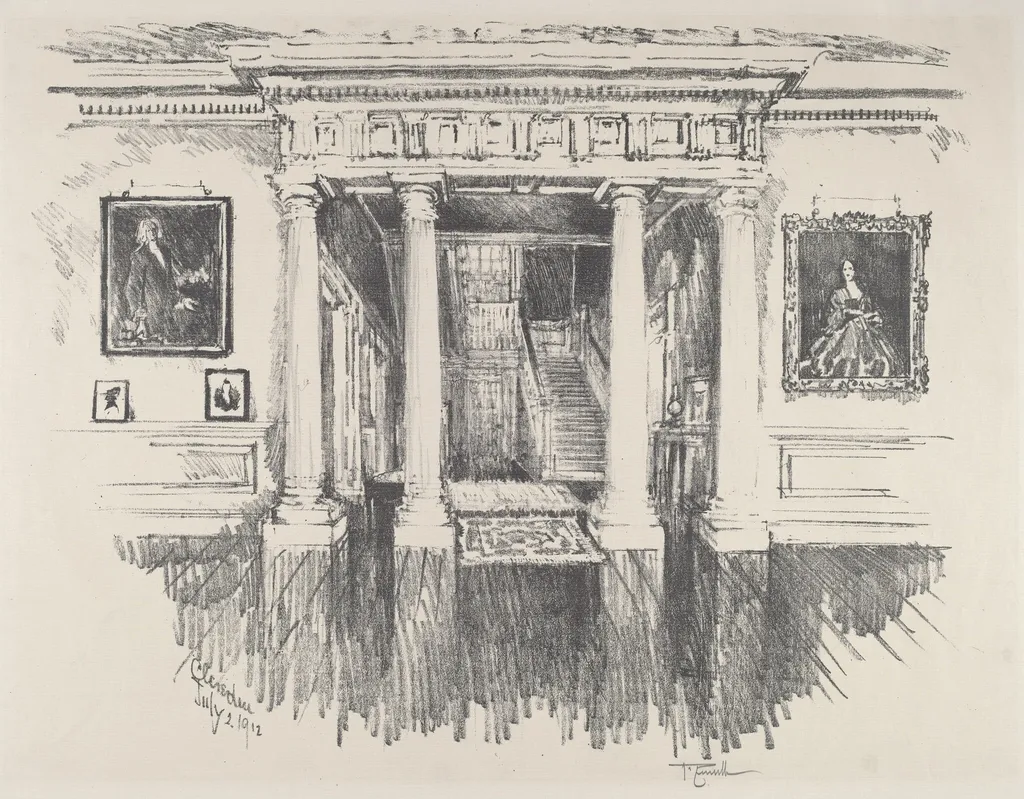
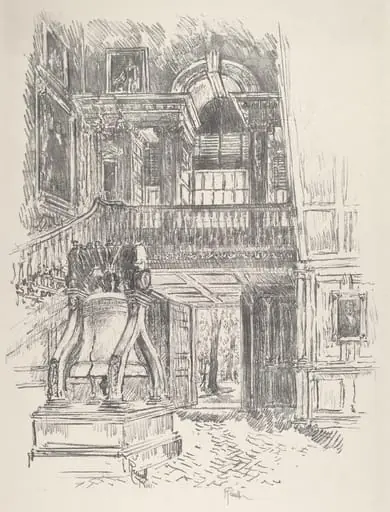
The Hall at Cliveden is an ink print by Joseph Pennell. It dates from 1912 and is held in the collection of the National Gallery of Art.
About this work
Overview
The print reflects his training under James Lambdin and Thomas Eakins, as well as his affinity for the tonal subtleties championed by James McNeill Whistler.
Joseph Pennell, an American artist based in Europe, produced this lithograph in 1912 as part of his sustained interest in architectural interiors. Working primarily in lithography, he captured the quiet grandeur of Cliveden, a historic English country house. The print reflects his training under James Lambdin and Thomas Eakins, as well as his affinity for the tonal subtleties championed by James McNeill Whistler. Pennell’s approach favored immediacy over polish, emphasizing the lived-in character of his subjects.
Subject & Meaning
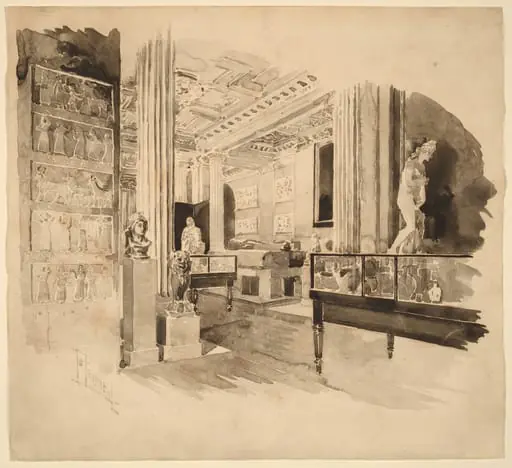
The image depicts the main hall of Cliveden, a stately home in Buckinghamshire, rendered with attention to its domestic grandeur. Tall windows, heavy drapery, and framed portraits suggest a space shaped by tradition and social status. The presence of a staircase and wall-mounted artworks implies a residence designed for both ceremony and daily life. Pennell’s loose lines convey a sense of fleeting observation, as if capturing the hall in a quiet, unguarded moment rather than as a formal portrait of wealth.
Technique & Style
Pennell employed lithography to achieve a spontaneous, sketch-like quality. His lines are fluid and economical, suggesting texture and form without heavy shading or detail. The composition avoids symmetry, favoring an informal perspective that draws the eye toward the staircase and distant windows. The contrast between the dark portraits and the light-filled interior enhances depth, while the roughness of the ink echoes the immediacy of a drawn note rather than a polished finish.
History & Provenance
Created during Pennell’s extended residence in Europe, the lithograph was likely made during one of his many travels through England’s historic estates. Cliveden, owned by the Astor family at the time, was a known cultural hub. Pennell’s prints of such sites were often published in periodicals or collected as independent works, contributing to a broader interest in architectural documentation among early 20th-century audiences. This piece remains part of the record of his systematic study of British interiors.
Context
In the early 1900s, lithography experienced a revival as artists sought accessible, reproducible mediums for capturing modern and historic environments. Pennell’s work aligned with a growing movement that valued the authenticity of observed spaces over idealized representations. His focus on interiors—rather than exteriors—distinguished him from contemporaries, emphasizing the human dimension of architecture. Collaborations with his wife, Elizabeth Robins, further connected his visual work to literary explorations of place and class.
Legacy
Pennell’s lithographs, including this one, helped define a genre of architectural observation that prioritized atmosphere over monumentality. His ability to convey the quiet rhythm of lived spaces influenced later generations of printmakers and documentary artists. Though less celebrated than his urban or industrial scenes, works like *The Hall at Cliveden* remain valuable for their unembellished record of domestic architecture in early 20th-century Britain.
Artist & collection
Artist
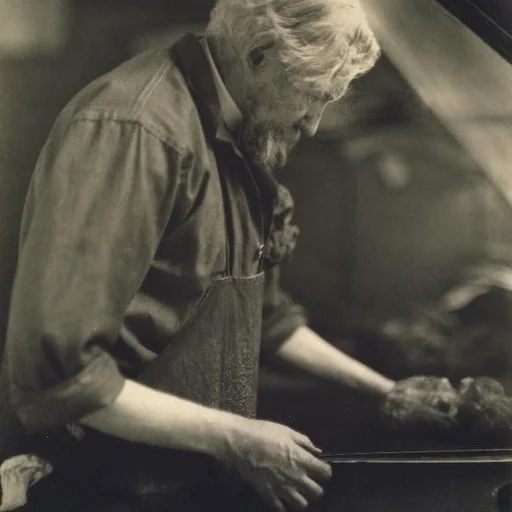
Joseph Pennell (July 4, 1857 – April 23, 1926) was an American draftsman, etcher, lithographer, and illustrator for books and magazines.