Artwork
The Ferry House
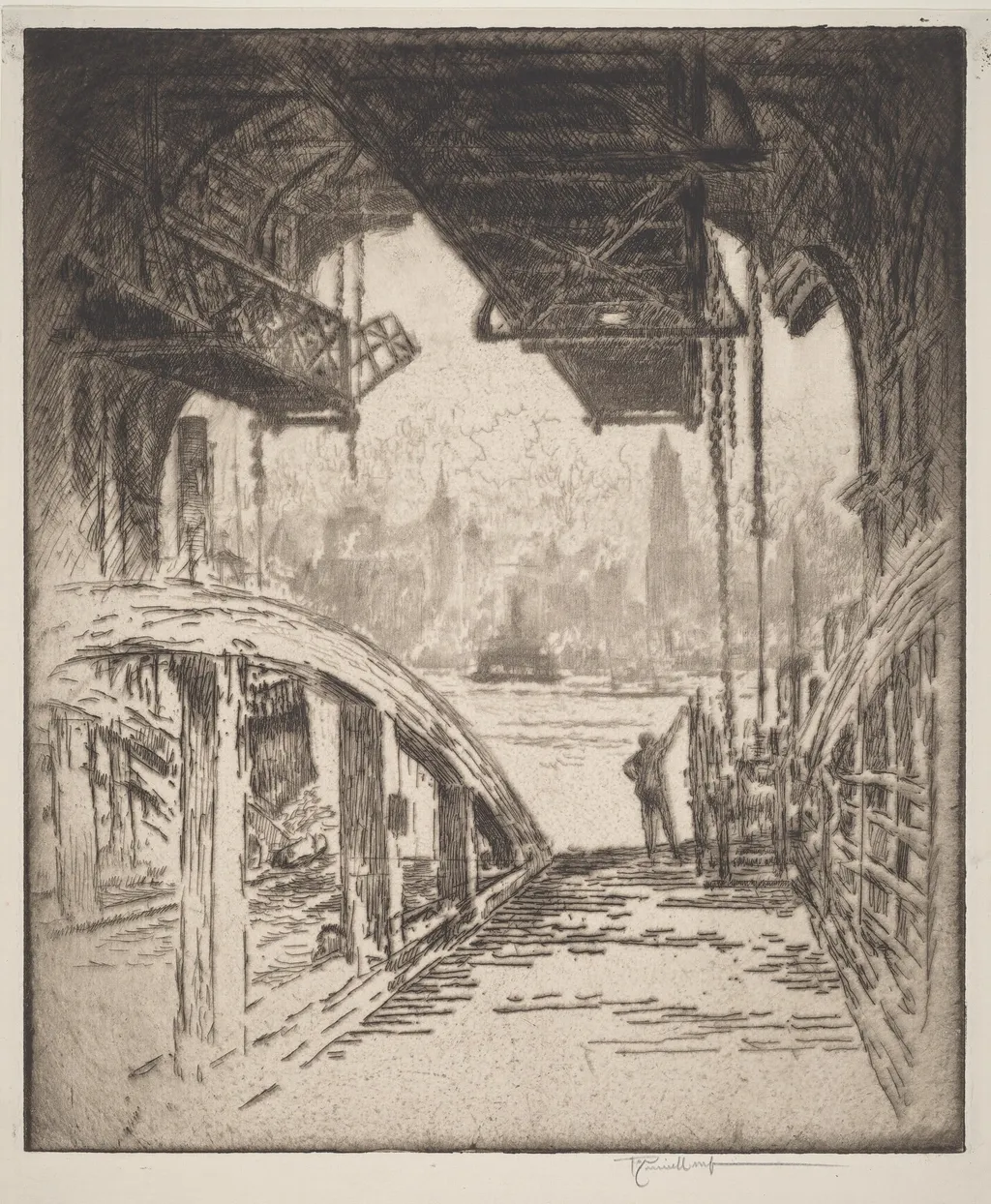
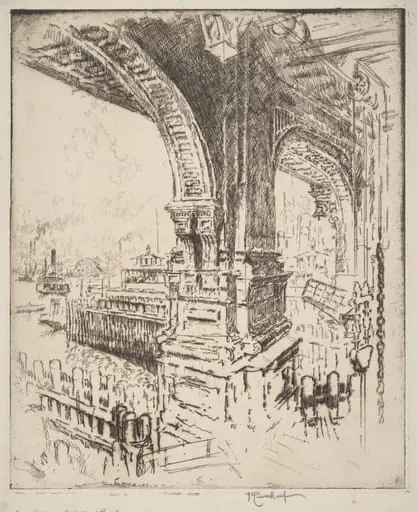
The Ferry House is an ink print by Joseph Pennell. It dates from 1919 and is held in the collection of the National Gallery of Art.
About this work
Overview
Created in 1919, *The Ferry House* is an etching by American artist Joseph Pennell, capturing a quiet urban riverside structure.
Created in 1919, *The Ferry House* is an etching by American artist Joseph Pennell, capturing a quiet urban riverside structure. As a printmaker deeply engaged with architectural subjects, Pennell used the etching process to render subtle tonal gradations, emphasizing the interplay of light and mass in a modest civic building. The work reflects his lifelong interest in industrial and transit architecture, rendered with precision yet without overt drama.
Subject & Meaning
The scene centers on a ferry house—a functional structure for river transport—flanked by a smaller adjacent building. Pennell avoids human figures, focusing instead on the architecture’s presence within its environment. The composition invites stillness, suggesting the quiet rhythm of daily urban life. The building’s arches and weathered surfaces imply endurance, framing the ferry as a quiet node in the city’s infrastructure.
Technique & Style
Pennell employed etching to achieve fine linear detail and nuanced grayscale tones. Acid-bitten lines define the textured stone of the ferry house, while softer washes and sparse hatching suggest atmospheric depth. The contrast between the darker, densely worked foreground and the lighter, more open background enhances spatial recession. His technique, refined through years of printmaking, prioritizes clarity and structural integrity over decorative flourish.
History & Provenance
Pennell produced *The Ferry House* during a period when he was actively documenting European and American urban landscapes. Though he spent much of his career abroad, this work likely stems from his return to the United States in the early 20th century. It was likely printed in limited editions, consistent with his practice of distributing etchings through galleries and art publications, often in collaboration with his wife, Elizabeth Robins.
Context
In the aftermath of World War I, Pennell turned to architectural subjects as a means of capturing stability amid societal change. His focus on ferry houses, bridges, and docks aligned with a broader interest among artists in the functional aesthetics of modern infrastructure. Unlike contemporaries who glorified industry, Pennell treated such structures with quiet reverence, emphasizing their role in daily life rather than their technological novelty.
Legacy
*The Ferry House* exemplifies Pennell’s contribution to American printmaking as a medium for observational realism. His etchings, including this one, helped elevate the status of architectural subjects in fine art. Though less widely known today, his work influenced later generations of printmakers who sought to document the built environment with technical rigor and restrained emotion.
Own this work as a print
Artist & collection
Artist
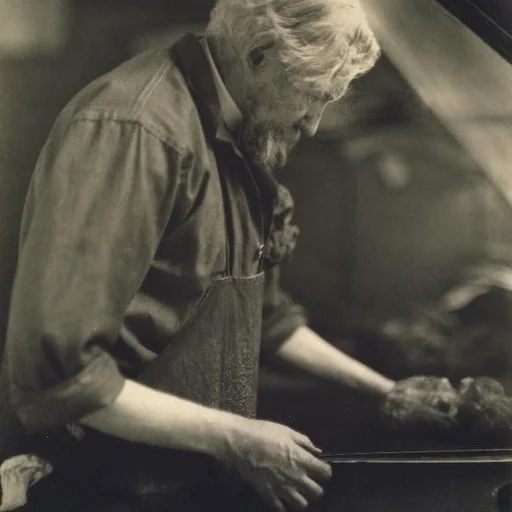
Joseph Pennell (July 4, 1857 – April 23, 1926) was an American draftsman, etcher, lithographer, and illustrator for books and magazines.