Artwork
The Great Hammer
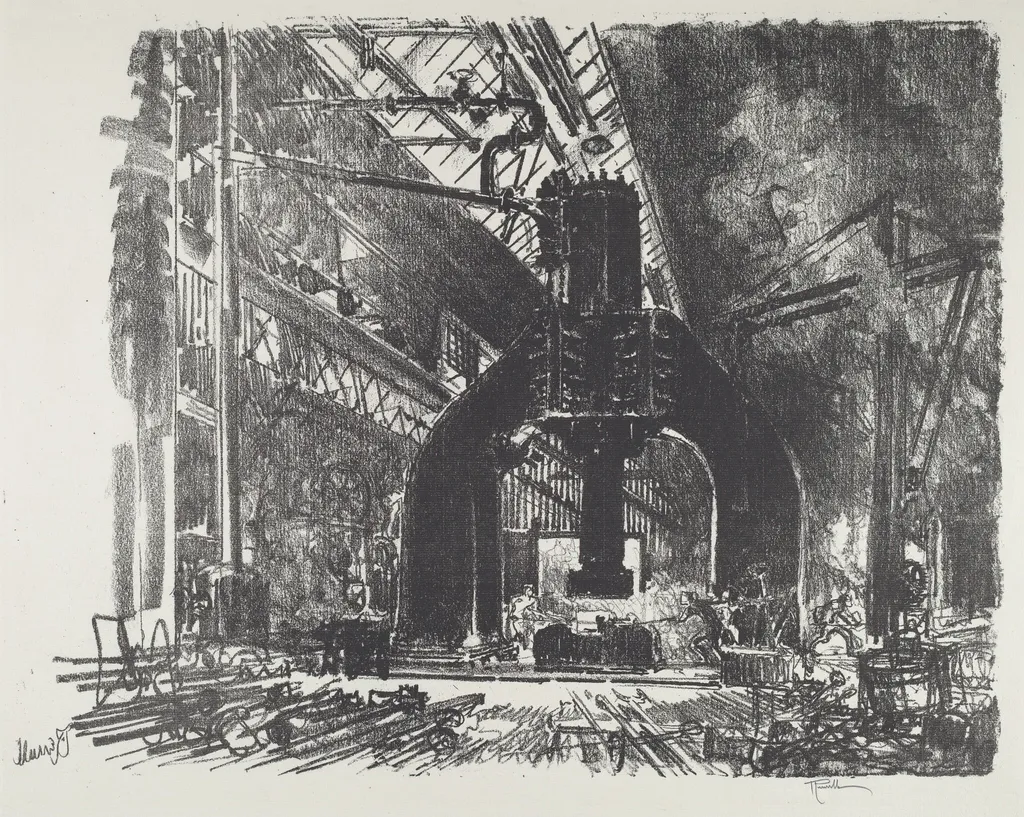
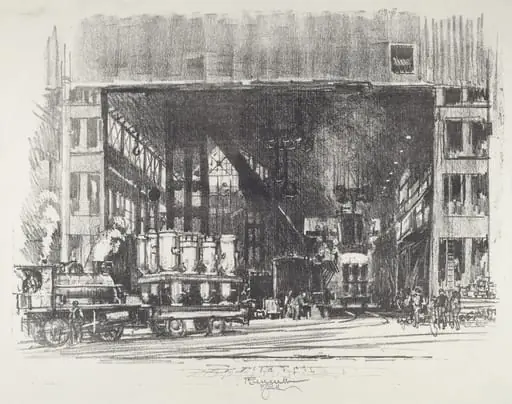
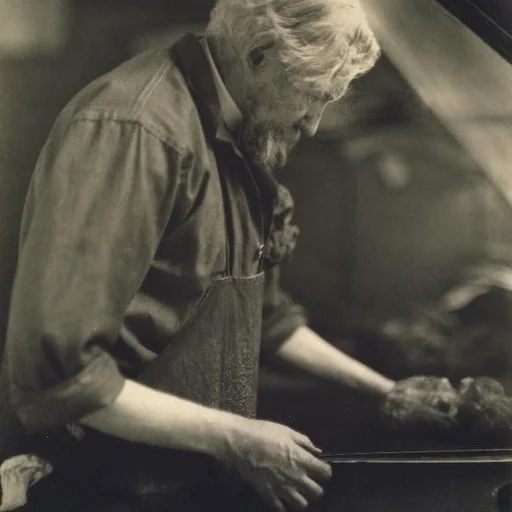
The Great Hammer is an ink print by Joseph Pennell. It dates from 1916 and is held in the collection of the National Gallery of Art.
About this work
Overview
Created in 1916, *The Great Hammer* is a lithograph by American artist Joseph Pennell, known for his detailed renderings of urban and industrial subjects.
Created in 1916, *The Great Hammer* is a lithograph by American artist Joseph Pennell, known for his detailed renderings of urban and industrial subjects. Executed during his time in Europe, the print captures a moment of active construction, emphasizing the physicality and rhythm of labor. Pennell’s background in etching and illustration informed his precise yet dynamic approach to printmaking, allowing him to translate the urgency of the scene into a single, cohesive image.
Subject & Meaning
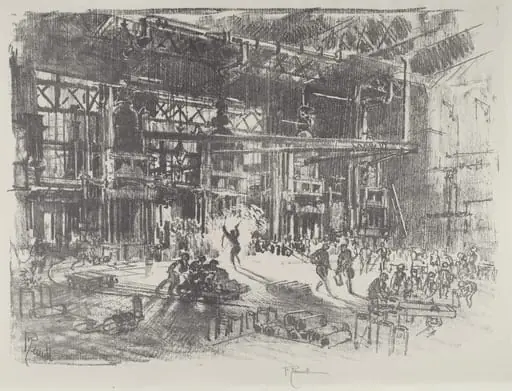
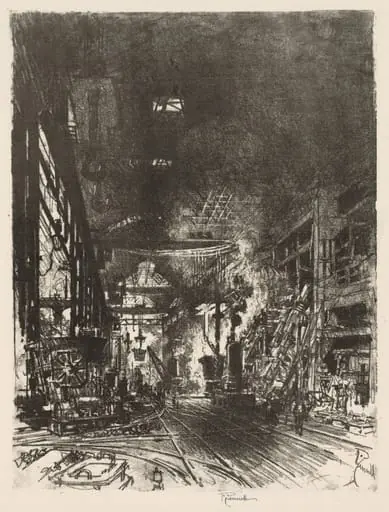
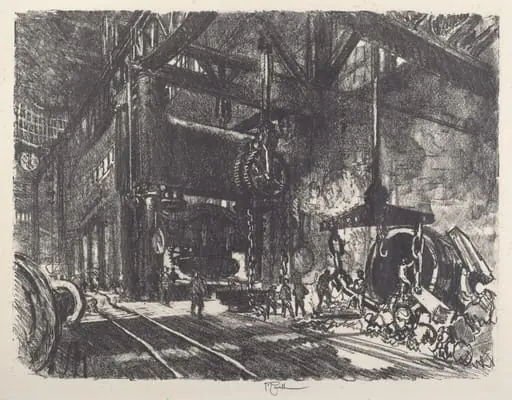
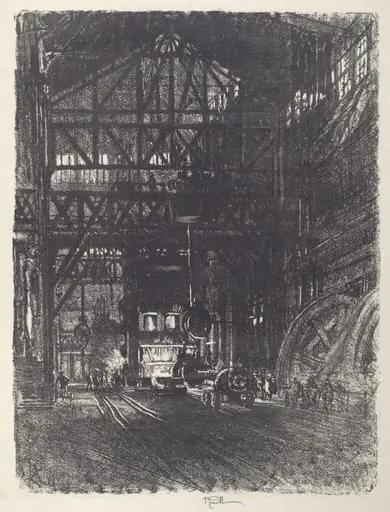
The scene depicts a bustling construction site with workers handling pipes and tools beneath a tangle of steel beams. At the center, a large hammer hangs suspended, its placement drawing attention without being used. The title suggests the tool functions as a symbol—perhaps of industrial power, human effort, or the force shaping modern infrastructure. The unfinished structure behind implies progress, while the workers’ focused movements convey the relentless pace of development.
Technique & Style
Pennell employed lithography to achieve sharp contrasts and fluid linework, capturing the texture of metal, wood, and stone with minimal but deliberate strokes. His lines are energetic and immediate, suggesting sketches made on-site rather than composed in the studio. The composition is tightly framed, focusing on the interplay of vertical beams and horizontal scaffolding, creating a sense of compression and movement that mirrors the activity of the site.
History & Provenance
Pennell produced *The Great Hammer* during a period when he was deeply engaged with industrial themes, following his earlier travels across Europe and the United States documenting architecture and engineering projects. The print was likely made for a broader audience interested in modernization, possibly as part of a series or publication. Its survival in institutional collections reflects its recognition as a significant example of early 20th-century American printmaking.
Context
In 1916, global industrial expansion was accelerating, and construction projects like those depicted here symbolized national progress. Pennell, influenced by Whistler’s tonal sensitivity and attention to urban life, aligned his work with a broader artistic interest in modernity. Unlike romanticized portrayals of labor, his images present work as structural, mechanical, and unembellished—reflecting the era’s fascination with technology and efficiency.
Legacy
Though not widely exhibited today, *The Great Hammer* remains a representative work of Pennell’s contribution to American printmaking. It exemplifies how lithography could convey both documentary precision and expressive force. The print’s focus on industrial labor anticipated later movements that sought to elevate the dignity of the working class through art, positioning Pennell as a quiet observer of America’s evolving built environment.
Artist & collection
Artist
Joseph Pennell (July 4, 1857 – April 23, 1926) was an American draftsman, etcher, lithographer, and illustrator for books and magazines.