Artwork
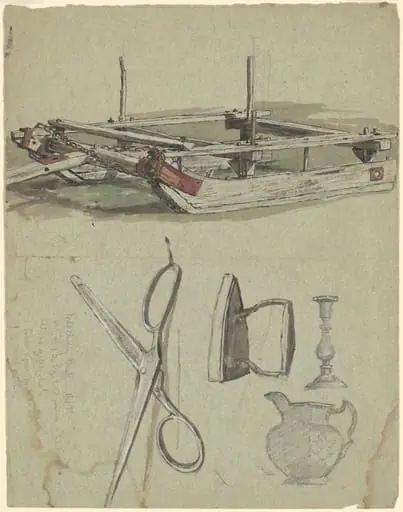
Studies of a Well and Wooden Trough
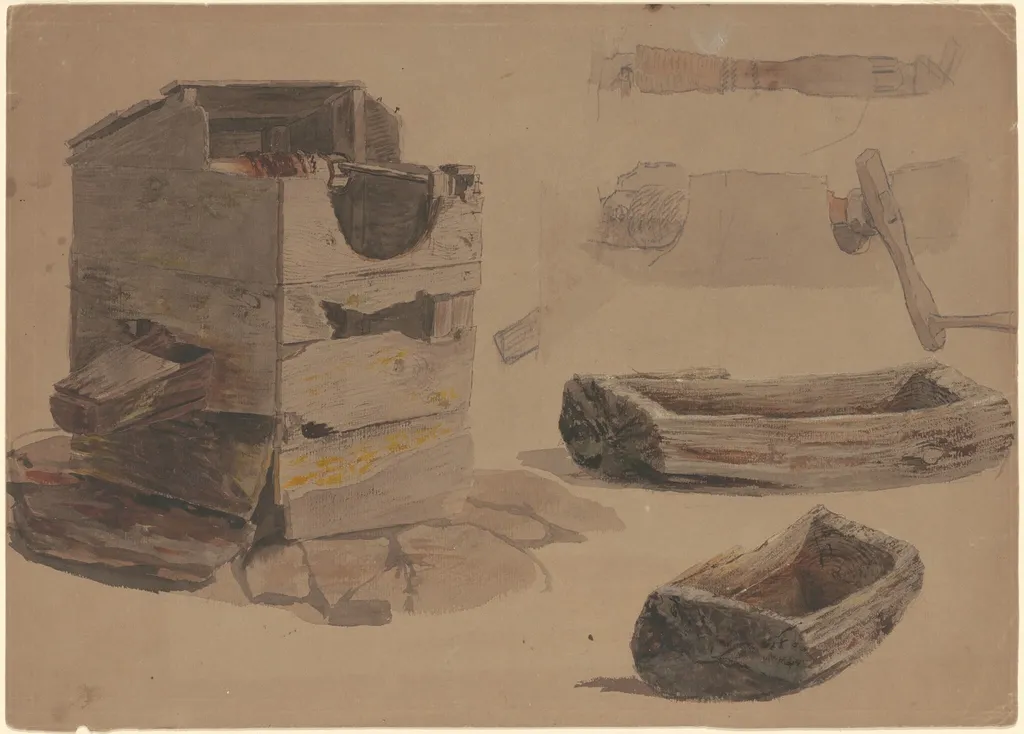
Studies of a Well and Wooden Trough is a gouache drawing by the Impressionist artist Perry, Enoch Wood, Jr.. It dates from 1870 and is held in the collection of the National Gallery of Art. Created in 1870 by Enoch Wood Perry, Jr.
About this work
Overview
It belongs to the category of preparatory studies, capturing a rural water source and its accompanying wooden trough with careful observation.
Created in 1870 by Enoch Wood Perry, Jr., this work is a detailed drawing executed in watercolor and gouache over graphite on wove paper. It belongs to the category of preparatory studies, capturing a rural water source and its accompanying wooden trough with careful observation. The medium suggests a focus on texture and light, typical of 19th-century American artists documenting everyday structures.
Subject & Meaning
The subject is a simple rural well and its adjacent wooden trough, likely used for watering livestock or collecting water. The absence of figures or narrative elements emphasizes the object’s functional presence in daily life. The study reflects an interest in vernacular architecture and the quiet dignity of utilitarian objects, common in post-Civil War American art.
Technique & Style
Perry employed layered watercolor and opaque gouache over a graphite underdrawing to build subtle tonal variations and surface detail. The brushwork is precise yet restrained, capturing the weathered grain of wood and the dampness of stone. The composition is tightly framed, focusing attention on materiality rather than landscape context.
History & Provenance
The work was produced during Perry’s active years as a watercolorist, likely as part of a series of studies from rural New England. It remained in private hands until acquired by a major American museum in the mid-20th century. Its survival as a standalone study, rather than a sketch for a larger painting, underscores its value as an independent observational work.
Context
In the late 19th century, American artists increasingly turned to domestic and rural subjects as the nation grappled with industrialization. Perry’s study aligns with a broader trend of documenting fading agrarian life. His approach, neither sentimental nor idealized, reflects a quiet realism shared by contemporaries in the American Watercolor Society.
Legacy
Though not widely exhibited, this drawing exemplifies the precision and quiet intensity of American watercolor studies from the period. It contributes to the understanding of how artists recorded everyday environments with technical rigor, influencing later generations interested in material truth over romanticized imagery.
Artist & collection


![Sail Makers [recto], by Perry, Enoch Wood, Jr.](https://artifactworldgallery.com/img/perry-enoch-wood-jr--sail-makers-recto--0553b8abee044150-w320.webp)
![Studies of Figures [verso], by Perry, Enoch Wood, Jr.](https://artifactworldgallery.com/img/perry-enoch-wood-jr--studies-of-figures-verso--08cd7fa67b50c519-w320.webp)
![Studies of Hands [recto], by Perry, Enoch Wood, Jr.](https://artifactworldgallery.com/img/perry-enoch-wood-jr--studies-of-hands-recto--594d36f72822a9f4-w320.webp)
![Tree [verso], by Perry, Enoch Wood, Jr.](https://artifactworldgallery.com/img/perry-enoch-wood-jr--tree-verso--696f4264834bd30c-w320.webp)