Artwork
II. Divine Kingship
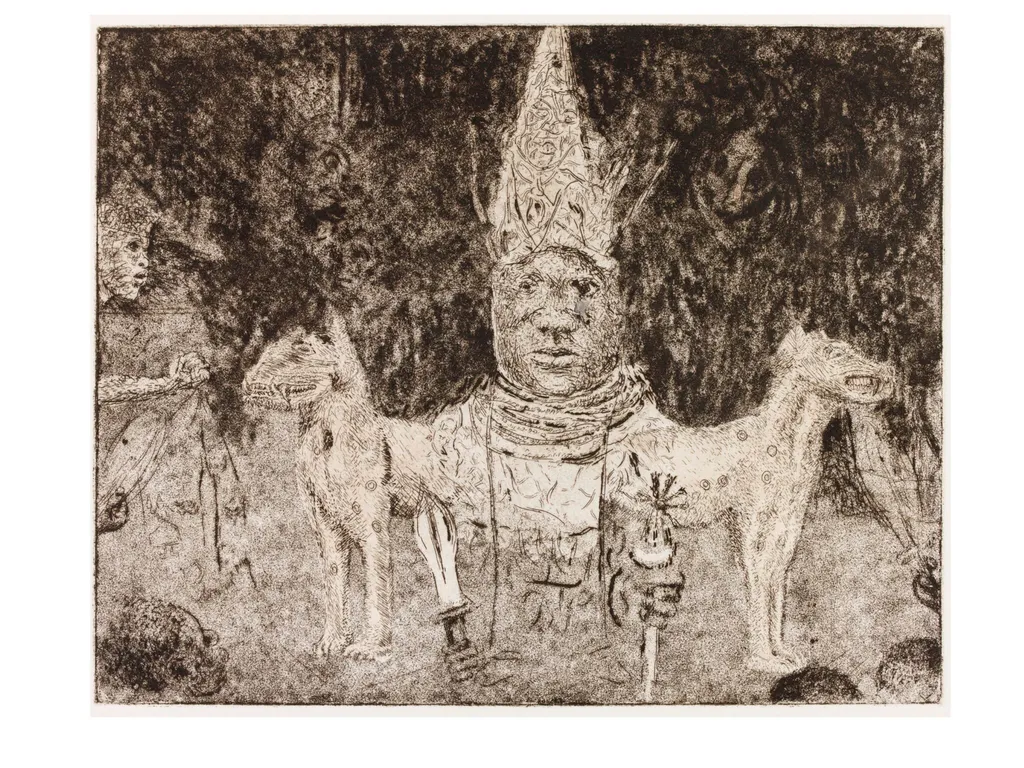
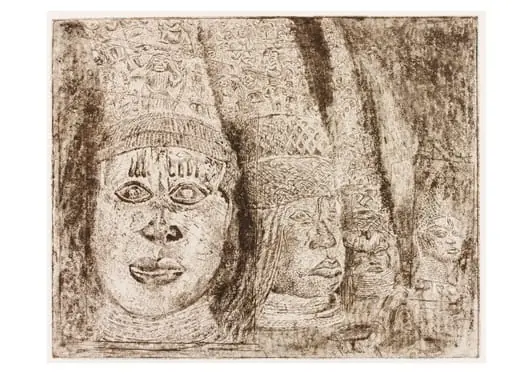
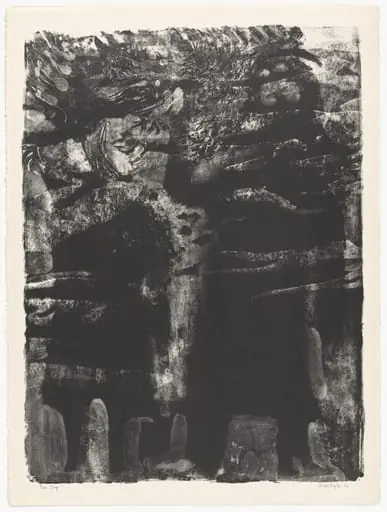
II. Divine Kingship is a print by Tony Phillips. It dates from 1984 and is held in the collection of the Victoria and Albert Museum.
About this work
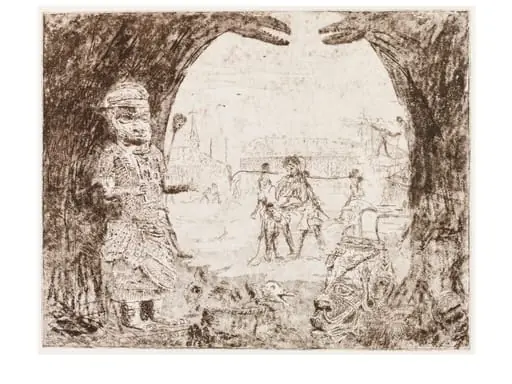
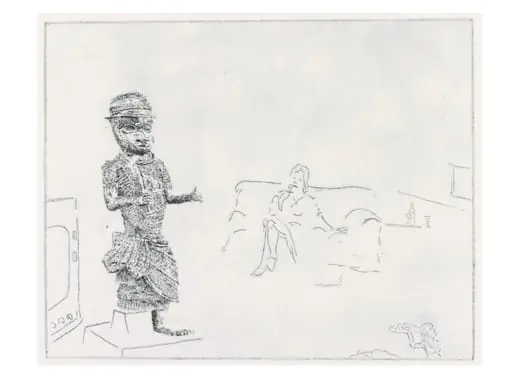
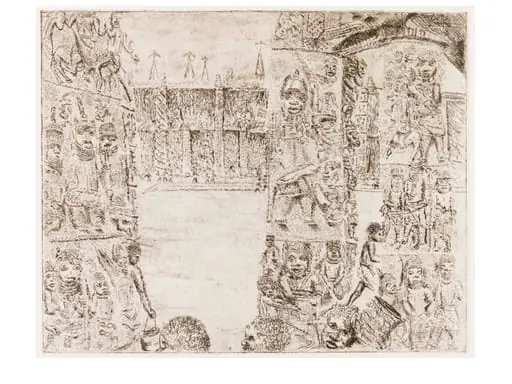
Tony Phillips made an etching in 1984 called II. Divine Kingship. It’s a print, part of a twelve-plate series he titled History of the Benin Bronzes.
He drew this after reading how British papers called the Oba and his people “savages.” That lie helped justify a violent raid and looting in Benin City in 1897.
Look up Tony Phillips next.
Overview
Divine Kingship in 1984 as the second plate in his twelve-part etching series, History of the Benin Bronzes.
Tony Phillips created II. Divine Kingship in 1984 as the second plate in his twelve-part etching series, History of the Benin Bronzes. The work responds to the 1897 British raid on Benin City and the subsequent looting of royal artifacts. Phillips used the medium of etching to confront the colonial narrative that framed the Oba’s court as barbaric, instead invoking the dignity and symbolism of Benin’s royal imagery.
Subject & Meaning
The print centers on the crowned head of the Oba, flanked by two leopards—traditional emblems of royal authority in Benin cosmology. By isolating this imagery, Phillips emphasizes the legitimacy and spiritual weight of Benin kingship, countering 19th-century British propaganda that dismissed it as savage. The composition evokes ritual permanence, contrasting sharply with the violence of the raid that removed such objects from their cultural context.
Technique & Style
Phillips employed fine-line etching to render the Oba’s regalia and the leopards with precise, controlled detail. The tonal contrasts and linear density evoke the texture of cast brass plaques, subtly referencing the original Benin artworks looted in 1897. The monochromatic palette and formal symmetry recall both European print traditions and the stylized portraiture of Benin court art, bridging visual languages without appropriation.
History & Provenance
The work emerges from Phillips’s engagement with the historical record of the 1897 British punitive expedition, during which hundreds of brass and ivory objects were taken from Benin’s royal palace. These artifacts later entered British museums, often displayed without context. Phillips’s series was a direct response to this displacement, reclaiming visual agency through art that repositions the Oba as a figure of sovereignty, not spectacle.
Context
In the 1980s, as debates over colonial restitution and museum ethics gained momentum, Phillips’s series intervened in public discourse by visually challenging the dehumanizing stereotypes used to justify the looting of Benin. His etchings were not mere reproductions but critical reinterpretations, inviting viewers to reconsider the moral foundations of colonial collections and the narratives embedded in their display.
Legacy
II. Divine Kingship remains a significant work in postcolonial art for its quiet but forceful reclamation of Benin’s royal iconography. It contributes to a broader artistic and scholarly effort to reframe the Benin Bronzes not as exotic trophies but as symbols of a complex, enduring civilization. Phillips’s series continues to inform contemporary dialogues on cultural restitution and the ethics of museum ownership.
Artist & collection
Artist
Tony Phillips made a series of twelve prints in 1984 that blend symbols and everyday scenes.