Artwork
Woman Picking Fruit and the Savage (Femme cueillant des fruits et oviri)
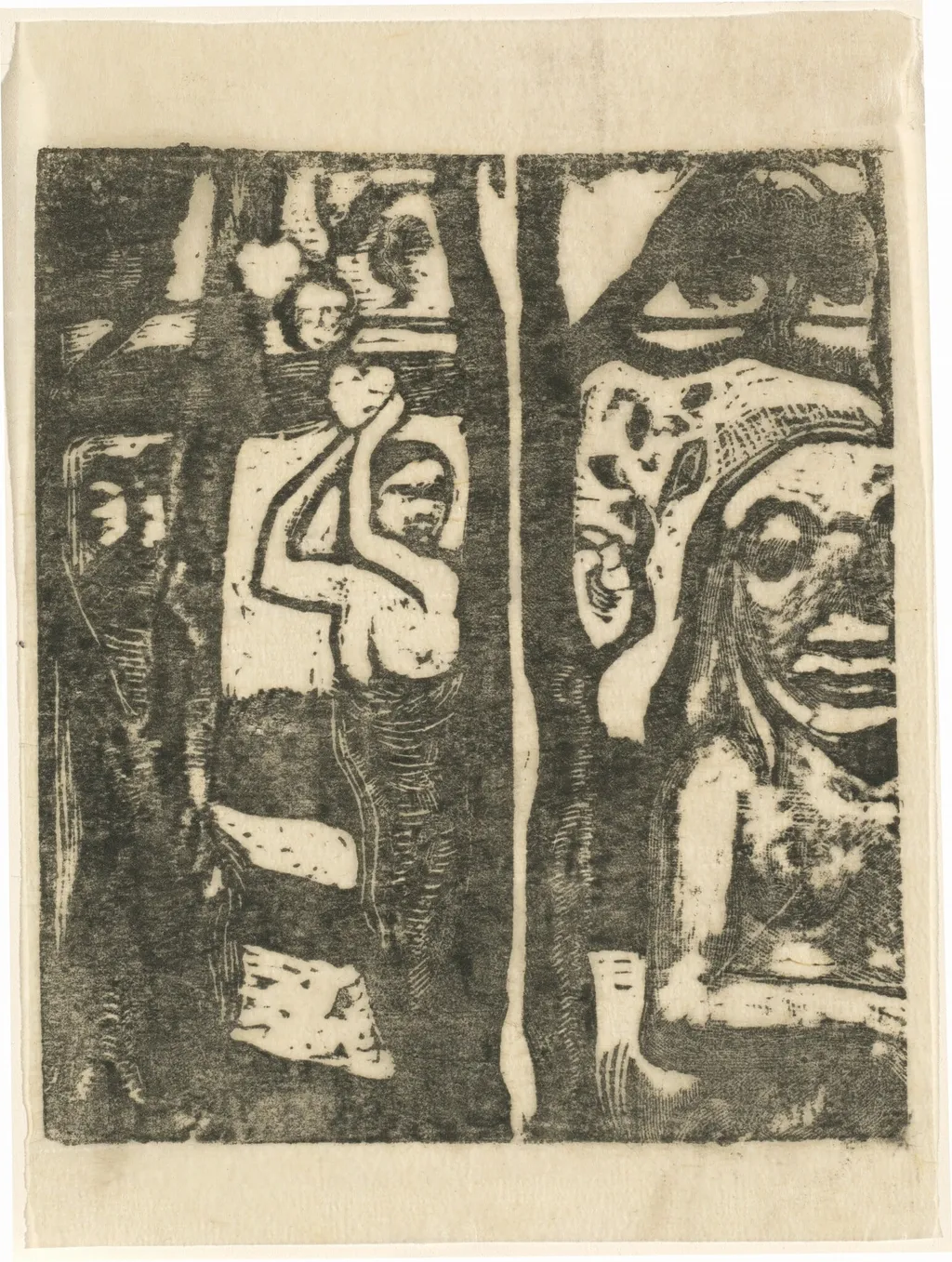
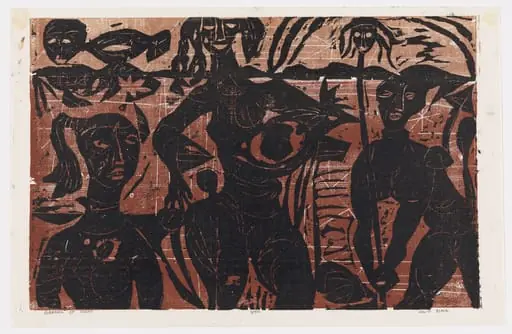
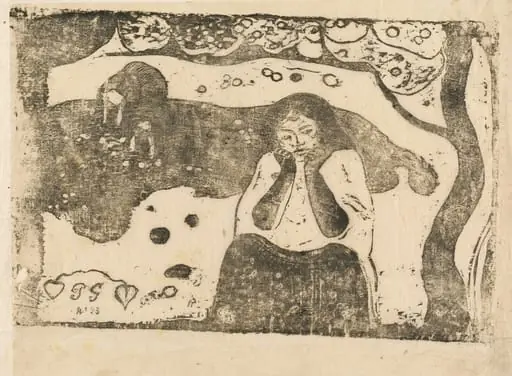
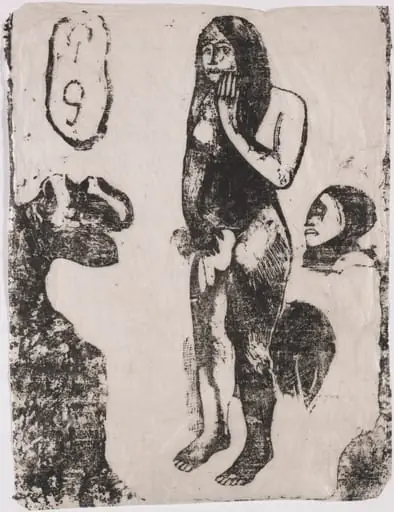
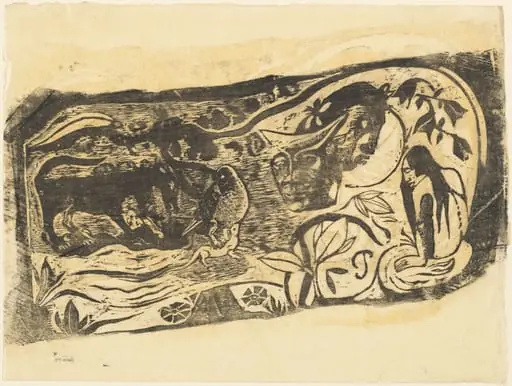
Woman Picking Fruit and the Savage (Femme cueillant des fruits et oviri) is an ink print by the Impressionist artist Paul Gauguin. It dates from 1894 and is held in the collection of the National Gallery of Art.
About this work
Overview
The image presents two female figures in a flattened, non-perspectival space, stripped of decorative detail and rendered with deliberate crudeness.
Created in 1894, this woodcut by Paul Gauguin belongs to a series of prints made during his time in Tahiti. Unlike his paintings, this work relies on the physicality of carved wood and ink to convey mood. The image presents two female figures in a flattened, non-perspectival space, stripped of decorative detail and rendered with deliberate crudeness. The technique emphasizes the hand of the artist, rejecting academic polish in favor of raw, direct expression.
Subject & Meaning
The two figures, one draped, the other clothed in a patterned wrap, are not literal portraits but symbolic presences. Their stillness and uniform posture suggest archetypes rather than individuals. The title references 'Oviri,' a Tahitian goddess of mourning and wild nature, implying a connection between femininity, the natural world, and spiritual forces. Their calm, mask-like faces resist emotional interpretation, inviting contemplation over narrative.
Technique & Style
Gauguin carved directly into a woodblock, using coarse, uneven lines to create a textured, almost primitive surface. The black ink contrasts sharply with the unprinted paper, eliminating gradation and depth. Forms are reduced to essential silhouettes, with minimal facial features and no modeling. The roughness of the carving is left visible, reinforcing the work’s rejection of refinement and its alignment with non-Western artistic traditions.
History & Provenance
Made during Gauguin’s second stay in Tahiti, the print was part of his broader effort to develop a visual language independent of European conventions. He produced limited impressions, often hand-colored or altered by hand, making each copy unique. The work was not widely circulated during his lifetime but later gained recognition among modernist collectors drawn to its raw aesthetic and symbolic ambiguity.
Context
Gauguin’s woodcuts emerged from his rejection of Impressionism and his pursuit of spiritual and cultural authenticity. Influenced by Breton folk art, Japanese prints, and Oceanic carvings, he sought to strip away Western naturalism. This print reflects his broader interest in myth, ritual, and the 'savage' as a counterpoint to industrial modernity — a theme central to his writings and artistic practice in the 1890s.
Legacy
The print’s bold abstraction and emotional restraint influenced early 20th-century Expressionists and Primitivist movements. Its emphasis on the carved surface and symbolic form prefigured the work of artists like Matisse and the German Expressionists. Rather than being seen as a mere illustration, it is now regarded as a pivotal example of printmaking as a vehicle for philosophical and cultural critique.
Artist & collection
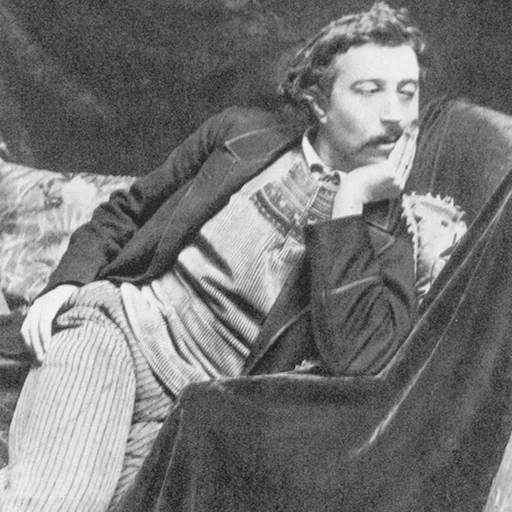
Artist
Eugène Henri Paul Gauguin (; French: ; 7 June 1848 – 8 May 1903) was a French painter, sculptor, printmaker, ceramist, and writer, whose work has been primarily associated with the Post-Impressionist and Symbolist movements.