Artwork
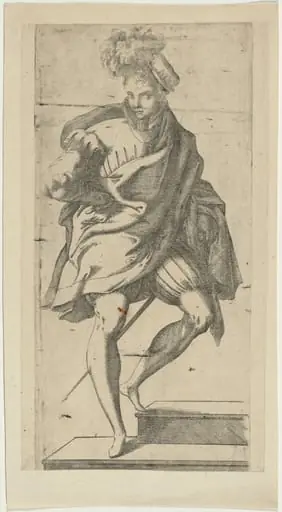
Fleeing Barbarian
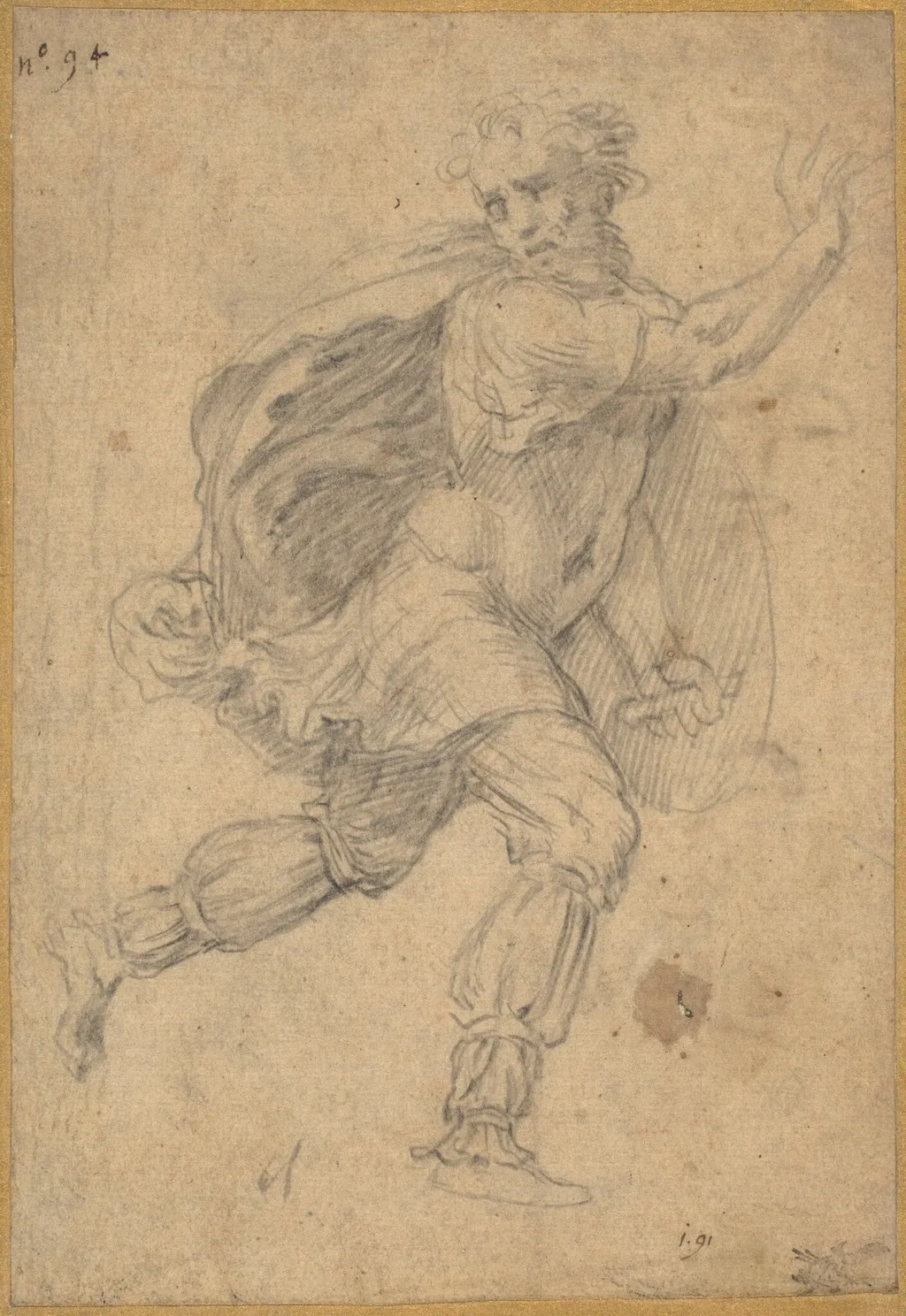
Fleeing Barbarian is a chalk drawing by the Renaissance artist Polidoro da Caravaggio. It dates from 1524 and is held in the collection of the National Gallery of Art.
About this work
Overview
It captures a single, dynamic figure in motion—running, twisting, and glancing backward—as if escaping an unseen threat.
Created around 1524, this drawing by Polidoro da Caravaggio is executed in black chalk on laid paper. It captures a single, dynamic figure in motion—running, twisting, and glancing backward—as if escaping an unseen threat. The work is unembellished, lacking background or context, and emphasizes physical tension over narrative detail. Its immediacy suggests it was made as a study or rapid observation rather than a finished piece.
Subject & Meaning
The figure appears to be a man in flight, his muscular form contorted by urgency. His wild hair and strained expression convey panic or desperation, evoking themes of chaos and vulnerability. Though labeled 'Fleeing Barbarian,' the identity remains ambiguous; the label may reflect Renaissance anxieties about invasion or moral decay rather than a specific historical event. The subject is less a person than an embodiment of unrest.
Technique & Style
Polidoro employed swift, unrefined chalk strokes to suggest motion rather than define form. There is no blending or tonal gradation; instead, sharp, angular lines trace the limbs and torso, creating a sense of kinetic energy. The paper’s texture and faint discoloration enhance the contrast, allowing the dark marks to feel urgent and spontaneous. The technique prioritizes expression over polish, aligning with the artist’s interest in the human body under stress.
History & Provenance
The drawing originates from Polidoro’s time in Rome, where he worked alongside Raphael’s circle before the Sack of 1527. Its survival through centuries suggests it was preserved as a study or personal sketch rather than a commissioned work. The paper’s aging and stains reflect its long history, though its early ownership remains undocumented. It entered modern collections in the 19th or early 20th century, likely through European private holdings.
Context
In early 16th-century Rome, artists increasingly turned to the nude figure as a vehicle for studying anatomy and emotion. Polidoro’s work reflects this trend, but with a rawness uncommon in more polished Renaissance drawings. The sketch’s urgency may also respond to the political instability preceding the Sack of Rome, where fears of violence and displacement were widespread among artists and citizens alike.
Legacy
Though not widely exhibited in its time, this drawing exemplifies a strand of Mannerist experimentation focused on expressive movement over idealized form. Later artists studying the human figure in motion, particularly in times of crisis, found in it a precedent for emotional intensity over technical finish. Its preservation offers insight into the private, observational practices of Renaissance draftsmen beyond public commissions.
Artist & collection


![A Deathbed Scene [recto], by Polidoro da Caravaggio](https://artifactworldgallery.com/img/polidoro-da-caravaggio--a-deathbed-scene-recto--003a0ab85138063d-w320.webp)
![Woman Seated with a Piece of Cloth [verso], by Polidoro da Caravaggio](https://artifactworldgallery.com/img/polidoro-da-caravaggio--woman-seated-with-a-piece-of-cloth-verso--ec763632d6897d6a-w320.webp)
![Mars and Diana [recto], by Zanguidi, called Bertoia, Jacopo](https://artifactworldgallery.com/img/zanguidi-called-bertoia-jacopo--mars-and-diana-recto--a528dea7036b44d0-w320.webp)