Artwork
Doncaster Race for the Great St. Legder Stakes
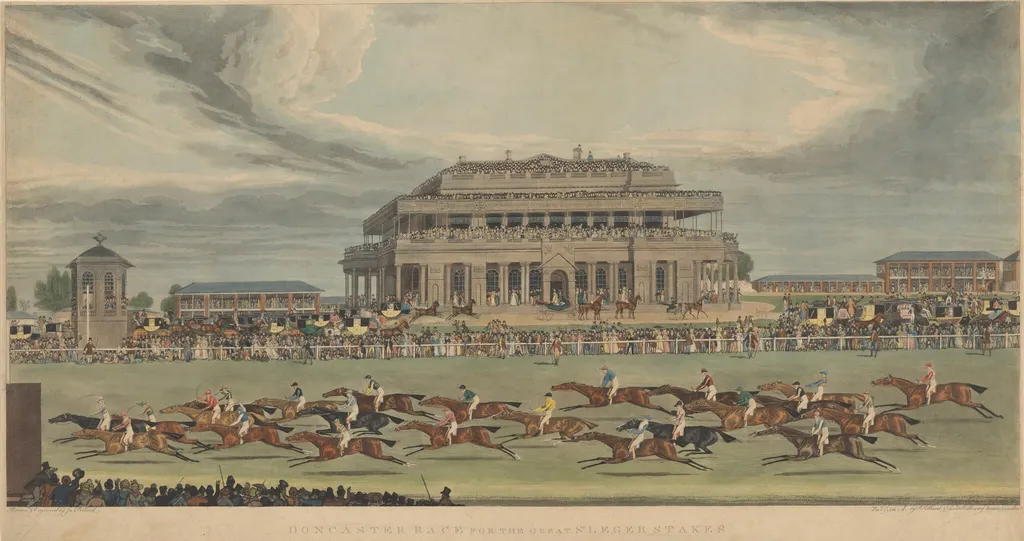
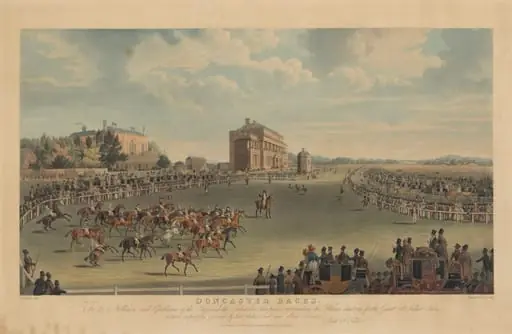
Doncaster Race for the Great St. Legder Stakes is an ink print by the Romanticist artist James Pollard. It dates from 1839 and is held in the collection of the National Gallery of Art.
About this work
Overview
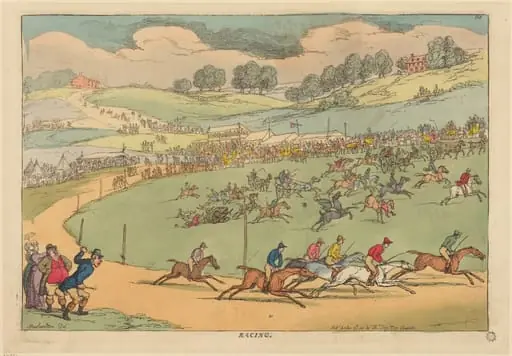
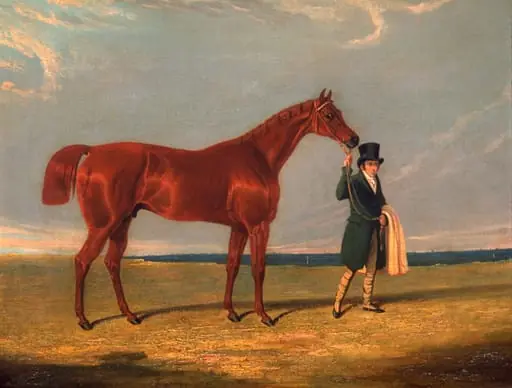
Created in 1839 by James Pollard, this hand-colored aquatint captures a moment from the Great St. Leger Stakes at Doncaster. The print combines etched lines with manual coloring to render the dynamism of a horse race. Its detailed composition includes jockeys in vivid attire, a dense spectator crowd, and a prominent grandstand, all rendered with precision and atmospheric depth.
Subject & Meaning
The scene depicts one of England’s oldest and most prestigious flat races, drawing attention to the social and sporting culture of the early 19th century. The presence of a large, attentive audience and the formal architecture of the grandstand suggest the event’s status as a public spectacle, blending aristocratic patronage with popular entertainment.
Technique & Style
Pollard employed aquatint, a printmaking method that allows tonal gradations, then added color by hand to enhance realism and vibrancy. The technique enabled subtle shading in the sky and grass, while the riders’ costumes and horse musculature were accentuated with deliberate brushwork. The result is a lively, textured image that balances detail with motion.
History & Provenance
The print was produced during a period when sporting subjects gained popularity in British print culture. Pollard, known for his equestrian scenes, likely created this as part of a series documenting major races. It was distributed as a commercial print, appealing to both racing enthusiasts and collectors of contemporary life imagery.
Context
In the 1830s, horse racing was a central feature of British social life, with events like the St. Leger attracting nobility and commoners alike. Doncaster’s racecourse was a well-established venue, and prints like this served as both records and souvenirs, reflecting the era’s fascination with sport, class, and public spectacle.
Legacy
Pollard’s work contributed to the documentation of 19th-century British racing culture. While not widely exhibited today, such prints remain valuable for historians studying the visual representation of sport, class, and leisure in the Victorian era. They offer insight into how public events were framed and consumed through print media.
Artist & collection