Artwork
Joshua, King David and Judas Maccabeus
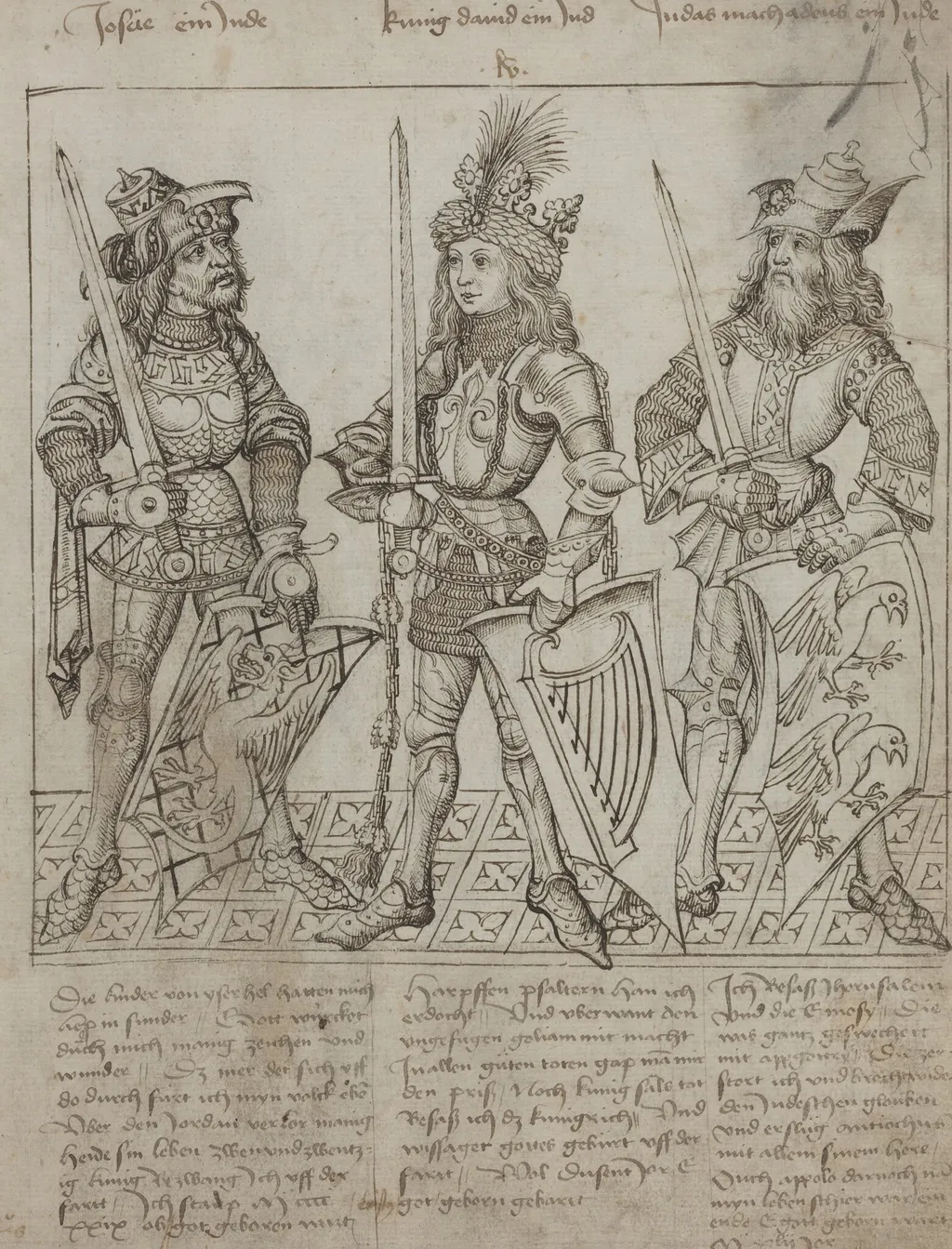
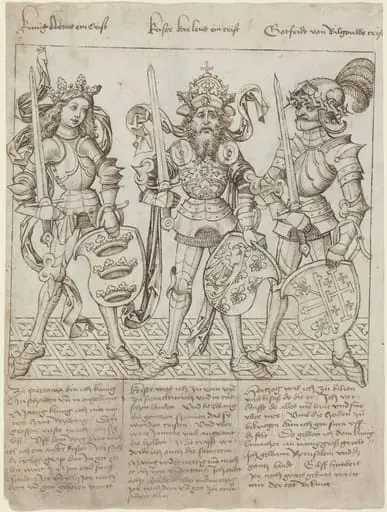
Joshua, King David and Judas Maccabeus is an ink drawing by the Renaissance artist Primary Master of the Strassburg Chronicle. It dates from 1492 and is held in the collection of the National Gallery of Art.
About this work
Overview
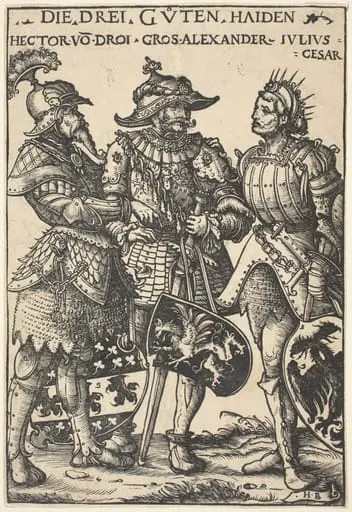
Created in 1492, this pen and black ink drawing on laid paper reflects the work of the Primary Master of the Strassburg Chronicle. Executed with precision over faint chalk underdrawings and leadpoint rulings, it depicts three biblical and historical warrior figures in armor, rendered with meticulous line work and subtle tonal modeling through cross-hatching.
Subject & Meaning
The surrounding German script may cite scriptural passages or epithets, reinforcing their symbolic status as righteous warriors.
The central figure, crowned with leaves, likely represents King David, flanked by Joshua and Judas Maccabeus—leaders revered for divine favor and military triumph. Their paired attributes—swords, spears, and emblematic shields—signal their roles as chosen defenders of faith. The surrounding German script may cite scriptural passages or epithets, reinforcing their symbolic status as righteous warriors.
Technique & Style
The artist employed fine pen strokes and layered cross-hatching to define the weight and texture of armor, creating depth without color. Traces of black chalk underpin the forms, while leadpoint rulings guided composition. The lines are controlled and deliberate, emphasizing structural clarity over expressive gesture, characteristic of late 15th-century German draftsmanship.
History & Provenance
The drawing originates from the circle of the Strassburg Chronicle, a manuscript tradition tied to regional religious and civic identity in the late Middle Ages. Its survival suggests it was valued as a preparatory study or devotional image, though its exact provenance before modern collections remains undocumented.
Context
In the decades before the Reformation, images of biblical heroes in martial guise served as moral exemplars for Christian rulers and soldiers. This drawing aligns with a broader Northern European trend of visualizing sacred history through contemporary armor and heraldic detail, blending scriptural narrative with the visual language of knightly culture.
Legacy
As a rare surviving example of the Primary Master’s draftsmanship, the work offers insight into the visual culture of late medieval Strasbourg. Its technical discipline influenced later illustrators of religious chronicles, though the artist’s identity remains obscure, preserving the anonymity typical of workshop production in the period.
Artist & collection

Artist
Primary Master of the Strassburg Chronicle
Primary Master of the Strassburg Chronicle (1492–1493) was an artist.

![King John [right side], by English 16th Century](https://artifactworldgallery.com/img/english-16th-century--king-john-right-side--70278027b2668ec3-w320.webp)