Artwork
A Kanja on the Nile at Luxor, with the Temple of Luxor behind
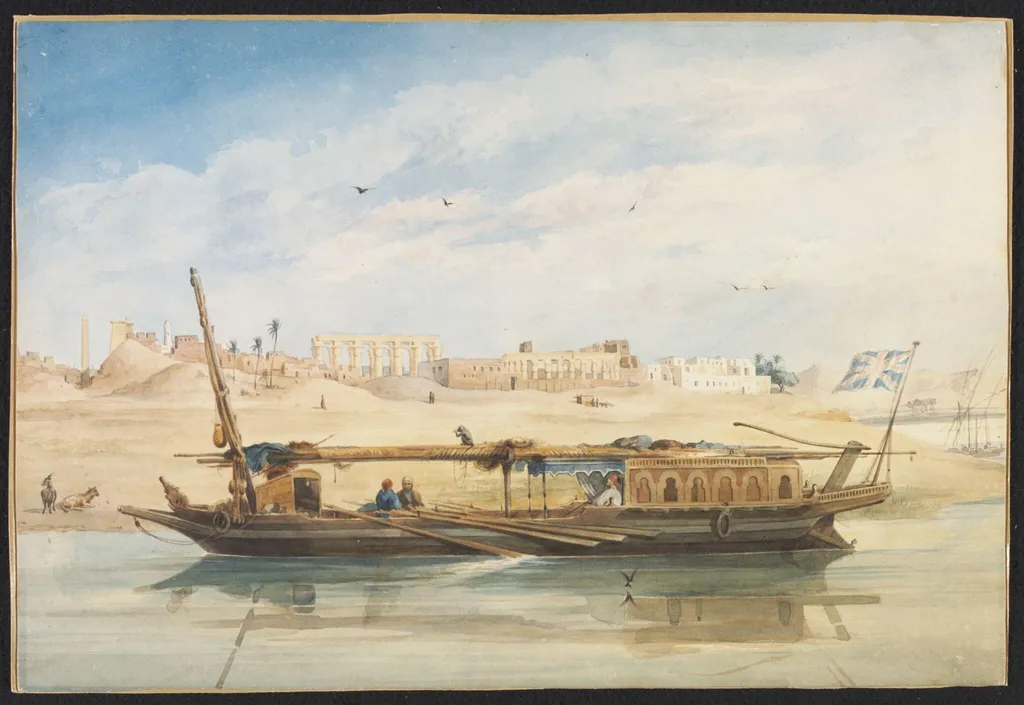
A Kanja on the Nile at Luxor, with the Temple of Luxor behind is a watercolor work on paper by the Orientalist artist Achille-Constant-Théodore-Emile Prisse d'Avennes. It dates from 1840 and is held in the collection of the Victoria and Albert Museum.
About this work
Overview
This watercolour by Prisse d'Avennes depicts a kanja, a traditional Nile vessel, moored along the east bank near Luxor, with the Temple of Luxor visible in the distance. Created during the artist’s time in Egypt in the early 1840s, the work reflects his dual role as observer and documenter, capturing both topographical accuracy and the quiet presence of European travelers in the region.
Subject & Meaning
Behind it, the landscape unfolds with Gazirat Saad island, Gabal Qurnat hill, and the faint outlines of the Colossi of Memnon among palm trees.
The scene centers on a British tourist’s vessel, identified by its Red Ensign, anchored beside the Nile. Behind it, the landscape unfolds with Gazirat Saad island, Gabal Qurnat hill, and the faint outlines of the Colossi of Memnon among palm trees. The Temple of Luxor, though not the focus, anchors the composition in historical continuity, suggesting the coexistence of ancient monuments and contemporary travel.
Technique & Style
Prisse employed watercolour with precision to render architectural forms and natural elements in delicate layers. His handling of light suggests an awareness of atmospheric perspective, subtly differentiating the temple’s silhouette from the hazy hills beyond. The brushwork is controlled yet fluid, balancing topographical fidelity with the immediacy of a sketch made on site.
History & Provenance
Commissioned by an unidentified British traveler, J.W.P., the work was one of many such commissions Prisse undertook during his years in Egypt. After returning to France in 1844, he published extensively on Egyptian antiquities and later Islamic art. This watercolour likely entered private collections before being acquired by its current holder, preserving its connection to early Western engagement with Egypt’s heritage.
Context
In the 1830s–40s, Egypt was undergoing modernization under Muhammad Ali, attracting European specialists. Prisse, though initially employed by the state, operated independently, gaining recognition for his detailed recordings of temples and tombs. His work contributed to a growing European interest in Egypt’s material culture, bridging archaeological documentation and travel literature.
Legacy
Prisse’s watercolours, including this one, remain valuable for their observational clarity and historical context. His later publications, particularly on Egyptian and Islamic art, established him as a foundational figure in the scholarly study of North African visual culture. This piece exemplifies the transitional role of amateur and professional observers in shaping 19th-century Egyptology.
Artist & collection

Artist
Achille-Constant-Théodore-Emile Prisse d'Avennes
Achille-Constant-Théodore-Émile Prisse d'Avennes was a French archaeologist, Egyptologist, architect and writer.

![A Nubian Girl standing beside the First[?] Cataract of the Nile, by Achille-Constant-Théodore-Emile Prisse d'Avennes](https://artifactworldgallery.com/img/achille-constant-theodore-emile-prisse-d-avennes--a-nubian-girl-standing-beside-the-first-cataract-of-the-nile--50be460b2df7006f-w320.webp)
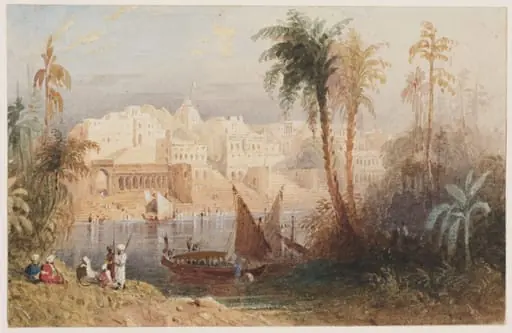 A view of an Indian city beside a river
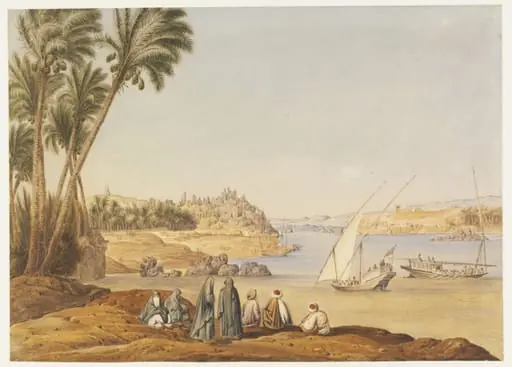 Aswan; looking south up the Nile
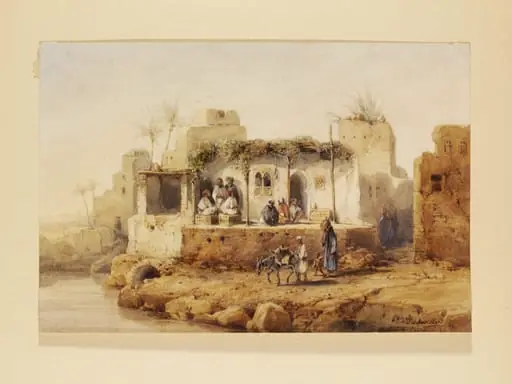 à Minieh, Egypte
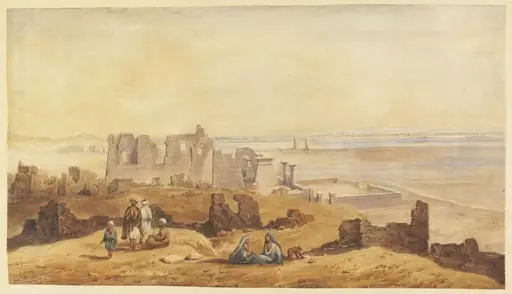 Luxor: the West Bank, with the Temple of Ramesses III at Madinat Habu; looking east towards the Nile
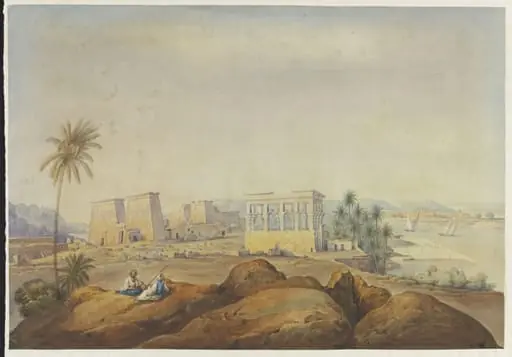 The Temple of Isis and Kiosk of Trajan on the Island of Philae
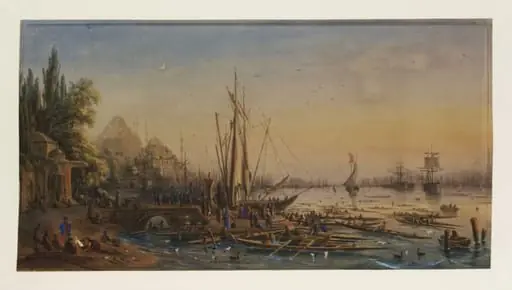 Harbour of Constantinople
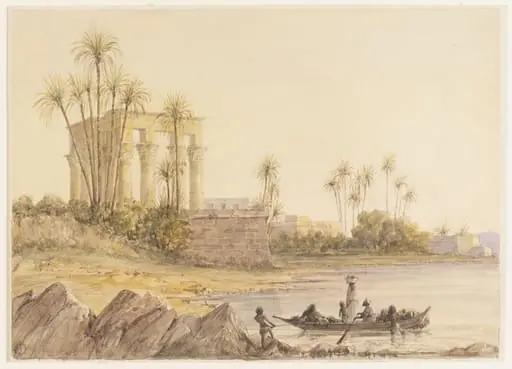 Landing Place. Philoe
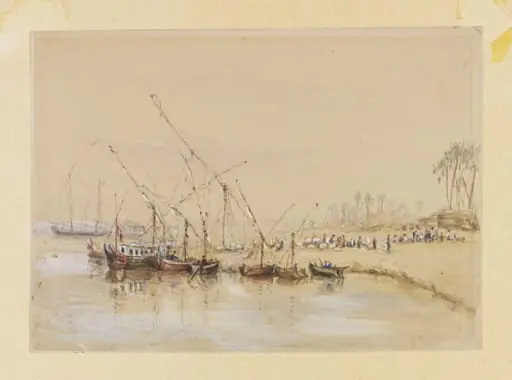 A Scene on the Nile: with dahabiyyahs and bales of cotton being loaded into feluccas