Artwork
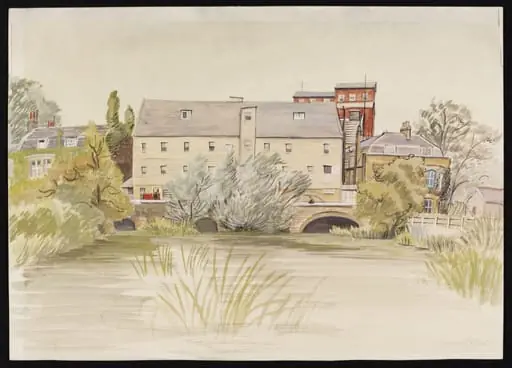
Silk Mills built in 1790, Malmesbury
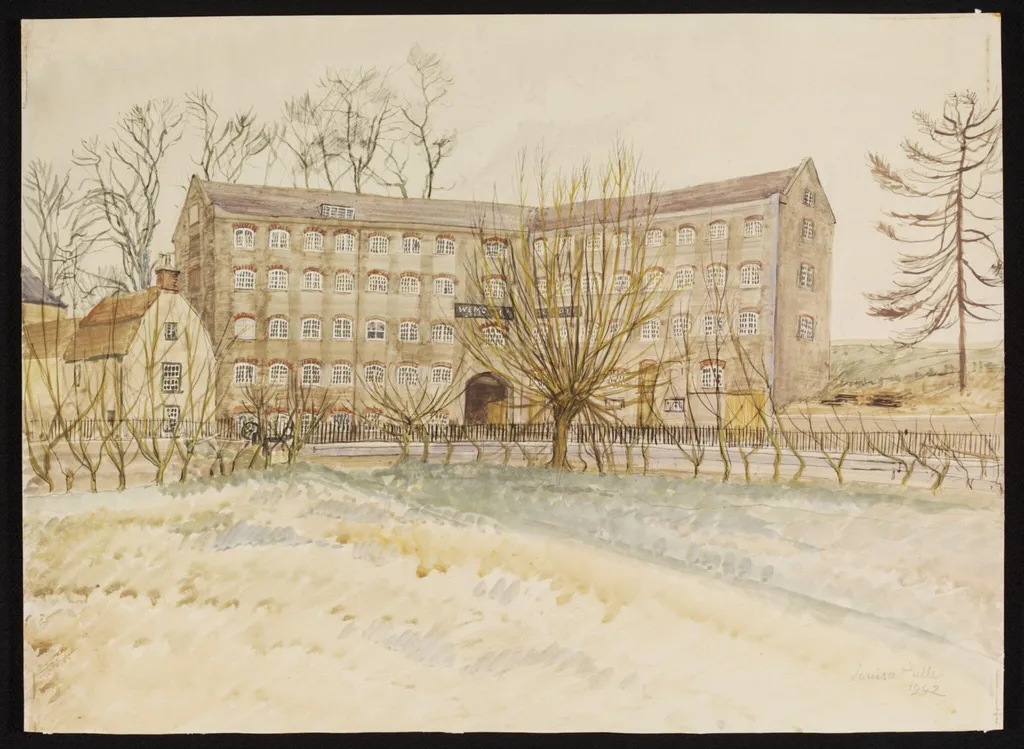
Silk Mills built in 1790, Malmesbury is a watercolor work on paper by Puller. It is held in the collection of the Victoria and Albert Museum.
About this work
Overview
This 1942 watercolour by Puller captures a silk mill in Malmesbury, originally constructed in 1790. The painting was created as part of the 'Recording Britain' project, a wartime effort to preserve visual records of at-risk architectural sites. It reflects the project’s focus on industrial and vernacular structures, documenting England’s changing landscape during a period of national uncertainty.
Subject & Meaning
The subject is a five-storey industrial building with two symmetrical wings, each containing eight window bays. Once central to local textile production, the mill represents the legacy of early industrialization in rural England. Its depiction in 1942 underscores its vulnerability to wartime disruption and postwar modernization, transforming it from a working facility into a historical relic.
Technique & Style
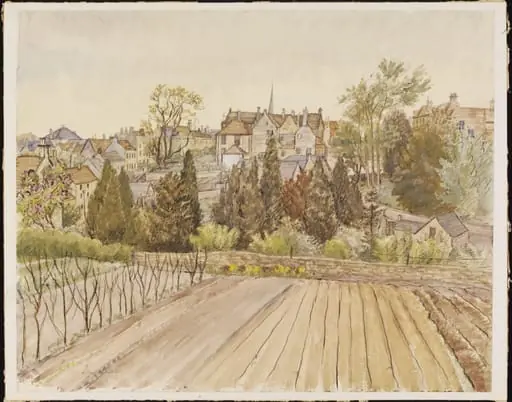
Puller employed a restrained watercolour technique, using light, neutral tones to convey the building’s weathered brickwork and dark roof. The composition emphasizes structure over detail, with minimal rendering of textures or ornamentation. Bare trees in the foreground frame the building without distracting from its form, reinforcing a quiet, observational approach.
History & Provenance
The work was produced in 1942 under the 'Recording Britain' initiative, commissioned by Sir Kenneth Clark and administered by the Victoria and Albert Museum. It was one of over 1,500 works created by 97 artists between 1940 and 1943. The painting entered the project’s official archive, later becoming part of public collections dedicated to British topographical art.
Context
The 'Recording Britain' project emerged amid fears that wartime bombing and urban redevelopment would erase historic buildings. Industrial sites like this mill, though not traditionally picturesque, were deemed culturally significant. Artists were tasked with recording structures that embodied regional identity, offering a counter-narrative to the era’s destruction.
Legacy
Puller’s watercolour remains a documented example of early 20th-century efforts to preserve Britain’s industrial heritage through art. The 'Recording Britain' collection, now held in major institutions, continues to serve as a resource for historians studying architectural change. The painting’s quiet realism contributes to a broader understanding of how ordinary structures shaped local life.
Artist & collection