Artwork
View on Lake Maggiore
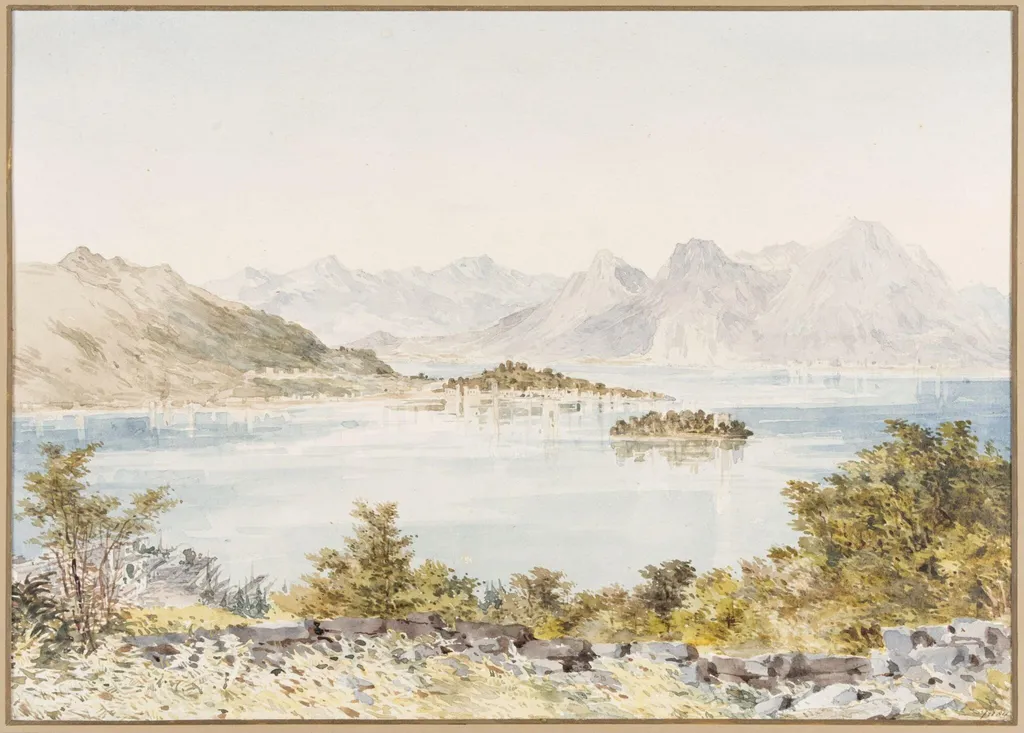
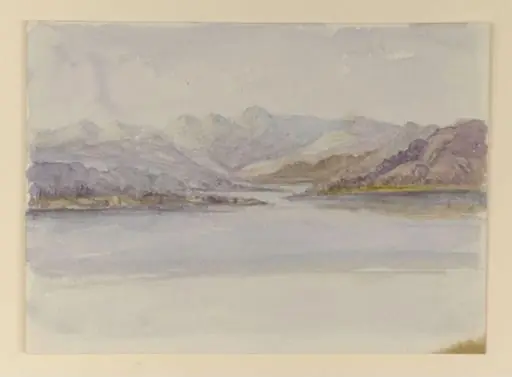
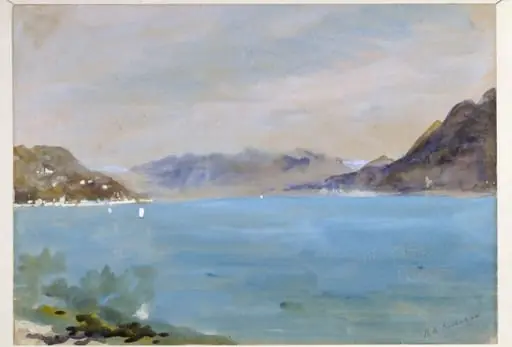
View on Lake Maggiore is a watercolor work on paper by Charles Claude Pyne. It dates from 1850 and is held in the collection of the Victoria and Albert Museum.
About this work
Overview
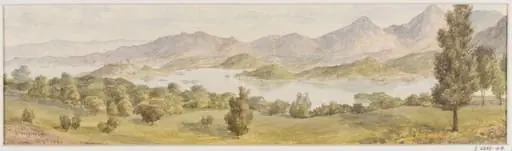
Painted in 1850, this watercolour by Charles Claude Pyne captures a tranquil stretch of Lake Maggiore. The composition balances open water with layered landforms, emphasizing stillness and quiet natural order. Soft washes of pale blue, gray, and muted green create a subdued atmosphere, characteristic of mid-nineteenth-century British landscape watercolours.
Subject & Meaning
The scene presents a serene lakeside vista with a distant mountain range, a small central island, and a foreground of rocky shorelines dotted with sparse vegetation. There is no human presence, suggesting an emphasis on nature’s quiet endurance. The composition invites contemplation rather than narrative, aligning with Romantic-era ideals of landscape as a space for reflection.
Technique & Style
Pyne employed delicate watercolour washes to suggest atmospheric depth, allowing the paper’s white to highlight reflections on the lake. The mountains are rendered in hazy, cool tones that recede into the distance, while the foreground uses restrained greens and yellows to define foliage without detail. The brushwork is loose yet controlled, prioritizing mood over precision.
History & Provenance
The work dates from Pyne’s active period in the mid-1800s, when British artists frequently traveled to the Italian Alps for sketching tours. Though specific ownership history is not documented, its style and subject align with works collected by British patrons interested in continental scenery during the Victorian era.
Context
This piece reflects a broader trend among British watercolourists who sought to capture the sublime yet accessible beauty of the European countryside. Lake Maggiore, a popular destination for Grand Tour travelers, was frequently depicted as an emblem of tranquil, picturesque nature—distinct from the dramatic Alpine vistas favored by earlier Romantic painters.
Legacy
Pyne’s work contributes to a body of watercolours that helped define the British tradition of topographical landscape art. While not widely known today, his restrained approach influenced contemporaries who valued subtlety and tonal harmony over bold expression, leaving a quiet mark on the evolution of landscape watercolour in the 19th century.
Own this work as a print
Artist & collection