Artwork
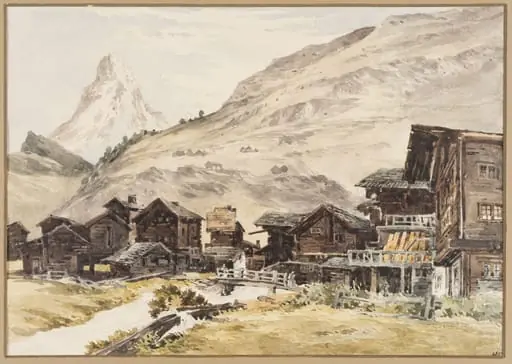
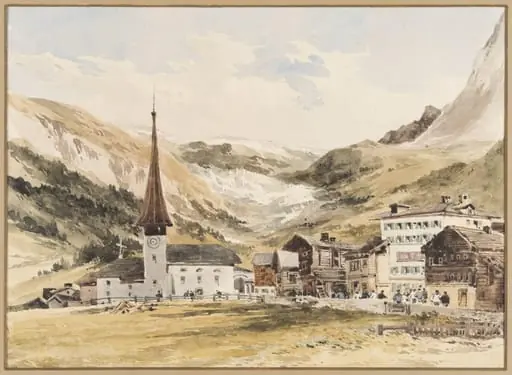
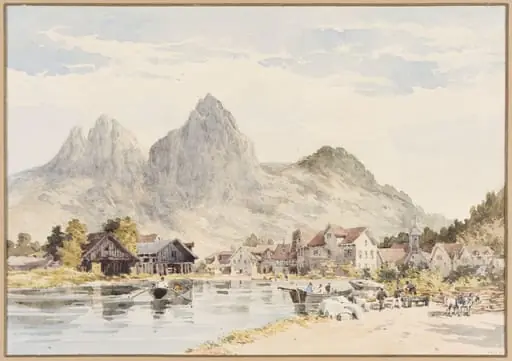
Village in the Saas Valley, Switzerland.
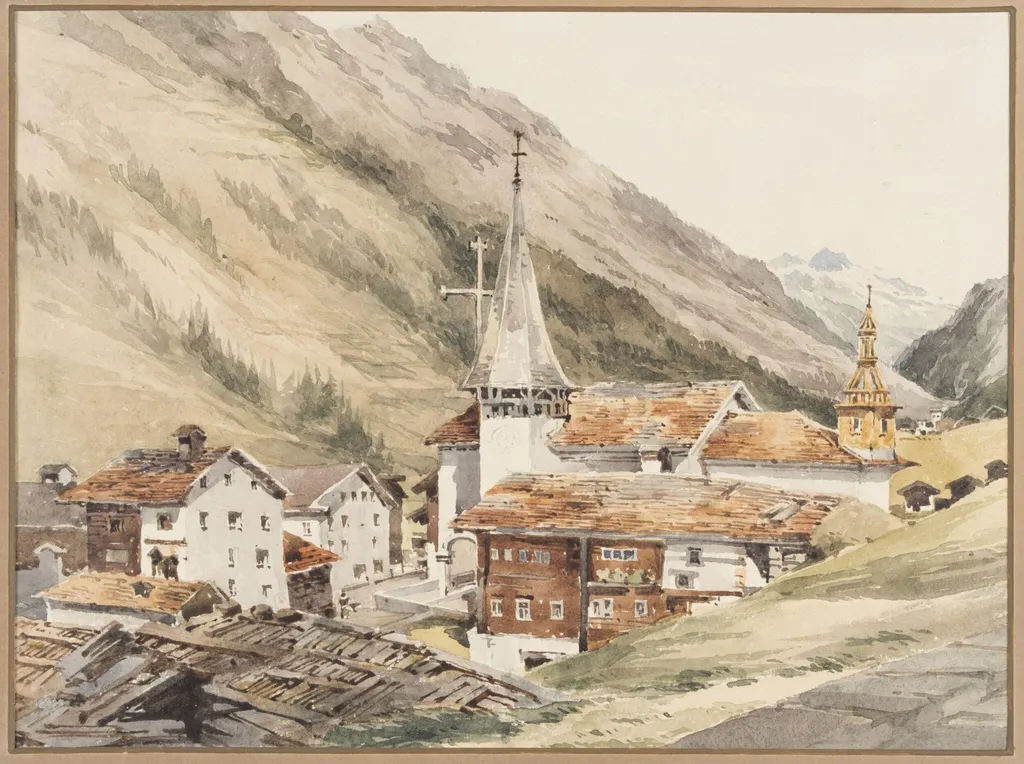
Village in the Saas Valley, Switzerland. is a watercolor work on paper by the British Romanticist artist Charles Claude Pyne. It dates from 1822 and is held in the collection of the Victoria and Albert Museum.
About this work
Overview
The composition centers on a tall church with a steep spire, surrounded by modest whitewashed homes with wooden shutters and brown roofs.
This watercolour captures a quiet alpine village in the Saas Valley, Switzerland. The composition centers on a tall church with a steep spire, surrounded by modest whitewashed homes with wooden shutters and brown roofs. Distant mountains recede into a hazy sky, while a wooden drying rack and small figures near the buildings suggest daily life. The artist employs delicate, translucent washes to convey stillness and spatial depth.
Subject & Meaning
The scene presents a harmonious integration of human settlement within the natural landscape. The church, as the tallest structure, implies spiritual and communal centrality, while the modest dwellings and utilitarian drying rack reflect rural subsistence. Figures are sparse, emphasizing solitude and quiet rhythm over narrative drama. The painting evokes contemplation rather than action, aligning with a quiet reverence for mountain life.
Technique & Style
The artist uses light, diluted watercolour washes to suggest atmosphere and distance. Soft edges and minimal detail in the background mountains create a sense of depth and ethereal haze. Brushwork is restrained, with precise yet fluid strokes defining architectural forms. The absence of sharp contrasts and saturated tones enhances the subdued, tranquil mood, characteristic of a lyrical approach to landscape.
History & Provenance
The work originates from the 19th century, likely created during a period of growing interest in Swiss alpine scenery among European artists and travelers. It was probably made on-site, as the composition reflects direct observation rather than idealized studio reconstruction. Its survival suggests it was kept within a private collection, possibly by a patron or artist associated with regional travel.
Context
This piece emerged during a time when Swiss landscapes were increasingly documented by artists and writers drawn to their perceived purity and grandeur. While not overtly dramatic, the painting aligns with broader Romantic-era sensibilities that valued quiet nature and rural authenticity. It contrasts with more theatrical Alpine depictions, favoring intimacy over spectacle.
Legacy
The watercolour contributes to a modest but enduring tradition of Swiss topographical art that prioritizes observation over embellishment. It reflects a shift toward personal, quiet responses to landscape, influencing later generations of regional painters who sought to capture the essence of mountain villages without romantic exaggeration.
Own this work as a print
Artist & collection