Artwork
Le Boulevard des Italiens
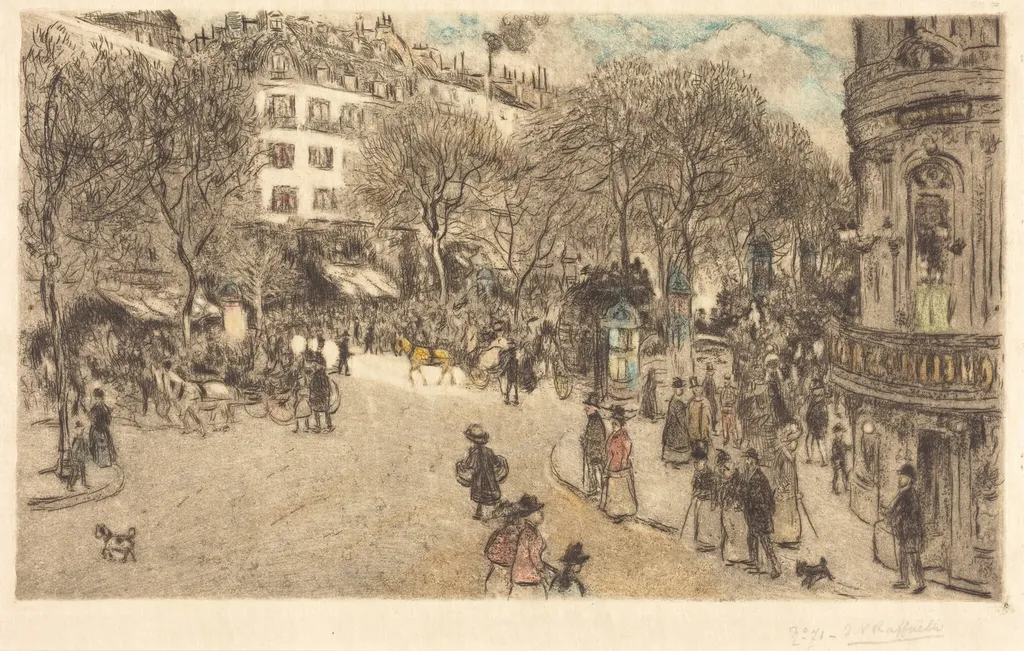
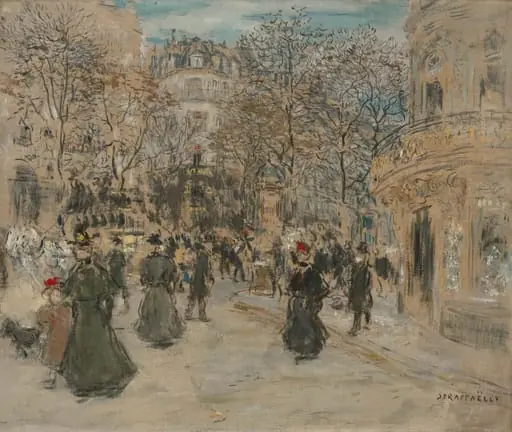
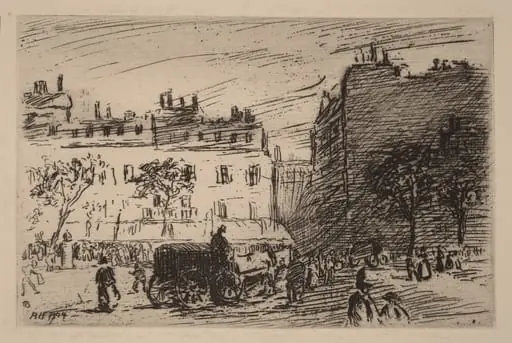
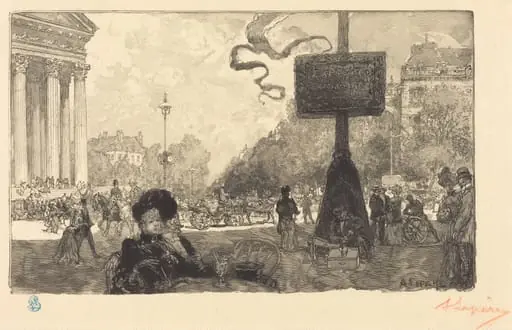
Le Boulevard des Italiens is an ink print by Jean François Raffaëlli. It dates from 1908 and is held in the collection of the National Gallery of Art.
About this work
Overview
Raffaëlli, known for his focus on everyday cityscapes, personally printed this work, applying ink to a metal plate he had incised by hand.
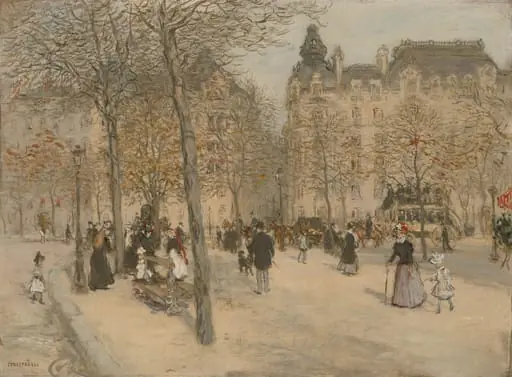
Le Boulevard des Italiens is a color etching produced by Jean-François Raffaëlli in 1908, capturing a bustling Parisian thoroughfare. Though dated to the early 20th century, the scene reflects the urban life of the late 1800s. Raffaëlli, known for his focus on everyday cityscapes, personally printed this work, applying ink to a metal plate he had incised by hand. The result is a textured, atmospheric rendering of public space.
Subject & Meaning
The print portrays pedestrians in formal attire moving past shopfronts, a horse-drawn cart, and the architectural rhythm of the boulevard. Raffaëlli’s choice of subject emphasizes the anonymity and motion of urban life. The absence of focal figures suggests a broader commentary on modernity—individuals absorbed in routine, framed by commerce and transit rather than narrative.
Technique & Style
Raffaëlli employed etching, a process involving acid-bitten lines on a metal plate, then added color through selective inking. The composition relies on stark contrasts: deep shadows cut by narrow beams of light, enhancing the gritty realism. His hand-scratched lines convey texture and movement, avoiding idealization. The tonal density and layered ink create a tactile, almost documentary quality.
History & Provenance
Raffaëlli lived near the Boulevard des Italiens and observed its daily rhythms for decades. He produced this print late in his career, after years of involvement with the Impressionist and Realist circles. Though not widely exhibited during his lifetime, the work reflects his sustained interest in recording Parisian life outside elite artistic circles. Its survival underscores his commitment to printmaking as a personal medium.
Context
In the late 19th century, Paris underwent rapid urban transformation. The Boulevard des Italiens, a hub of commerce and social exchange, became a symbol of modernity. Raffaëlli’s etching aligns with contemporaries like Degas and Daumier, who turned to urban scenes to explore shifting social dynamics. Unlike decorative prints, his work prioritizes observation over ornament, reflecting a quiet realism.
Legacy
Raffaëlli’s etchings, including this one, contributed to the recognition of printmaking as a vehicle for social observation. Though overshadowed by his painting contemporaries, his technical precision and unvarnished depictions influenced later realist printmakers. The work remains a quiet testament to the rhythms of everyday life in a transforming city, valued for its honesty rather than its spectacle.
Own this work as a print
Artist & collection