Artwork
Illustration
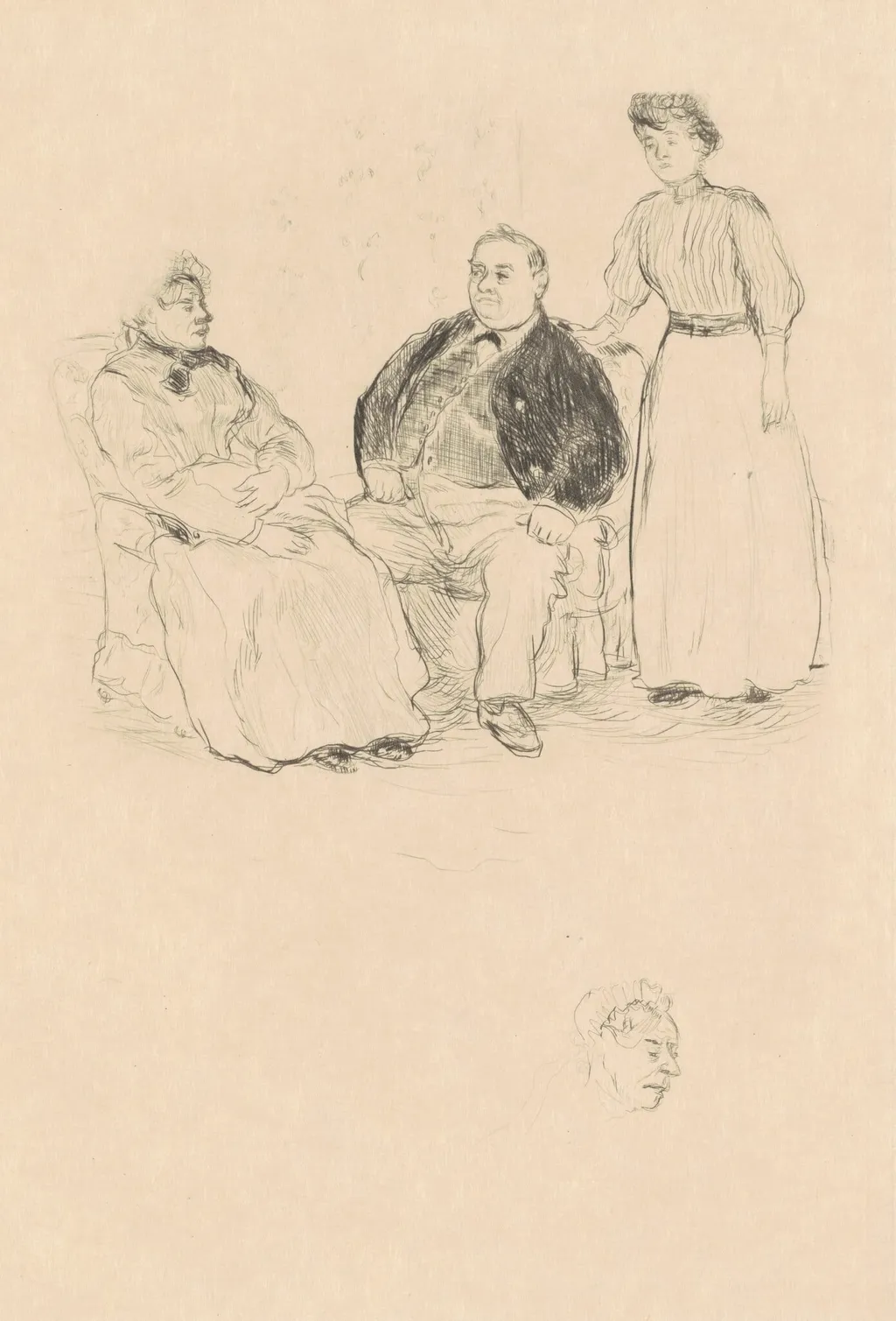
Illustration is an ink print by Pierre Auguste Raffaëlli. It dates from 1909 and is held in the collection of the National Gallery of Art.
About this work
Overview
Created in 1909, this etching by Pierre Auguste Raffaëlli is part of the National Gallery of Art’s collection in Washington, D.C. As a print made through the etching process, it captures a quiet domestic moment with minimal detail and a spontaneous feel. The work reflects Raffaëlli’s interest in everyday life, rendered not as a polished scene but as an intimate, fleeting observation.
Subject & Meaning
Their arrangement suggests familiarity, perhaps familial or domestic, but no narrative is explicitly stated.
The scene depicts three figures in a modest interior: a seated man in formal attire, a woman to his left holding a fan, and another woman standing behind him with a hand on his shoulder. Their arrangement suggests familiarity, perhaps familial or domestic, but no narrative is explicitly stated. The lack of context invites quiet contemplation rather than storytelling, emphasizing presence over action.
Technique & Style
Raffaëlli employed etching to achieve a loose, sketchlike quality, with thin, irregular lines that resemble pencil strokes. The surface is lightly worked, avoiding heavy ink or dense crosshatching. This restrained technique gives the image a sense of immediacy, as if captured in a single moment. The unfinished appearance aligns with late 19th-century interests in spontaneity and the artist’s hand.
History & Provenance
The etching was produced in 1909, near the end of Raffaëlli’s career, and entered the National Gallery of Art’s collection through established acquisition channels. While not widely exhibited, it remains part of the museum’s holdings of prints that document the transition from academic to modern approaches in graphic art during the early 20th century.
Context
Raffaëlli worked during a period when artists increasingly turned to informal subjects and experimental techniques. Etching, once used for detailed reproduction, was revived by contemporaries as a medium for personal expression. This work aligns with broader trends in European printmaking that valued immediacy and emotional resonance over technical finish.
Legacy
Though not among Raffaëlli’s most famous works, this etching exemplifies his consistent focus on ordinary life and his skill in adapting traditional print methods to convey psychological subtlety. It contributes to the understanding of how printmakers in the early 20th century redefined the boundaries of the medium through simplicity and restraint.
Artist & collection

 Gossiping Women
 Untitled
 Lebaudy Trial - Testimony of Mlle. Marsy (Procès Lebaudy - Déposition de Mlle. Marsy)
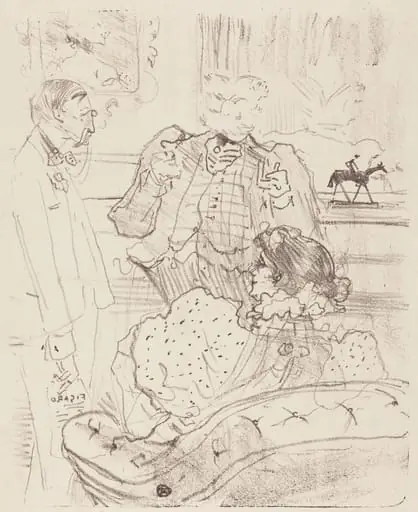 The Forfeit (La gage)
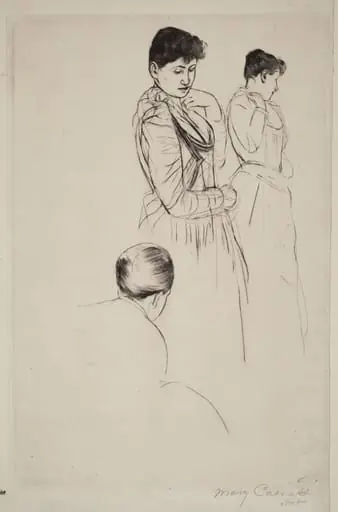 The Fitting
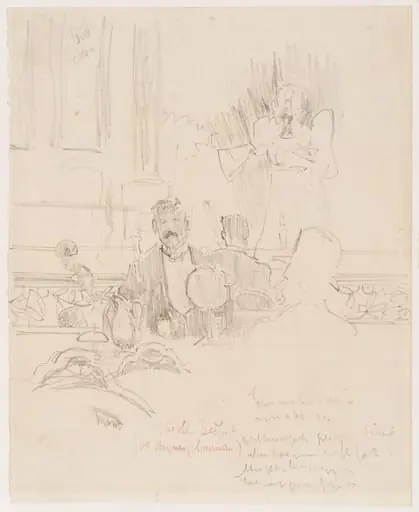 The Old Bedford
![The Margrave, the Prince[ss] and the Hermit (from Sketchbook), by James McNeill Whistler](https://artifactworldgallery.com/img/james-mcneill-whistler--the-margrave-the-prince-ss-and-the-hermit-from-sketchbook--bcfa9fb65ff50451-w320.webp) The Margrave, the Prince[ss] and the Hermit (from Sketchbook)
The Margrave, the Prince[ss] and the Hermit (from Sketchbook)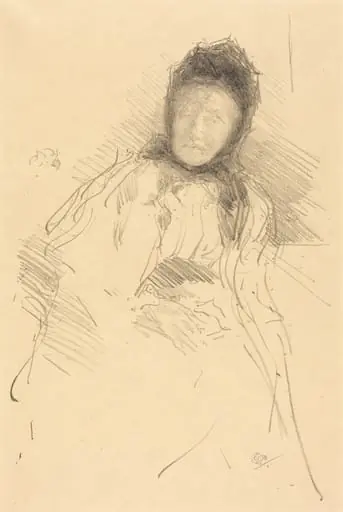 Unfinished Sketch of Lady Haden
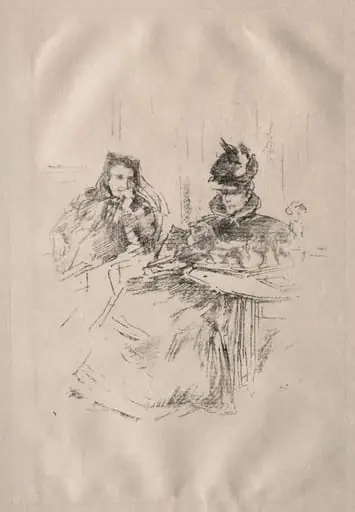 Afternoon Tea, Mrs. Phillips and Mrs. Charles Whibley
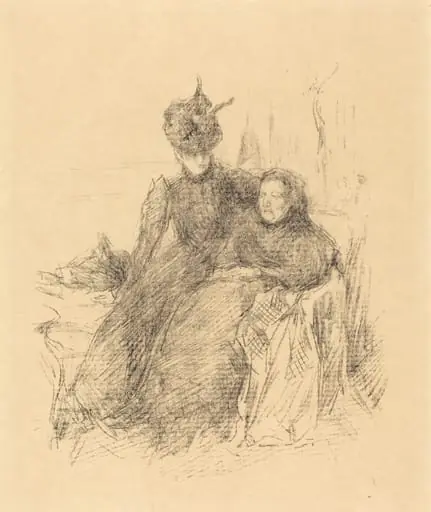 Mother and Daughter
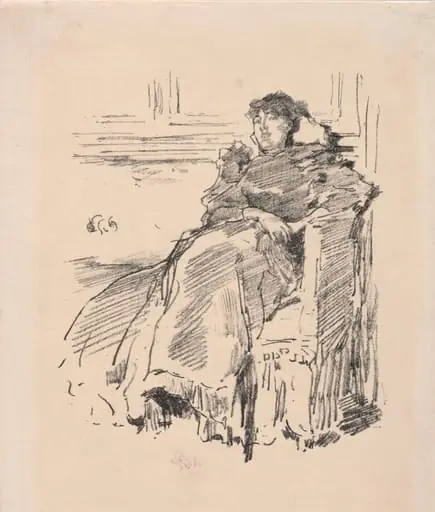 La Robe Rouge
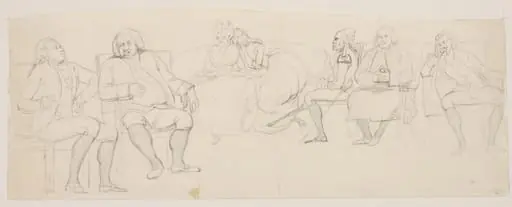 Interior of a drawing room