Artwork
Topographical Map of Modern Rome
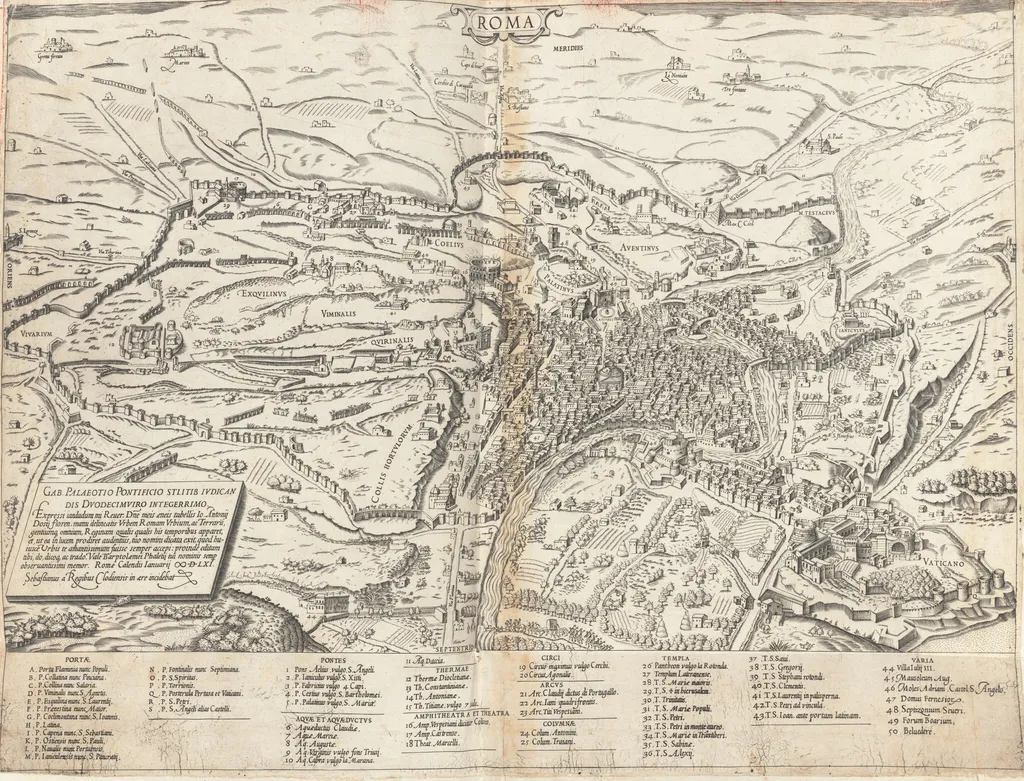
Topographical Map of Modern Rome is an ink print by the Renaissance artist Sebastiano di Re. It dates from 1561 and is held in the collection of the National Gallery of Art.
About this work
Overview
Sebastiano di Re’s 1561 engraving, titled Topographical Map of Modern Rome, presents a panoramic, bird’s‑eye depiction of the city. The print captures the urban layout with winding streets, the meandering Tiber River, and recognizable landmarks such as the Colosseum and the dome of the Pantheon, populated by diminutive figures that suggest everyday activity.
Subject & Meaning
The work functions as a visual survey of Rome during the mid‑sixteenth century, emphasizing the coexistence of contemporary life with the remnants of antiquity. By placing tiny pedestrians near the ancient amphitheater, the engraving highlights the continuity of the city’s habitation while foregrounding its historic monuments as focal points within the modern fabric.
Technique & Style
Executed in fine engraving, the image relies on precise line work and dense cross‑hatching to render depth and shadow. The sharp, intersecting strokes delineate architectural forms and the river’s surface, while the meticulous linear perspective creates a sense of spatial order across the sprawling urban scene.
History & Provenance
Created shortly after the renewed scholarly interest in Rome’s classical ruins, this print is among the earliest detailed cartographic representations of the city. It reflects the period’s burgeoning desire to document and study the urban environment, and it now resides in the museum’s print collection, catalogued under the artist’s name, Sebastiano di Re.
Context
The engraving emerges at a time when Renaissance humanists were re‑examining ancient sources and mapping the city’s topography for both scholarly and practical purposes. Its detailed layout complements contemporary textual descriptions, offering a visual counterpart to the growing body of antiquarian literature that sought to reconcile Rome’s past with its present urban reality.
Artist & collection


![The Siege of La Rochelle [plate 6 of 16; set comprises 1952.8.97-112], by Jacques Callot](https://artifactworldgallery.com/img/jacques-callot--the-siege-of-la-rochelle-plate-6-of-16-set-comprises-1952-8--87e690454dc011ee-w320.webp) The Siege of La Rochelle [plate 6 of 16; set comprises 1952.8.97-112]
The Siege of La Rochelle [plate 6 of 16; set comprises 1952.8.97-112]![The Siege of Breda [plate 3 of 6], by Jacques Callot](https://artifactworldgallery.com/img/jacques-callot--the-siege-of-breda-plate-3-of-6--c43bd4a835426ed7-w320.webp) The Siege of Breda [plate 3 of 6]
The Siege of Breda [plate 3 of 6]![The Siege of La Rochelle [plate 7 of 16; set comprises 1952.8.97-112], by Jacques Callot](https://artifactworldgallery.com/img/jacques-callot--the-siege-of-la-rochelle-plate-7-of-16-set-comprises-1952-8--ed3ab4aaddd2281d-w320.webp) The Siege of La Rochelle [plate 7 of 16; set comprises 1952.8.97-112]
The Siege of La Rochelle [plate 7 of 16; set comprises 1952.8.97-112]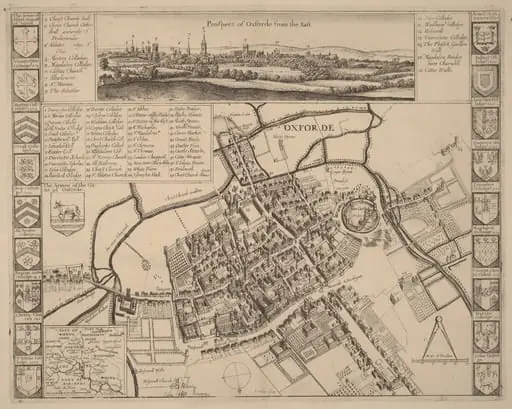 Prospect of Oxford
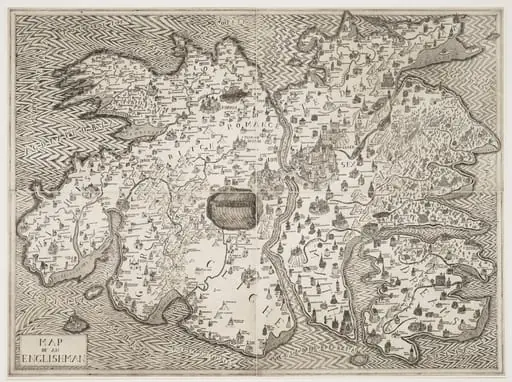 Untitled
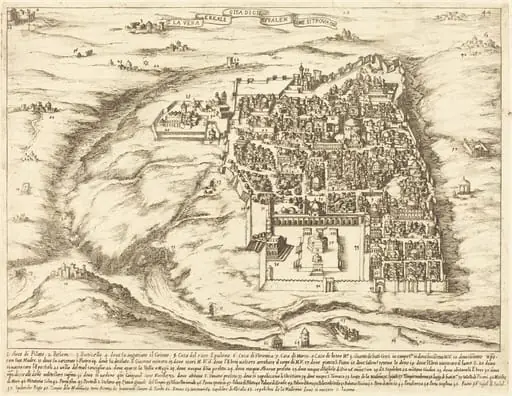 Aerial View of the City of Jerusalem
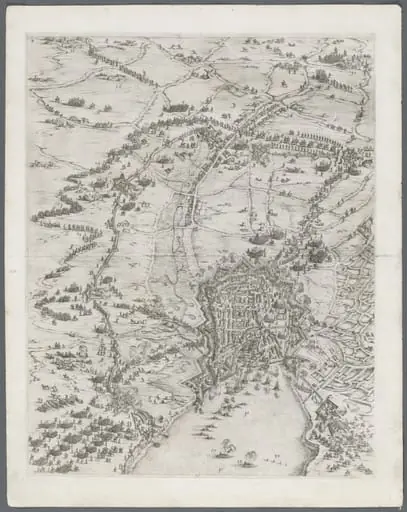 The Siege of La Rochelle: Plate 6
![Septem Urbis Ecclesiae [Seven Churches of Rome], by Giacomo Lauro](https://artifactworldgallery.com/img/giacomo-lauro--septem-urbis-ecclesiae-seven-churches-of-rome--12b958a6c59681c6-w320.webp) Septem Urbis Ecclesiae [Seven Churches of Rome]
Septem Urbis Ecclesiae [Seven Churches of Rome]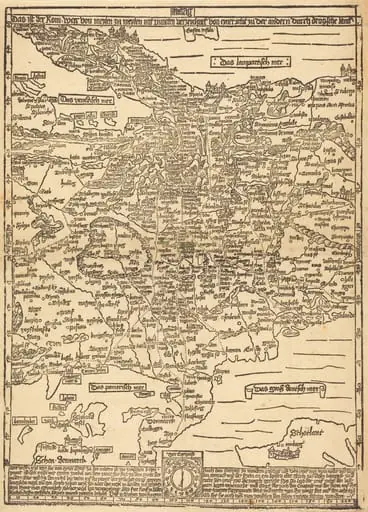 Road Map of Central Europe
![The Siege of Breda [plate 4 of 6], by Jacques Callot](https://artifactworldgallery.com/img/jacques-callot--the-siege-of-breda-plate-4-of-6--3e777c648194dcba-w320.webp) The Siege of Breda [plate 4 of 6]
The Siege of Breda [plate 4 of 6]![View of Venice [upper left block], by Jacopo de' Barbari](https://artifactworldgallery.com/img/jacopo-de-barbari--view-of-venice-upper-left-block--5b60543442b987bc-w320.webp) View of Venice [upper left block]
View of Venice [upper left block]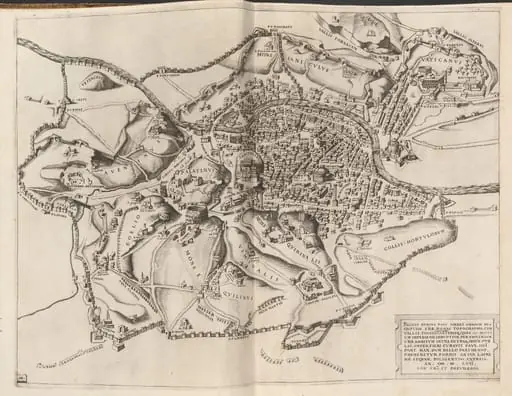 Topographical Map of Ancient Rome