Artwork
Aerial View of the City of Jerusalem
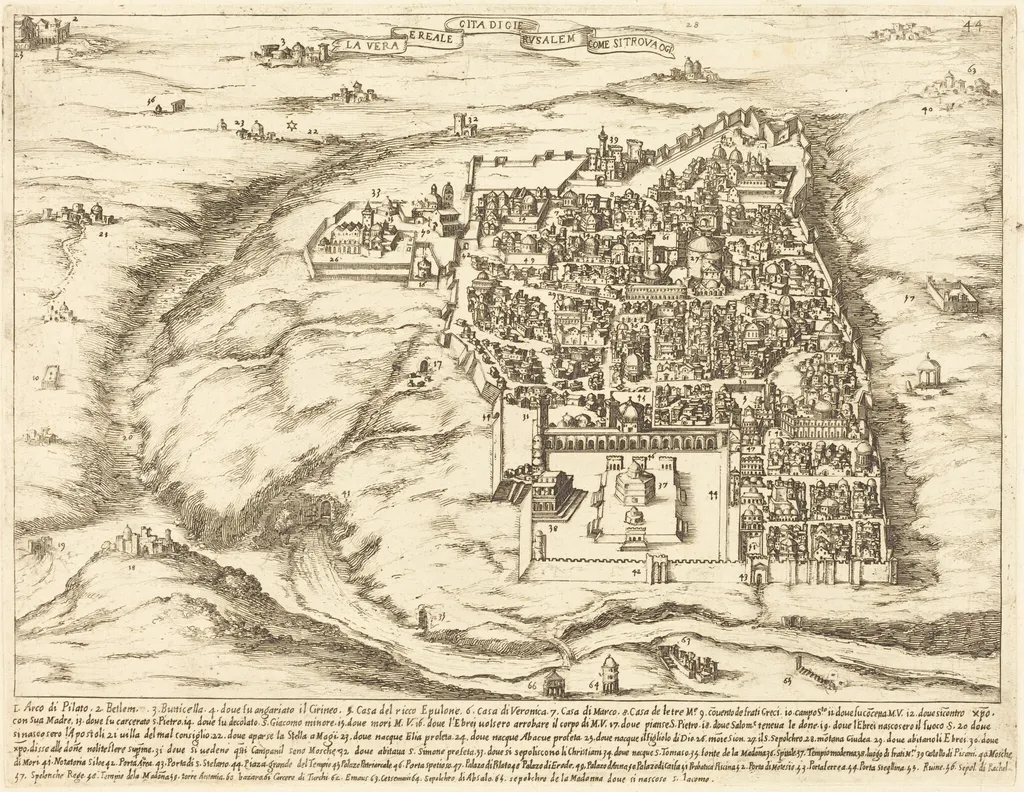
Aerial View of the City of Jerusalem is an ink print by the Baroque artist Jacques Callot. It dates from 1619 and is held in the collection of the National Gallery of Art. Created in 1619, this print presents an elevated perspective of Jerusalem, rendered as a compact, densely built city set on uneven ground.
About this work
Overview
Created in 1619, this print presents an elevated perspective of Jerusalem, rendered as a compact, densely built city set on uneven ground.
Created in 1619, this print presents an elevated perspective of Jerusalem, rendered as a compact, densely built city set on uneven ground. The composition combines tightly grouped structures, defensive walls, towers, and a meandering river, all annotated with the names of gates and temples in a precise script along the lower margin. The image functions both as a visual record and a schematic representation of the urban layout.
Subject & Meaning
The work offers a top‑down survey of Jerusalem, emphasizing the organization of its streets, fortifications, and religious sites. By depicting the city as a mapped tableau, the artist highlights the interplay between sacred architecture and civic infrastructure, suggesting an interest in the spatial order of a historically significant metropolis.
Technique & Style
Executed through a combination of etching and engraving on laid paper, the image relies on fine lines to convey depth, texture, and architectural detail. The etching process allowed for delicate tonal variations, while engraving added crisp outlines, together producing a map‑like quality that balances illustrative precision with the baroque penchant for intricate surface treatment.
History & Provenance
The print originates from the workshop of Jacques Callot, a prolific French printmaker active in the early seventeenth century. Known for a corpus exceeding 1,400 prints, Callot’s output includes military scenes, courtly life, and landscapes. This particular aerial view is a restrike, indicating it was produced from an existing plate after the initial issue, a common practice to meet continued demand.
Context
During the baroque period, European artists increasingly explored topographical and documentary subjects, reflecting a broader curiosity about distant lands and historical sites. Callot’s depiction of Jerusalem aligns with this trend, offering a European interpretation of a city revered in religious tradition, while also showcasing the technical capabilities of printmaking as a means of disseminating detailed visual information.
Artist & collection
Artist
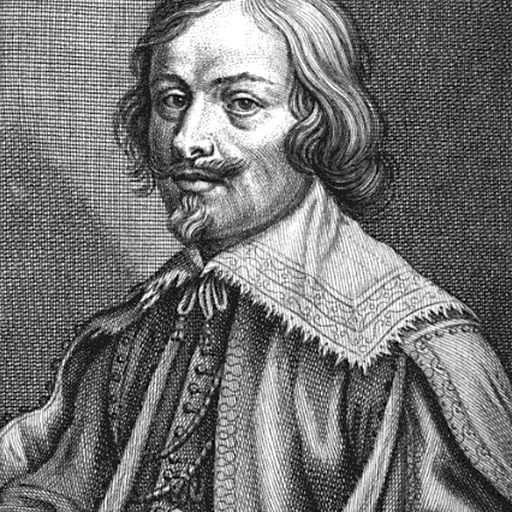
Jacques Callot was a baroque printmaker and draftsman from the Duchy of Lorraine.

 Holy Family at supper
 Restoration of the Aqueduct at Pisa
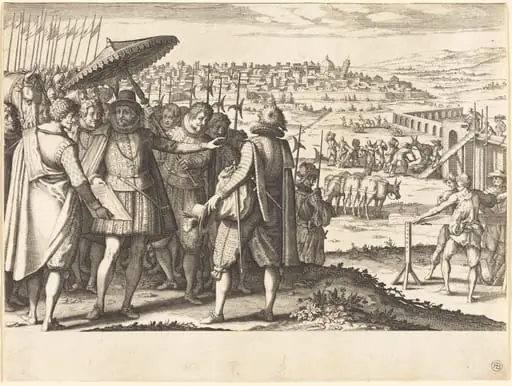 Restoration of the Aqueduct at Pisa
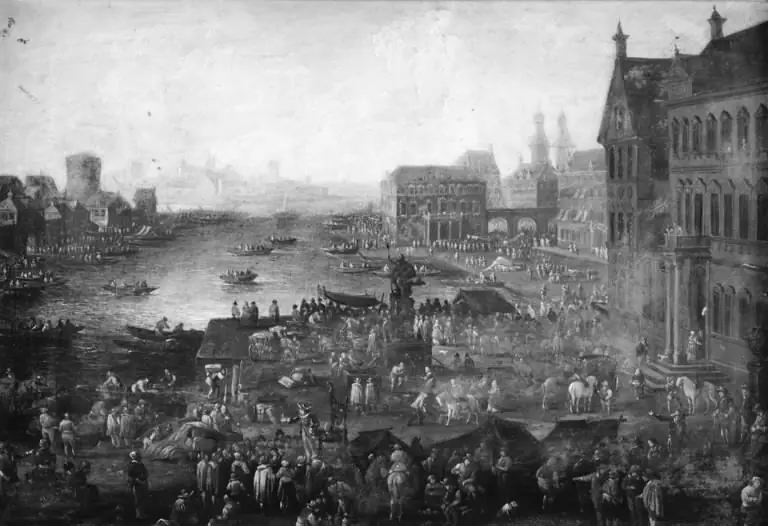 Square in Paris with Many Figures
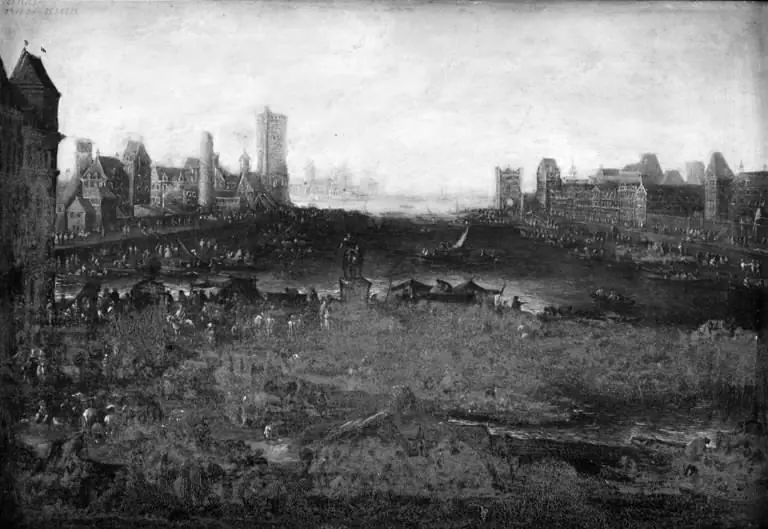 Square in Paris with Many Figures
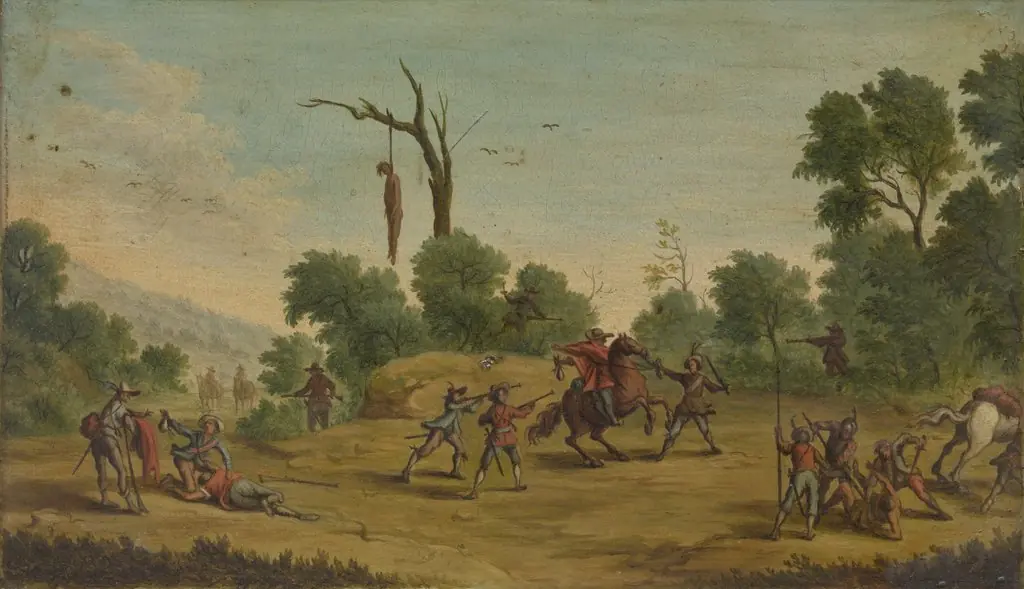 Horsemen Attacked by Robbers
 HOW WILL A COVERED PART BE CORRECTED?HOW WIKA A COVERED HEART DEED CORRECTED?
![Christ Walking on the Water [second plate], by Jacques Callot](https://artifactworldgallery.com/img/jacques-callot--christ-walking-on-the-water-second-plate--2069f3bfe4cb2126-w320.webp) Christ Walking on the Water [second plate]
Christ Walking on the Water [second plate]
![View of Nuremberg from the East [left section], by Hanns Lautensack](https://artifactworldgallery.com/img/hanns-lautensack--view-of-nuremberg-from-the-east-left-section--53a897f84943df87-w320.webp) View of Nuremberg from the East [left section]
View of Nuremberg from the East [left section] Topographical Map of Ancient Rome
![Foro Romano from "Prospectus Locurum Urbis Romae Insign[ium]", by Lievin Cruyl](https://artifactworldgallery.com/img/lievin-cruyl--foro-romano-from-prospectus-locurum-urbis-romae-insign-ium--30ee5e2aeedd53b6-w320.webp) Foro Romano from "Prospectus Locurum Urbis Romae Insign[ium]"
Foro Romano from "Prospectus Locurum Urbis Romae Insign[ium]" Four Parts of the Via Dolorosa
![View of Nuremberg from the East [center section], by Hanns Lautensack](https://artifactworldgallery.com/img/hanns-lautensack--view-of-nuremberg-from-the-east-center-section--7aaed3dd23c167ee-w320.webp) View of Nuremberg from the East [center section]
View of Nuremberg from the East [center section] Veuë de temple de Soleil à Rome (View of the Sun Temple in Rome)
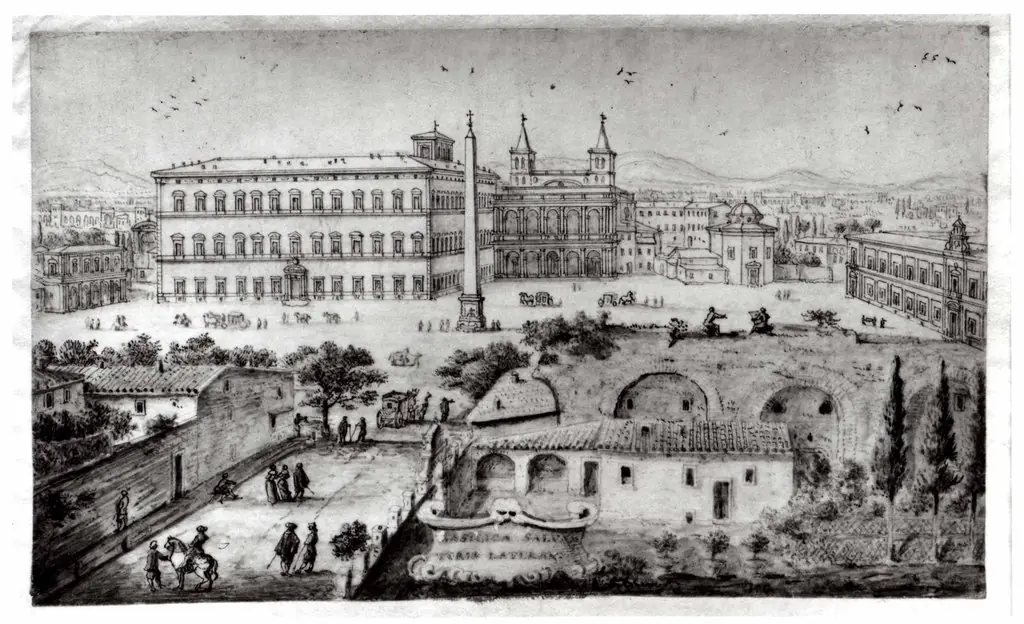 View of Lateran, Rome
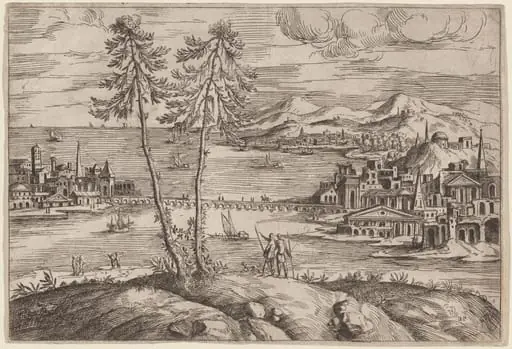 Landscape with Two Trees
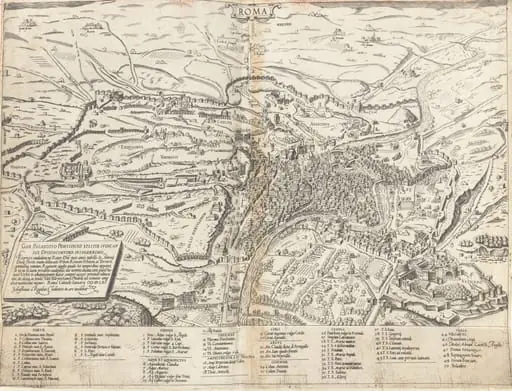 Topographical Map of Modern Rome
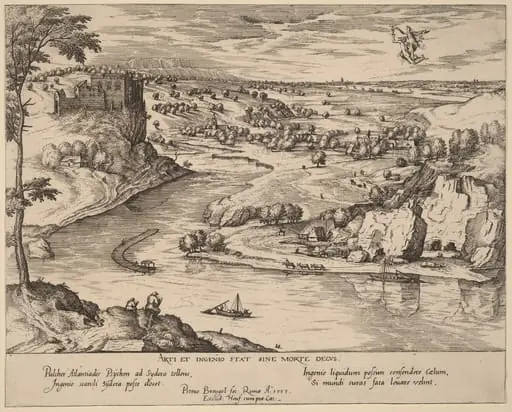 River Landscape with Mercury and Psyche
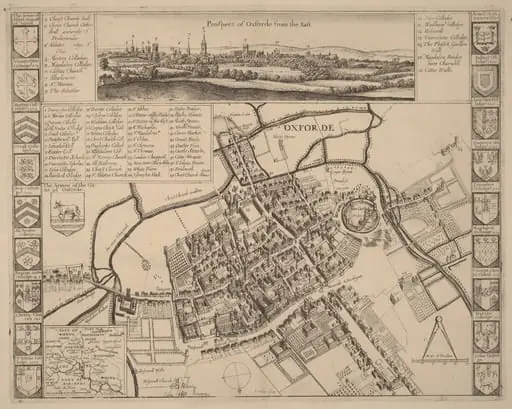 Prospect of Oxford
![The Siege of Breda [plate 3 of 6], by Jacques Callot](https://artifactworldgallery.com/img/jacques-callot--the-siege-of-breda-plate-3-of-6--c43bd4a835426ed7-w320.webp) The Siege of Breda [plate 3 of 6]
The Siege of Breda [plate 3 of 6]