Artwork
Dancing Dervishes of Constantinople
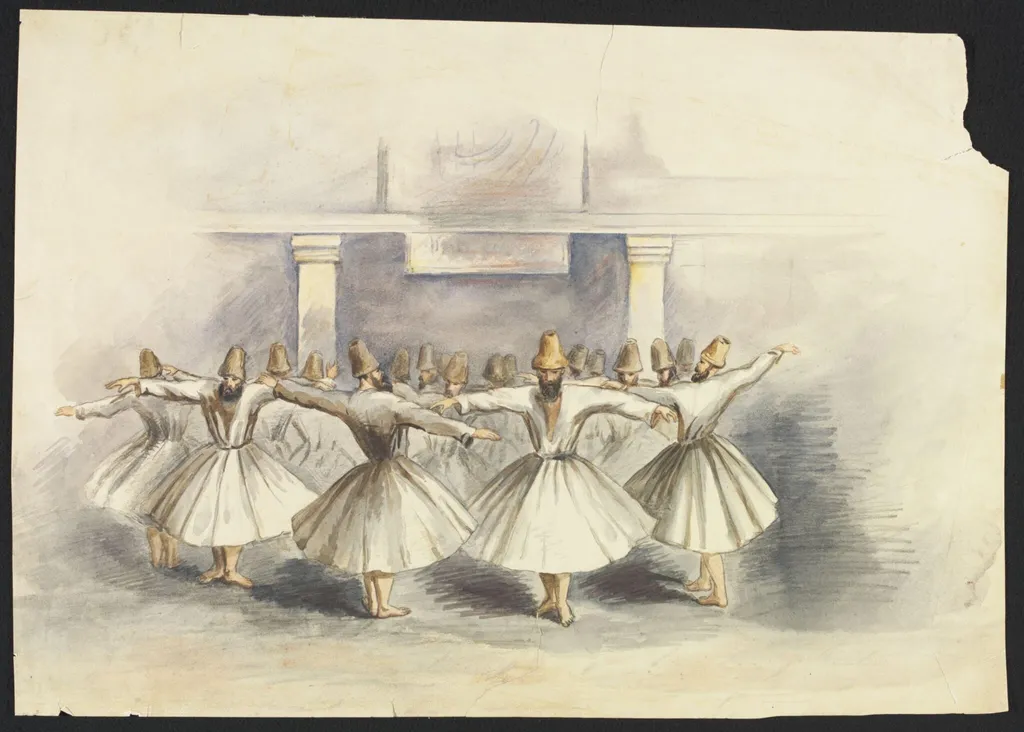
Dancing Dervishes of Constantinople is a watercolor work on paper by the Impressionist artist Samuel Read. It dates from 1854 and is held in the collection of the Victoria and Albert Museum.
About this work
Overview
Executed as a preparatory study for an engraving in the Illustrated London News, it reflects a Western observer’s documentation of Ottoman religious practice.
This watercolour captures a ritual performance by the Mevlevi dervishes in Constantinople, recorded by Samuel Read in 1853. Executed as a preparatory study for an engraving in the Illustrated London News, it reflects a Western observer’s documentation of Ottoman religious practice. The work entered a collection in 1966 after passing through private hands, preserving a moment of cross-cultural visual exchange during the mid-nineteenth century.
Subject & Meaning
The painting portrays the sema, the spiritual dance of the Mevlevi Sufi order, in which participants whirl in precise, meditative motion to achieve mystical union. Dervishes in white robes and conical hats symbolize the tomb and shroud, their arms extended to connect earth and heaven. The composition isolates the ritual from its surroundings, emphasizing inward focus and the transcendence sought through repetitive movement.
Technique & Style
Read employed delicate watercolour washes to suggest the swirling motion of the dervishes’ garments, using soft, layered brushwork to convey texture and flow. The muted background recedes, directing attention to the figures’ dynamic poses. Subtle tonal variations and loose contours avoid sharp definition, enhancing the sense of motion and spiritual abstraction without overt realism.
History & Provenance
The watercolour was made from a sketch Read produced during his visit to Constantinople in 1853, intended for reproduction in the Illustrated London News. After its publication, the original remained in private custody until acquired by a collector in May 1966 from N. Vilag. Its journey reflects the 19th-century European interest in documenting Eastern rituals through direct observation and print media.
Context
In the mid-1800s, Western travelers and illustrators increasingly recorded Ottoman customs as part of broader ethnographic curiosity. The Mevlevi ceremony, though longstanding, was rarely depicted with such immediacy. Read’s work emerged amid rising European fascination with Sufi practices, often filtered through exoticizing lenses, yet here rendered with restrained observation rather than theatricality.
Legacy
Though not widely exhibited, the painting stands as a primary visual record of a ritual that would later be suppressed in Turkey in the 1920s. Its survival offers insight into how such practices were perceived and transmitted visually before modern photography. It remains a quiet testament to cross-cultural documentation during a period of imperial and religious transition.
Artist & collection

Artist
Samuel Read was an English illustrator who provided many illustrations for the Illustrated London News.