Artwork
Landscape with a Cottage and Hay Barn: Oblong
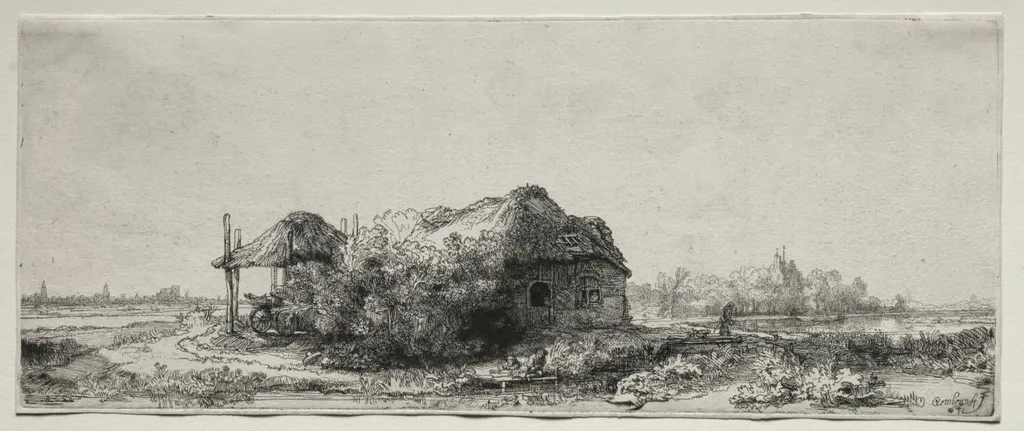
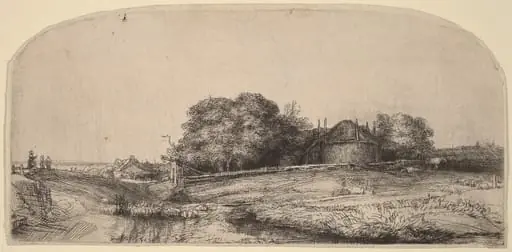
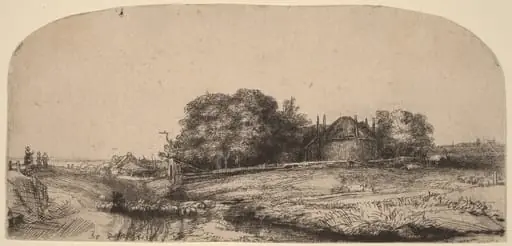
Landscape with a Cottage and Hay Barn: Oblong is a print by the Baroque artist Rembrandt. It dates from 1641 and is held in the collection of the Cleveland Museum of Art.
About this work
Overview
Landscape with a Cottage and Hay Barn: Oblong is a 1641 etching by Rembrandt van Rijn, part of his series of landscape prints. Executed in ink on paper, it measures horizontally to emphasize the breadth of the rural scene. The work is held in the collection of The Cleveland Museum of Art and reflects Rembrandt’s deep engagement with natural environments during his later years in Amsterdam.
Subject & Meaning
The scene depicts a quiet Dutch countryside with a modest cottage and a hay barn nestled among trees. No human figures are present, yet the structures suggest domestic life and agricultural routine. The composition conveys stillness and solitude, inviting contemplation rather than narrative. The setting evokes a sense of enduring rural existence, grounded in the rhythms of nature and labor.
Technique & Style
The sky is rendered with loose, sweeping marks, while the buildings and trees are built from denser, more deliberate lines.
Rembrandt employed etching with burin and drypoint to achieve rich tonal variation. He layered fine lines and textured strokes to model forms, using chiaroscuro to define volume and atmosphere. The sky is rendered with loose, sweeping marks, while the buildings and trees are built from denser, more deliberate lines. This interplay of precision and spontaneity gives the print its tactile immediacy and emotional resonance.
History & Provenance
Created in 1641, the print was made during Rembrandt’s most prolific period in printmaking. It entered The Cleveland Museum of Art’s collection in the 20th century through established acquisition channels. Its preservation in good condition reflects careful handling over centuries, and it has been exhibited in multiple scholarly surveys of Dutch graphic art.
Context
In the 1640s, Rembrandt turned increasingly to landscape subjects, moving beyond biblical and portrait themes. These works responded to a growing market for intimate, non-narrative scenes among Dutch collectors. His landscapes, though less publicized than his portraits, reveal a personal meditation on place, light, and the quiet dignity of the rural world.
Legacy
This print exemplifies Rembrandt’s influence on the evolution of landscape as a subject in printmaking. Later artists studied his handling of light and texture, adapting his expressive line work. While not widely reproduced in his lifetime, the work now stands as a quiet testament to his ability to convey depth and mood with minimal means.
Artist & collection
Artist
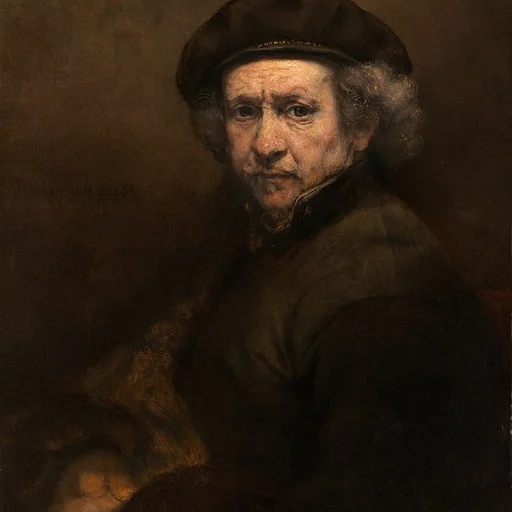
Rembrandt Harmenszoon van Rijn (15 July 1606 – 4 October 1669), known mononymously as Rembrandt, was a Dutch Golden Age painter, printmaker, and draughtsman.