Artwork
Untitled
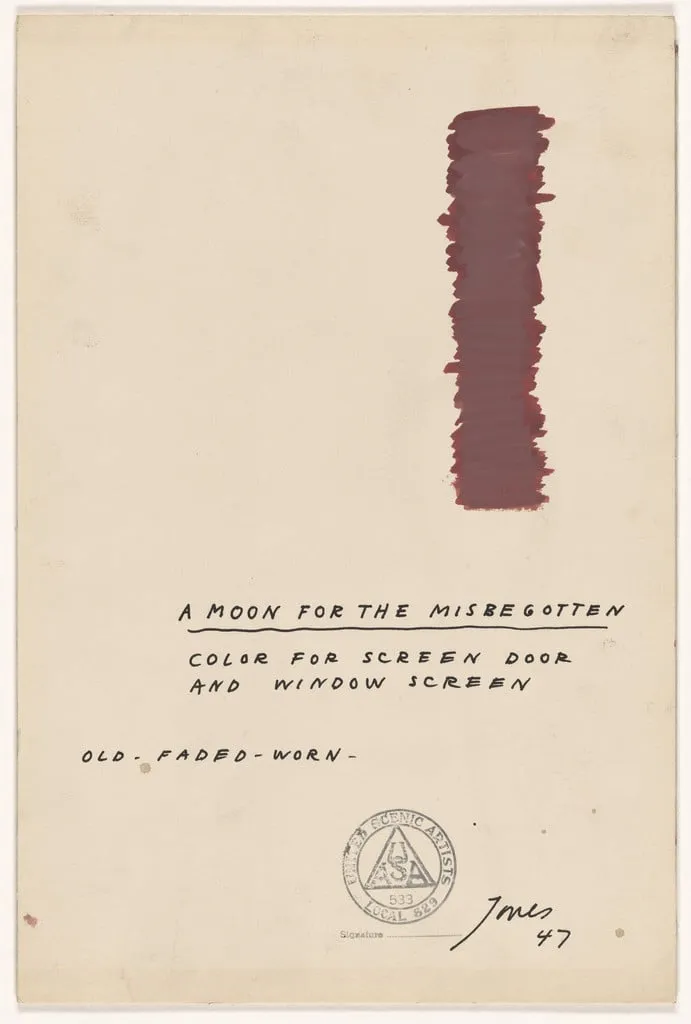
Untitled is a gouache drawing by Robert Edmond Jones. It dates from 1947 and is held in the collection of the Museum of Modern Art.
About this work
You see two rectangles—one red, one green—floating on a pale blue background. Thin black lines sketch a window frame and a screen door.
This is a set design for a 1947 play. The colors are flat, like stage lights, not realistic. Jones used gouache, a thick, opaque watercolor, to make the hues pop under theater lamps.
Look up the technique: gouache.
Overview
Created in 1947, this drawing by Robert Edmond Jones is a set design executed in gouache and felt-tip pen on paperboard. It was made for a theatrical production and is now part of The Museum of Modern Art’s collection. The composition features two flat, saturated rectangles—red and green—floating against a pale blue ground, suggesting architectural elements rather than naturalistic space.
Subject & Meaning
The image depicts a simplified interior space, likely a room with a window and screen door, rendered through minimal linear cues. The absence of detail and the use of bold color blocks imply a symbolic or atmospheric function rather than literal representation. It conveys mood and spatial suggestion suited to stage lighting, prioritizing emotional tone over realism.
Technique & Style
Jones employed gouache for its opaque, matte quality, allowing vibrant hues to remain intense under stage lights without glare. Felt-tip pen added crisp, thin outlines to define structural elements like window frames. The flat, unmodulated colors and lack of shading reflect a design aesthetic rooted in modernist abstraction, aligned with mid-century theatrical conventions.
History & Provenance
The work was produced as a preparatory design for a 1947 stage production, though the specific play remains unconfirmed. It entered The Museum of Modern Art’s collection as part of its broader effort to document design as an art form. Its preservation reflects institutional recognition of theatrical design as a legitimate medium of visual expression.
Context
In the postwar era, American theater embraced minimalist and expressionistic set designs, moving away from literalism. Jones, a leading figure in this shift, used color and form to evoke psychological environments. This drawing aligns with contemporaneous trends in design that favored suggestion over detail, emphasizing the actor’s presence and the audience’s imagination.
Legacy
The work stands as an example of how stage design was elevated from technical craft to visual art in the 20th century. Jones’s approach influenced subsequent generations of designers who prioritized emotional resonance through abstraction. Its presence in MoMA underscores the institutional validation of theatrical design within modern art discourse.
Artist & collection

Artist
Robert Edmond Jones was an American scenic, lighting, and costume designer.