Artwork
Untitled
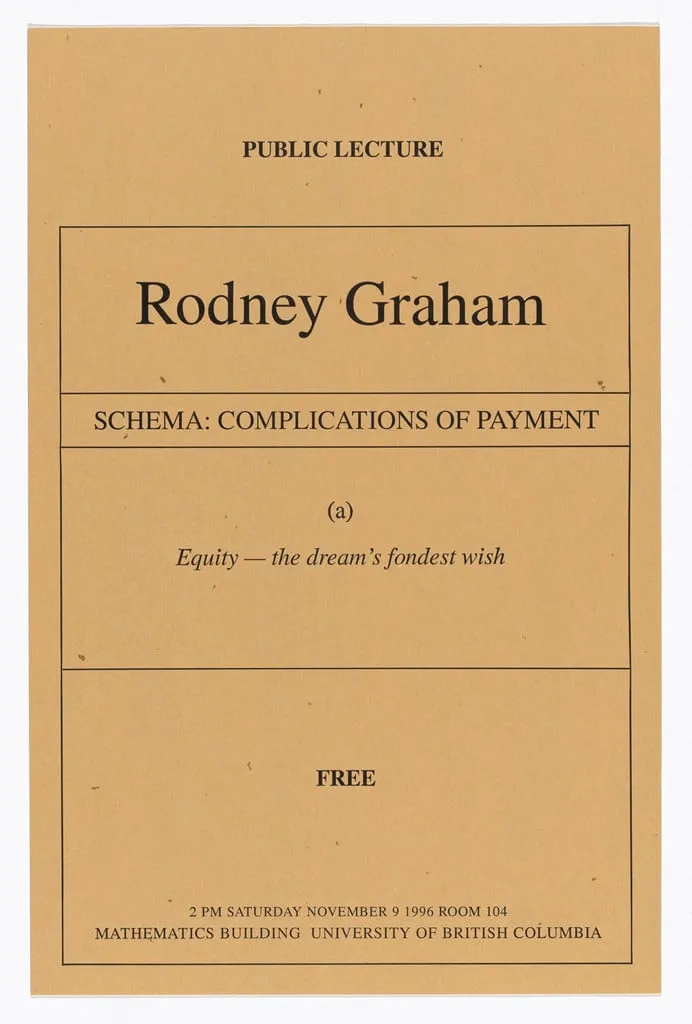
Untitled is a print by Rodney Graham. It dates from 1996 and is held in the collection of the Museum of Modern Art.
About this work
"* There’s a date, time, and location at the bottom: *2 PM Saturday, November 9, 1996, Room 104, Mathematics Building, University of British Columbia.
This is a simple beige poster with black text. It looks like a flyer for a free public lecture. The title reads *"Rodney Graham: SCHEMA: COMPLICATIONS OF PAYMENT (a) Equity – the dream’s fondest wish."* There’s a date, time, and location at the bottom: *2 PM Saturday, November 9, 1996, Room 104, Mathematics Building, University of British Columbia.*
The poster’s clean, typed design makes it feel like an official announcement. The phrase *"Equity – the dream’s fondest wish"* hints at a deeper idea, maybe about fairness or money.
If you like this kind of conceptual art, check out Rodney Graham.
Overview
Created in 1996, this set of twelve letterpress posters by Canadian artist Rodney Graham presents a single, repeated announcement formatted like a public lecture flyer. Each poster shares identical text and layout, using minimal typographic elements on a beige background. The work belongs to Graham’s broader exploration of institutional language and the aesthetics of information dissemination, blurring boundaries between art, academia, and everyday printed matter.
Subject & Meaning
The posters advertise a fictional lecture titled 'SCHEMA: COMPLICATIONS OF PAYMENT (a) Equity – the dream’s fondest wish,' referencing abstract economic concepts through dry, bureaucratic phrasing. The phrase suggests a critique of idealized notions of fairness, framing equity as an elusive aspiration. By presenting this as a real event at UBC’s Mathematics Building, Graham undermines the authority of institutional discourse, inviting skepticism toward the systems that define value and justice.
Technique & Style
Graham employed standard letterpress printing to mimic the look of institutional announcements, using clean, sans-serif typography and restrained layout. The absence of imagery or decorative elements reinforces the work’s impersonal, functional appearance. This deliberate austerity contrasts with the conceptual weight of the text, emphasizing how meaning is constructed through form and context rather than visual spectacle.
History & Provenance
Produced in 1996, the set was created in conjunction with Graham’s exhibition activities in Vancouver, where he was a central figure in the local art scene. The referenced lecture—never held—was a fictional device, part of his strategy to disrupt expectations around art events. The posters circulated as both promotional material and autonomous artworks, later entering institutional collections as examples of conceptual print practice.
Context
Graham’s work emerged from the Vancouver School’s interest in language, media, and the reproduction of meaning. In the mid-1990s, artists in this circle frequently engaged with the aesthetics of bureaucracy, education, and mass communication. By appropriating the format of academic flyers, Graham aligned his practice with critiques of knowledge production, reflecting broader postmodern concerns about authority and representation in cultural institutions.
Legacy
The posters remain a key example of Graham’s ability to transform mundane formats into vehicles for philosophical inquiry. Their quiet, unassuming design has influenced subsequent generations of artists working with institutional critique and text-based art. The work’s endurance lies in its capacity to appear ordinary while prompting questions about the structures that govern value, communication, and belief.
Artist & collection
Artist
William Rodney Graham (January 16, 1949 – October 22, 2022) was a Canadian visual artist and musician. He was closely associated with the Vancouver School.