Artwork
Bookplate: Ruthven Deane
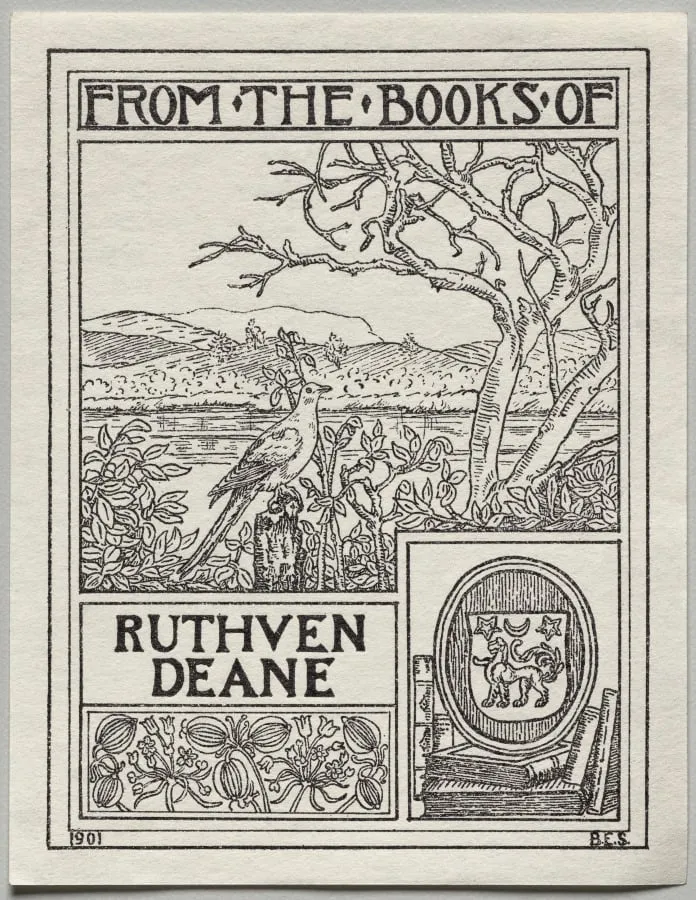
Bookplate: Ruthven Deane is a print by Unknown. It dates from 1901 and is held in the collection of the Cleveland Museum of Art. This modest print, dated 1901, functions as a bookplate bearing the name “Ruthven Deane” rendered in an elegant hand‑lettered script.
About this work
You see a small, neat drawing of a bookplate—a label for the inside cover of a book—with the name "Ruthven Deane" in elegant script.
You see a small, neat drawing of a bookplate—a label for the inside cover of a book—with the name "Ruthven Deane" in elegant script.
This tiny work was made in 1901, likely by an amateur or a jobbing artist. Bookplates were common then, a way to mark ownership, but most were mass-produced. This one feels personal, almost handmade. The artist’s name is lost to time, but the care in the lettering suggests someone took pride in it.
To see more quiet, everyday art like this, visit The Cleveland Museum of Art.
Overview
This modest print, dated 1901, functions as a bookplate bearing the name “Ruthven Deane” rendered in an elegant hand‑lettered script. Designed to be affixed to the inside cover of a volume, it exemplifies the small‑scale decorative objects that circulated among private libraries in the early twentieth century.
Subject & Meaning
The sole purpose of the piece is to signal ownership, a customary practice among book collectors of the period. The personalized lettering conveys a sense of pride and identity, turning a utilitarian label into a discreet statement of personal taste.
Technique & Style
Executed as a print, the design relies on clean, precise lines and a balanced composition typical of amateur bookplate work. The script, while not attributed to a known designer, displays careful hand‑drawing, suggesting a handcrafted approach rather than mass‑produced stamping.
History & Provenance
Created in 1901, the plate likely originated from a small workshop or an individual artist whose name has not survived. It entered the Cleveland Museum of Art’s collection as an example of everyday ephemera, illustrating the domestic visual culture of its era.
Context
During the turn of the century, bookplates were a popular means of marking private libraries, often produced by professional engravers or by hobbyists. This piece reflects the latter tradition, where personal involvement and modest production values were common.
Artist & collection

 Domestic Scene
 Giacomo and Cardinal Marco, investing Andrea, Abbot of San Zeno, with his Benefice
 The Nymph of Fontainebleau
 Portrait of a Woman
 Madonna and Child with Saints in the Enclosed Garden
 Venus and Minerva
 Family Group of Four on Sofa
 Wall painting from Room H of the Villa of P. Fannius Synistor at Boscoreale
 Design for a book-plate for Bernard Hughes
 Bookplate: Lillian Durham Jones, Ex Libris inscribed
 Young Woman Seated in a Garden
 Untitled
 Small Flowers of Saint Francis
 Paris Almanac, 1897: Decorative Border, Autumn
 Child, from On Death, Part I, Opus XI (Kind, Vom Tode, Erster Teil, Opus XI)
 The Lady and the Rooks
 Paris Almanac, 1897: Decorative Border, Winter