Artwork
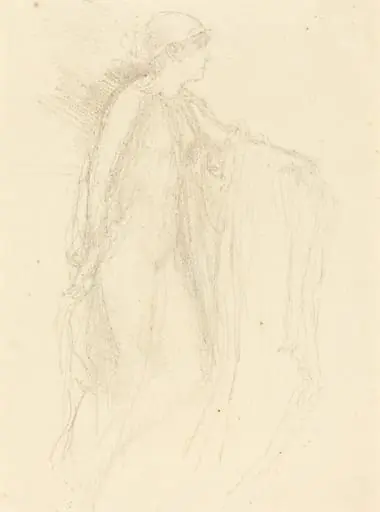
An Elegant Lady in Classical Dress [recto]
![An Elegant Lady in Classical Dress [recto], by George Romney, ink](https://artifactworldgallery.com/img/george-romney--an-elegant-lady-in-classical-dress-recto--c0f4e57cf0adb97c-w1024.webp)
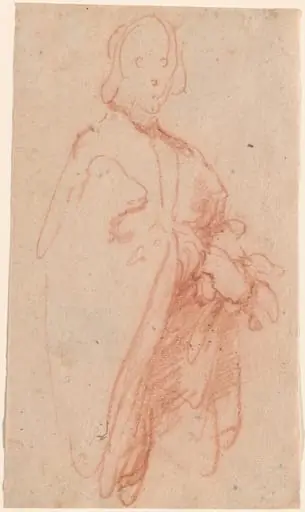
An Elegant Lady in Classical Dress [recto] is an ink drawing by the Romanticist artist George Romney. It is held in the collection of the National Gallery of Art.
About this work
Overview
The absence of detail in the face and setting shifts focus to the drapery and stance, suggesting an idealized rather than individualized subject.
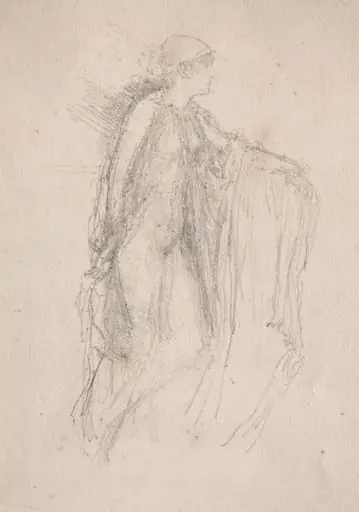
This ink drawing by George Romney, dated around 1784, depicts a woman in classical attire against a minimal background. Executed in pen and brown ink on laid paper, it is a study of form and posture rather than a finished portrait. The figure stands beside a column, her pose relaxed yet composed, with no facial features rendered. The absence of detail in the face and setting shifts focus to the drapery and stance, suggesting an idealized rather than individualized subject.
Subject & Meaning
The figure embodies a classical ideal, evoking ancient statuary through her draped robe and serene posture. The blank face removes personal identity, inviting interpretation as a symbol of virtue, contemplation, or muse-like presence. The column, a reference to architectural antiquity, anchors her in a timeless realm. The work does not narrate a specific story but rather suggests a quiet, introspective state, aligning with 18th-century interests in classical antiquity as a moral and aesthetic model.
Technique & Style
Romney employs fluid, economical pen strokes to define the contours of the robe and the column, relying on line weight and subtle shading to suggest volume. The paper’s texture subtly interacts with the ink, enhancing the softness of the fabric. Background elements are reduced to minimal linear suggestions, emphasizing the figure’s isolation. The style prioritizes grace and rhythm over anatomical precision, reflecting a preference for expressive form over detailed realism.
History & Provenance
Created during Romney’s active period in London, this drawing likely served as a preparatory study for larger works or as an independent exercise in classical idealization. It remained in private collections after the artist’s death, with no public exhibition record until the 20th century. Its survival as a single sheet, unattached to a larger composition, suggests it was valued for its aesthetic qualities rather than its function in a commissioned project.
Context
In the 1780s, British artists increasingly turned to classical themes as a response to Enlightenment ideals and archaeological discoveries in Italy. Romney, though primarily a portraitist, engaged with these motifs to explore timeless beauty. This drawing reflects a broader trend among artists to use classical dress and posture as vehicles for emotional and intellectual expression, distinct from the rigid formalism of earlier neoclassical works.
Legacy
Though not widely reproduced, this drawing exemplifies Romney’s ability to infuse portraiture with classical resonance. It influenced later 19th-century artists interested in the interplay between figure and abstraction. Its restrained technique and emphasis on mood over narrative contributed to evolving definitions of the sketch as a legitimate artistic expression, separate from finished paintings.
Artist & collection


![Statue of a Roman Woman (Female Deity?) Seen from the Side [verso], by Hubert Robert](https://artifactworldgallery.com/img/hubert-robert--statue-of-a-roman-woman-female-deity-seen-from-the-side-vers--4bf9208a795411cc-w320.webp)
![Woman in Toga [verso], by Hubert Robert](https://artifactworldgallery.com/img/hubert-robert--woman-in-toga-verso--1c4b04982206f60e-w320.webp)
![Man on a Horse [verso], by Jean Honoré Fragonard](https://artifactworldgallery.com/img/jean-honore-fragonard--man-on-a-horse-verso--7bf78fe7013dcb54-w320.webp)
![Figure Studies [verso], by George Romney](https://artifactworldgallery.com/img/george-romney--figure-studies-verso--19708132818b32a0-w320.webp)