Artwork
Soldier Seated
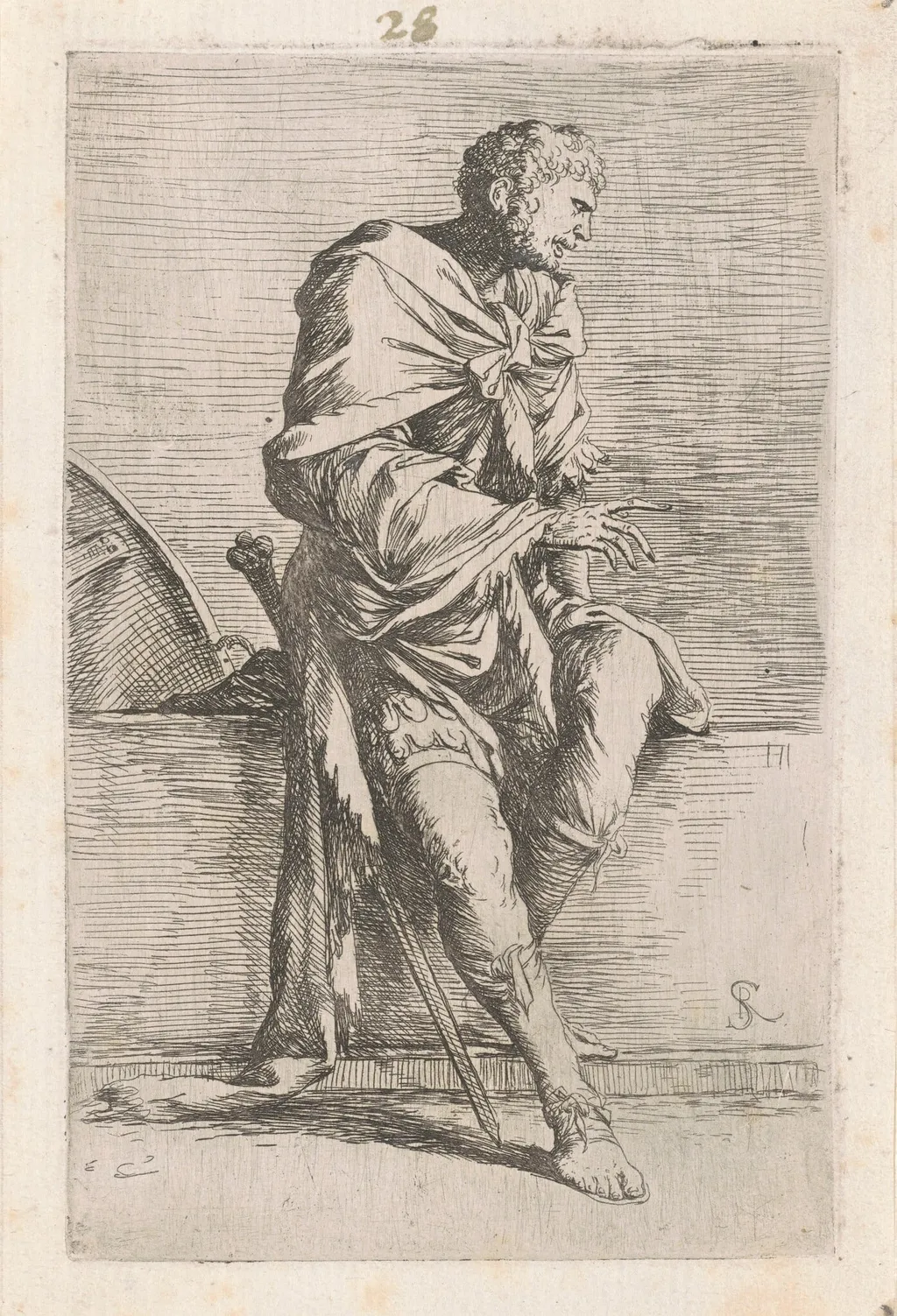
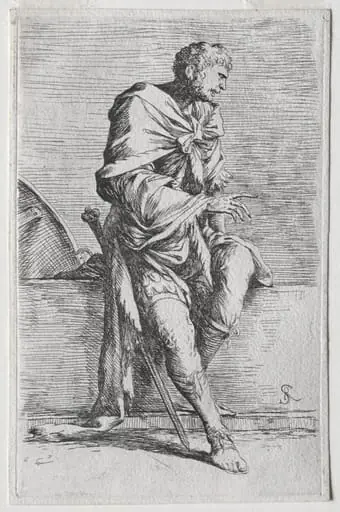
Soldier Seated is an ink print by the Baroque artist Salvator Rosa. It dates from 1644 and is held in the collection of the National Gallery of Art.
About this work
Overview
Created in 1644, *Soldier Seated* is an etching by Salvator Rosa, an Italian artist active across Naples, Rome, and Florence.
Created in 1644, *Soldier Seated* is an etching by Salvator Rosa, an Italian artist active across Naples, Rome, and Florence. Though best known for his turbulent landscapes and historical scenes, Rosa also produced a significant body of prints. This work exemplifies his engagement with printmaking as a distinct medium, separate from his painted output, and reflects his broader intellectual and artistic pursuits during the mid-seventeenth century.
Subject & Meaning
The figure is a solitary soldier, barefoot and clad in a long robe fastened with a bow, seated with a sword in hand and gaze lowered. His posture and expression convey quiet introspection rather than action. The absence of context or setting isolates him, suggesting inner turmoil or contemplation after conflict. The image avoids heroism or narrative, instead emphasizing psychological stillness, aligning with Rosa’s interest in human vulnerability and existential themes.
Technique & Style
Rosa employed etching to render fine linear detail and tonal variation, using controlled acid bites to create soft shadows and crisp contours. The plain background focuses attention on the figure’s form and demeanor. His handling of the plate emphasizes texture in fabric and the weight of the sword, while the sparse composition reflects a deliberate restraint, contrasting with the dramatic intensity of his larger paintings.
History & Provenance
The etching was produced during Rosa’s most active period as a printmaker, when he circulated his works among collectors and fellow artists. While specific early ownership records are sparse, the piece aligns with other prints from his 1640s output, many of which were distributed independently of his paintings. Its survival in institutional collections attests to its recognition among connoisseurs of printmaking in the centuries following its creation.
Context
In mid-17th-century Italy, printmaking was increasingly valued as a vehicle for personal expression beyond commercial reproduction. Rosa, known for his sharp intellect and contentious relationships with patrons, used etching to explore themes of solitude and melancholy outside the constraints of commissioned painting. His prints often reflected his literary and philosophical interests, positioning him as an artist who blurred boundaries between disciplines.
Legacy
Rosa’s etchings, including *Soldier Seated*, influenced later generations of artists drawn to expressive line and psychological depth. Though less celebrated than his paintings, his prints contributed to the elevation of etching as a serious artistic medium in Europe. His ability to convey complex emotion through minimal means helped shape the development of Romantic and even modern sensibilities in graphic art.
Artist & collection
Artist
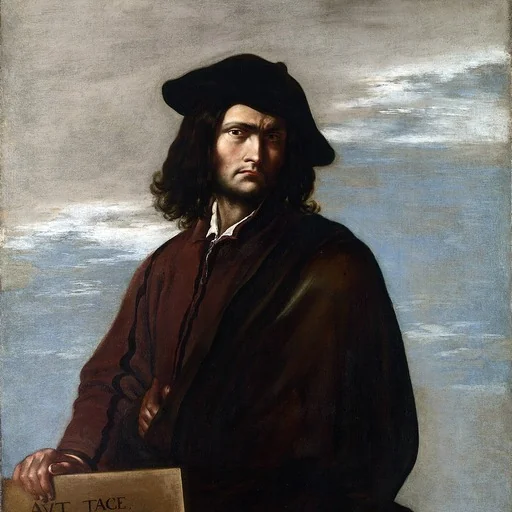
Salvator Rosa (1615 – 15 March 1673) is best known today as an Italian Baroque painter, whose romanticised landscapes and history paintings, often set in dark and untamed nature, exerted considerable influence from the 17th century into…

 The Figurine Series: Figurina
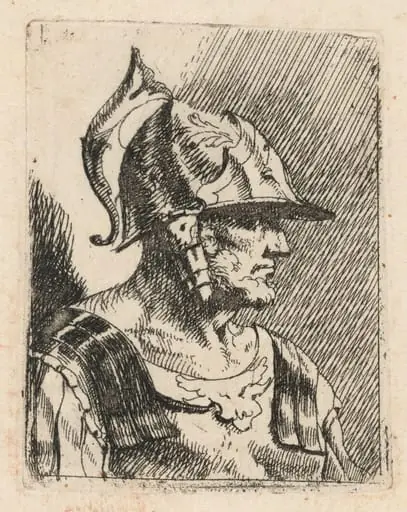 Bust of a Bearded Warrior
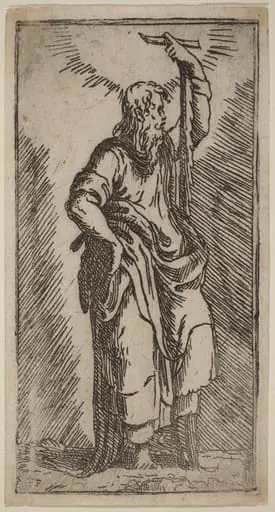 Saint Simon
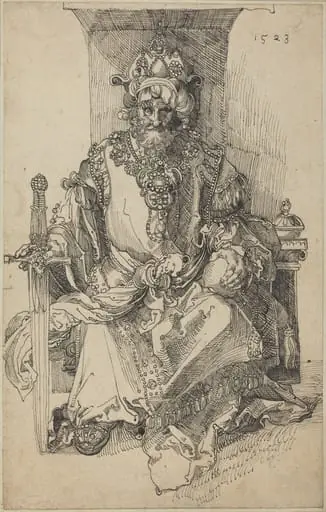 An Oriental Ruler Seated on His Throne
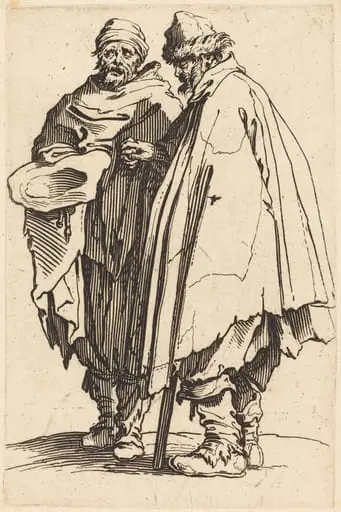 Blind Beggar and Companion
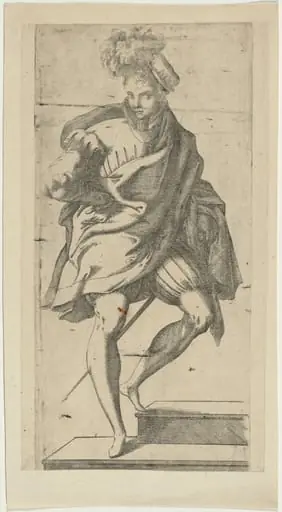 Francis II, King of France
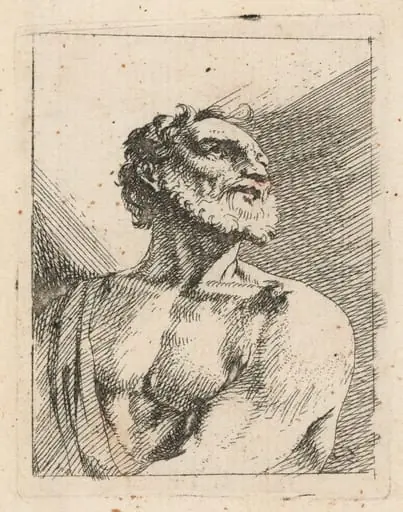 Bust of a Bearded Man
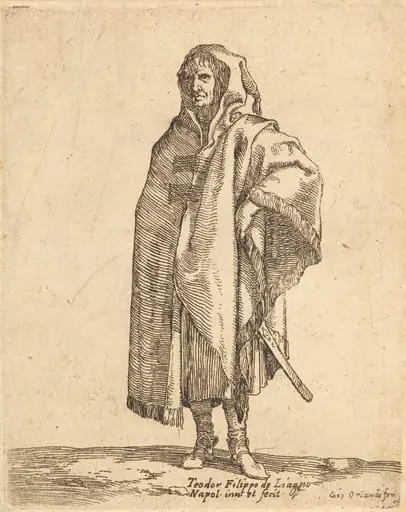 Standing Soldier in a Long Cloak
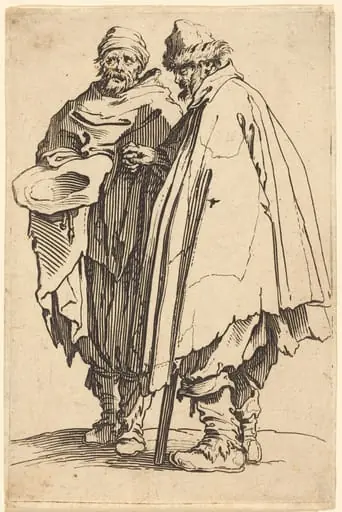 Blind Beggar and Companion
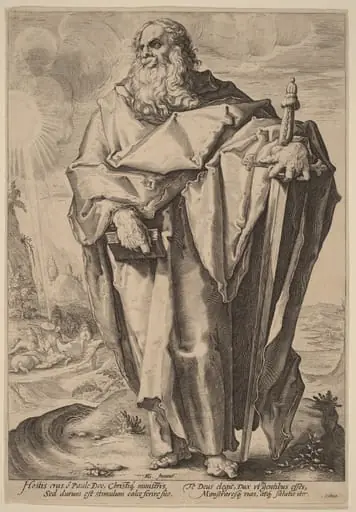 Saint Paul
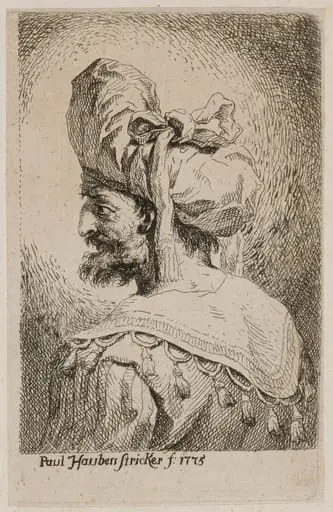 Oriental with a Soft Hat in Profile, Looking Left
![An Apostle, from Albert [sic] Durer, by James Henry Lynch](https://artifactworldgallery.com/img/james-henry-lynch--an-apostle-from-albert-sic-durer--8d1f7b246df4fa78-w320.webp) An Apostle, from Albert [sic] Durer
An Apostle, from Albert [sic] Durer