Artwork
A Sacrifice to Pan
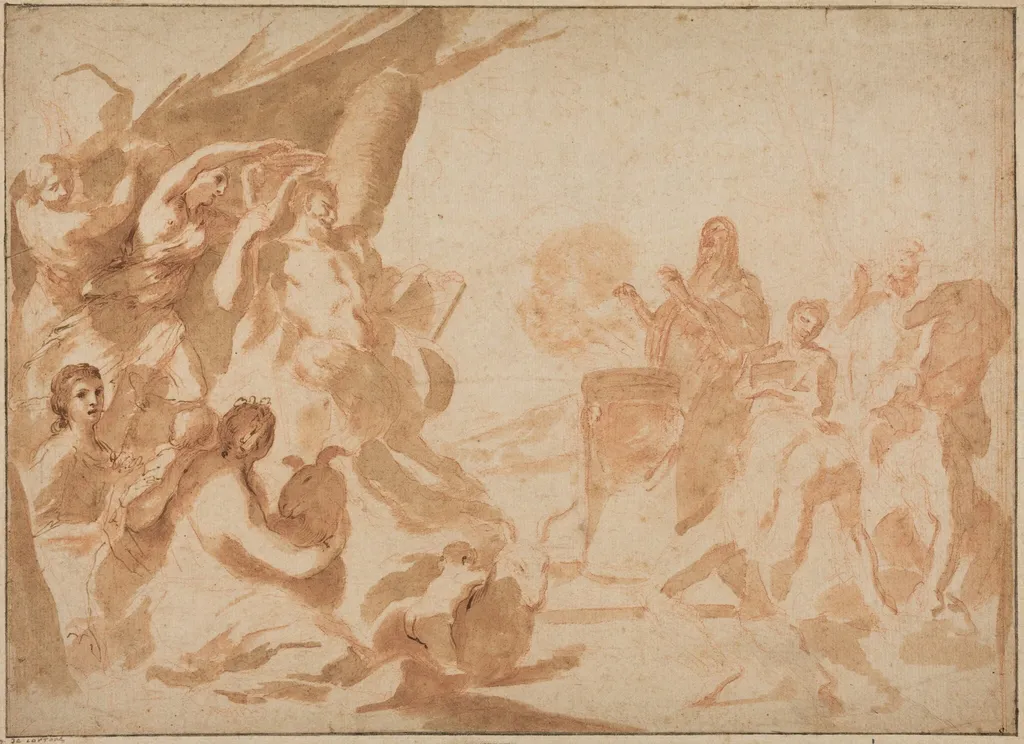
A Sacrifice to Pan is an ink drawing by the Baroque artist Andrea Sacchi. It dates from 1634 and is held in the collection of the National Gallery of Art.
About this work
Overview
Created around 1634, this drawing by Andrea Sacchi is executed in pen and brown ink with wash over red chalk on laid paper, later mounted on a support.
Created around 1634, this drawing by Andrea Sacchi is executed in pen and brown ink with wash over red chalk on laid paper, later mounted on a support. It belongs to a body of preparatory works made during Sacchi’s time in Rome, where he engaged deeply with classical themes and the emerging ideals of High Baroque Classicism. The medium allowed for both precision and expressive fluidity, suited to his explorations of mythological subjects.
Subject & Meaning
The scene portrays a ritual offering to Pan, the Greek god of the wild, fertility, and rustic music. A central female figure lies prone as a goat-legged deity looms above her, surrounded by a group of attendants in varied poses—some kneeling, others reaching or turning. The composition suggests a moment of sacred tension, blending reverence with primal energy, reflecting Baroque interests in emotional intensity and mythological narrative.
Technique & Style
Sacchi employed rapid, dynamic pen strokes and layered washes to convey motion and volume. The red chalk underdrawing guides the forms, while ink and wash create depth and atmospheric contrast. Figures overlap and twist in a compressed space, their limbs and drapery rendered with loose, almost urgent lines. The effect is one of visceral movement, balancing controlled draftsmanship with spontaneous energy.
History & Provenance
The drawing emerged from Sacchi’s circle in mid-17th century Rome, where he collaborated with artists like Nicolas Poussin and sculptors Alessandro Algardi and François Duquesnoy. Its survival as a standalone sheet suggests it was valued as a study or independent work, though its early ownership remains undocumented. It was later mounted on a support, a common practice to preserve fragile paper drawings.
Context
In Rome during the 1630s, artists sought to reconcile classical antiquity with contemporary emotional expression. Sacchi, aligned with the Carracci tradition, favored clarity and restraint over theatrical excess. This drawing reflects that tension: its mythological subject is rendered with a sense of physical immediacy, bridging idealized form and lived movement, distinct from the more rigid compositions of his contemporaries.
Legacy
Though less known than his finished paintings, this drawing exemplifies Sacchi’s skill in translating complex narratives into intimate, dynamic studies. It influenced later draftsmen interested in the expressive potential of ink and wash, particularly those exploring mythological themes with psychological nuance. Its preservation offers insight into the working methods of Roman Classicists during a pivotal moment in Baroque art.
Artist & collection
Artist
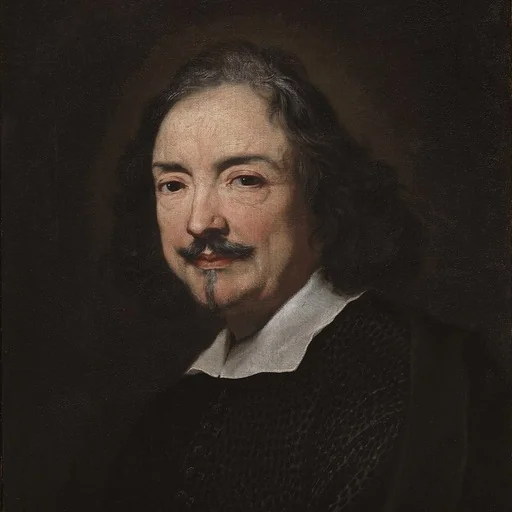
Andrea Sacchi (30 November 1599 – 21 June 1661) was an Italian painter of High Baroque Classicism, active in Rome.

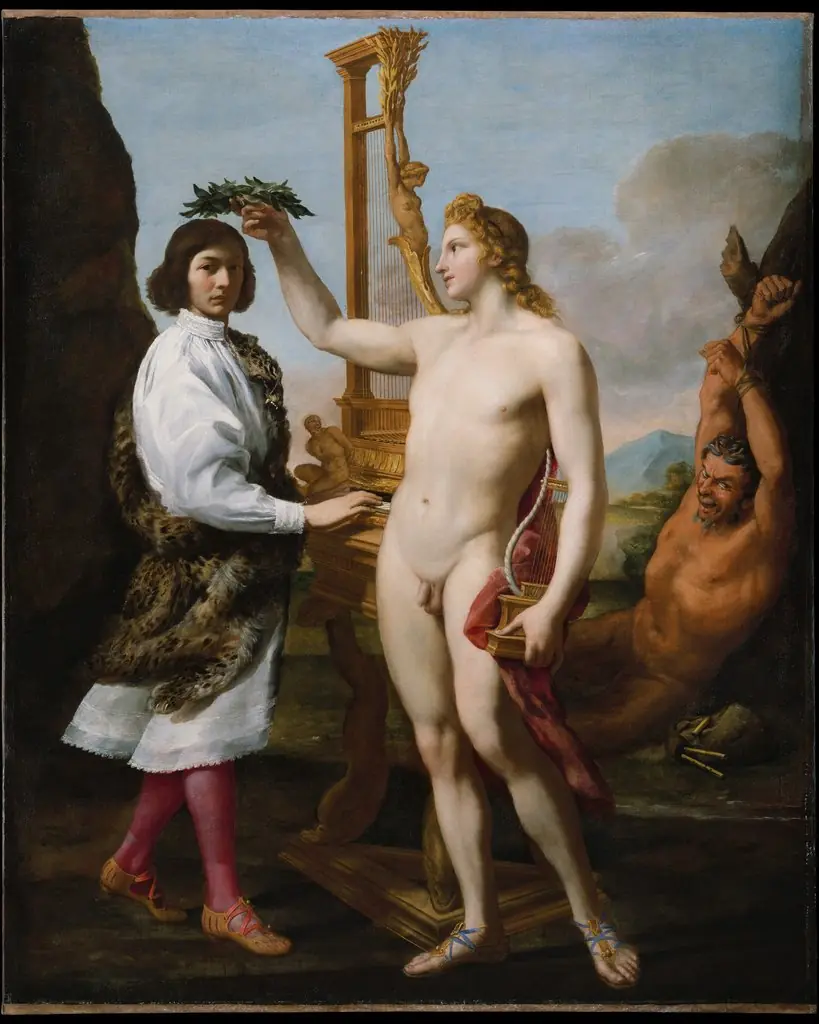
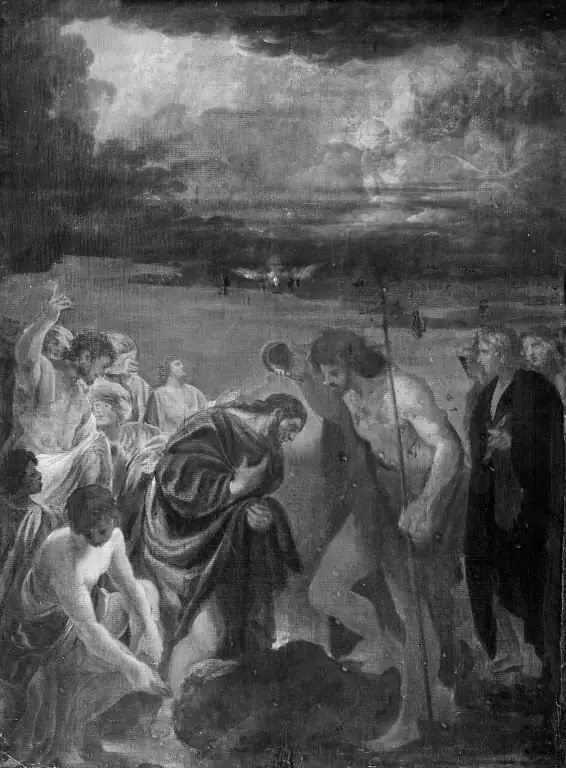
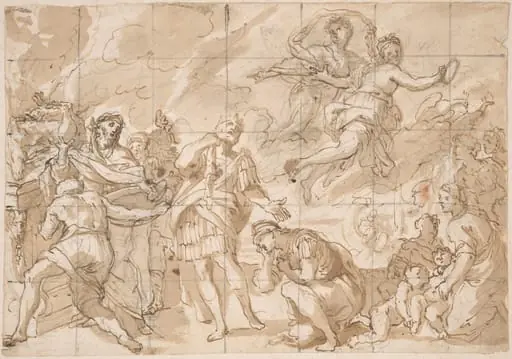 The Sacrifice of Iphigenia
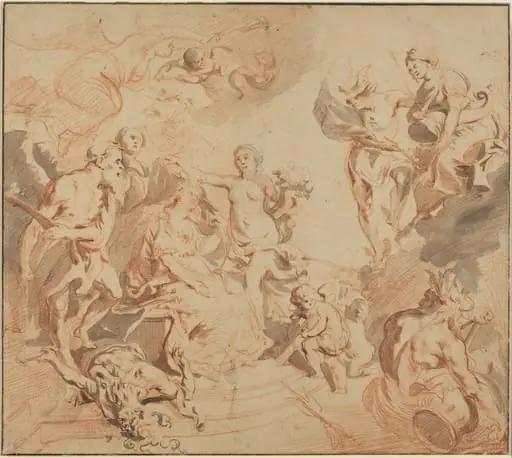 Antwerp Blessed with Abundance
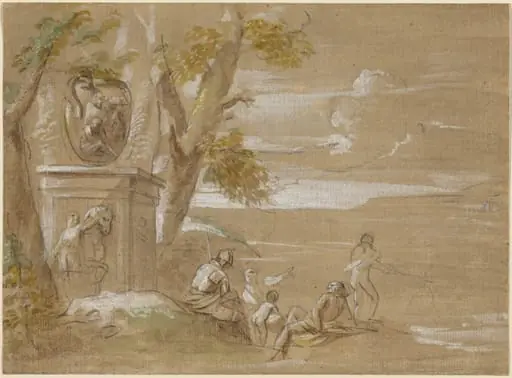 A Landscape with Seated Soldiers and Fishermen
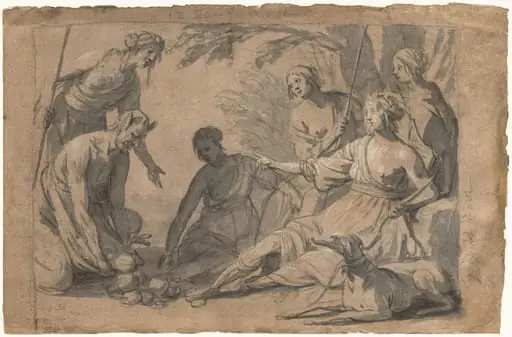 Diana and Four Nymphs Receiving Gifts from a Satyr
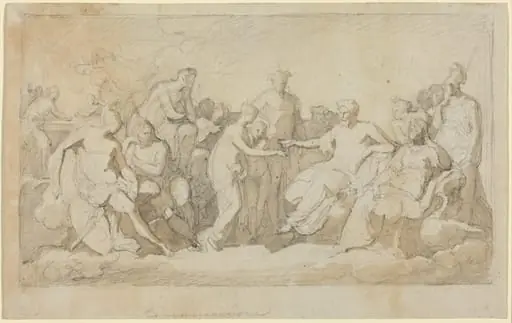 Psyche Received on Mount Olympus
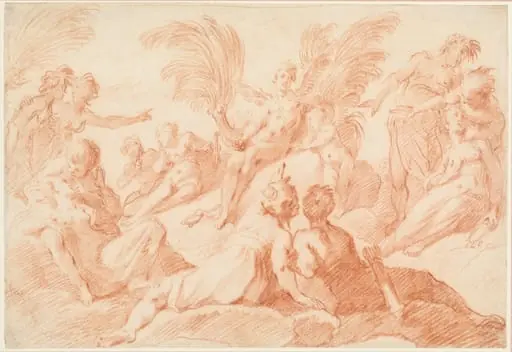 Harpocrates
 Design for an overdoor painting depicting Apollo, Pan and Midas
 Apollo and the Muses on Mount Parnassus
 The Four Elements