Artwork
Vishnu on Garuda
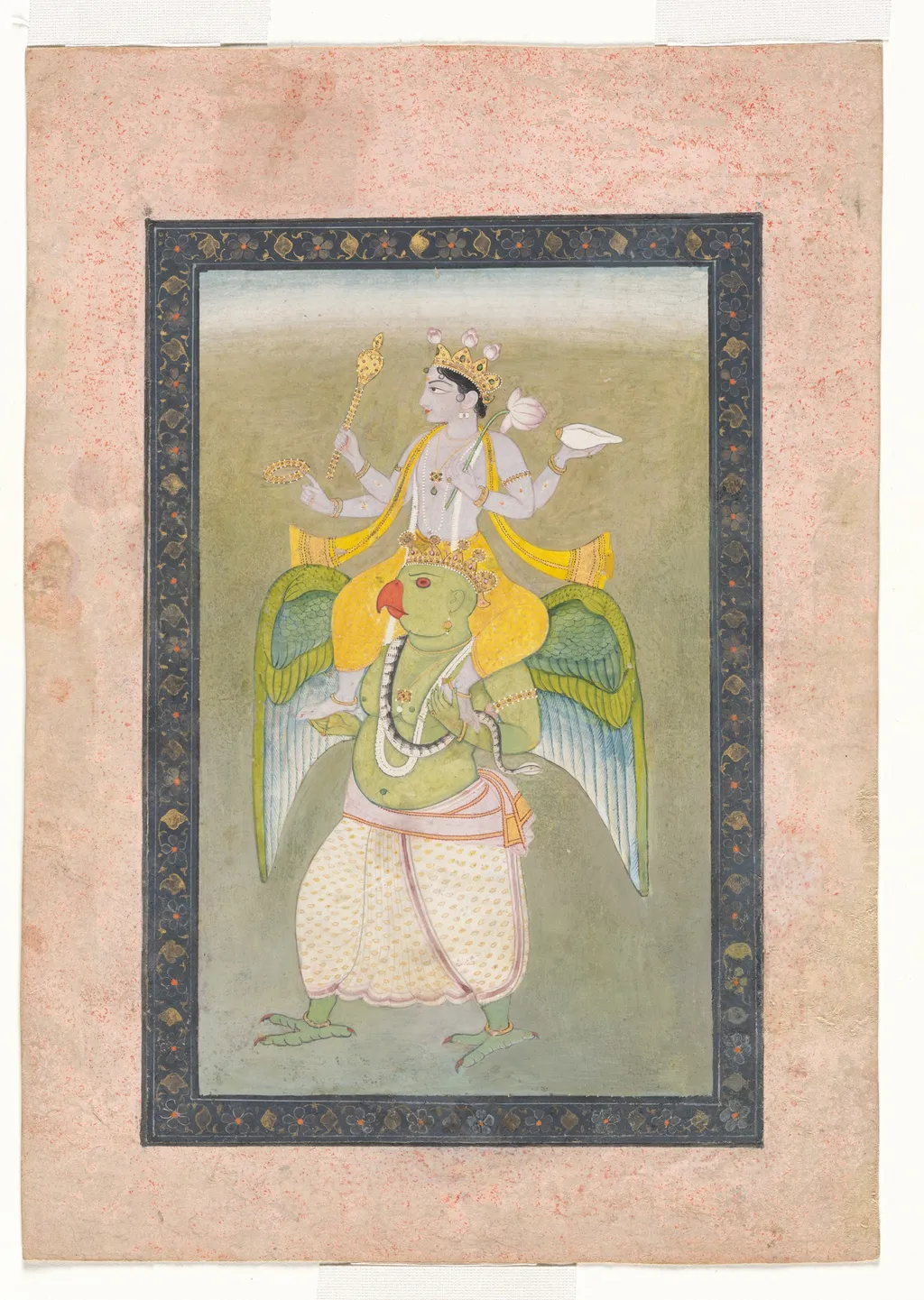
Vishnu on Garuda is an unspecified painting by Sajnu of Mandi. It dates from 1815 and is held in the collection of the Metropolitan Museum of Art.
About this work
The bird has a human-like face and a red tongue sticking out, dressed in a patterned skirt and holding a necklace.
This painting shows a pale-skinned figure riding a bright yellow bird with green wings. The rider holds a lotus flower and a staff, wearing a crown and jewelry. The bird has a human-like face and a red tongue sticking out, dressed in a patterned skirt and holding a necklace. The background is a plain green, and the whole scene is framed by a dark border with tiny gold designs.
The bird is called Garuda, a mythical creature often linked to Hindu gods. This painting was made in India around 1815 by an artist named Sajnu of Mandi.
If you like this style, check out more works by Sajnu of Mandi.
Overview
Created in 1815 by the artist Sajnu of Mandi, this painting depicts the Hindu deity Vishnu mounted on his divine mount, Garuda. The composition centers on the pale-skinned Vishnu, who wears an ornate crown and jewelry while holding a lotus flower and a staff. He is seated atop Garuda, who is rendered with a bright yellow body, green wings, and a distinct anthropomorphic face featuring a protruding red tongue. Garuda is dressed in a patterned skirt and holds a necklace, blending avian and human characteristics. The figures are set against a plain background, a stylistic choice common in the Mandi school of Himachal Pradesh that directs full attention to the iconography and vibrant color palette. This work exemplifies the regional tradition of Pahari painting, where mythological narratives are presented with a focus on decorative detail and symbolic clarity. Produced during the early 19th century, the piece reflects the continued patronage of religious art in the Mandi state, showcasing Sajnu's adherence to established iconographic conventions while employing the local aesthetic of bold outlines and flat, unmodulated color fields.
Subject & Meaning
The central figures are Vishnu, identifiable by his pale complexion, crown, and attributes such as a lotus flower and staff, and Garuda, his traditional mount. Garuda is portrayed with a human-like face, a red tongue, and a bird's body with bright yellow and green plumage. He wears a patterned skirt and a necklace, signifying his divine status as the king of birds.
Technique & Style
Sajnu of Mandi employed a distinct visual language in this painting. The figures are rendered with clear outlines and bright, contrasting colors, such as the pale skin of Vishnu against the vivid yellow and green of Garuda. A plain green background emphasizes the main subject, while a dark border adorned with small gold motifs frames the composition, adding a decorative element typical of Indian miniature painting.
History & Provenance
This painting was produced in India around 1815 by Sajnu, an artist associated with the Mandi court. Sajnu was a notable painter of his time, known for his contributions to the Pahari school of painting. The artwork has since entered the collection of The Metropolitan Museum of Art, where it represents an example of early 19th-century Indian devotional art.
Artist & collection
Artist
Sajnu of Mandi was a court artist who painted gods so alive they could step off the page—literally: one of his Vishnus has Garuda’s feathers brushing the frame as if caught mid-flap.
