Artwork
John Speed
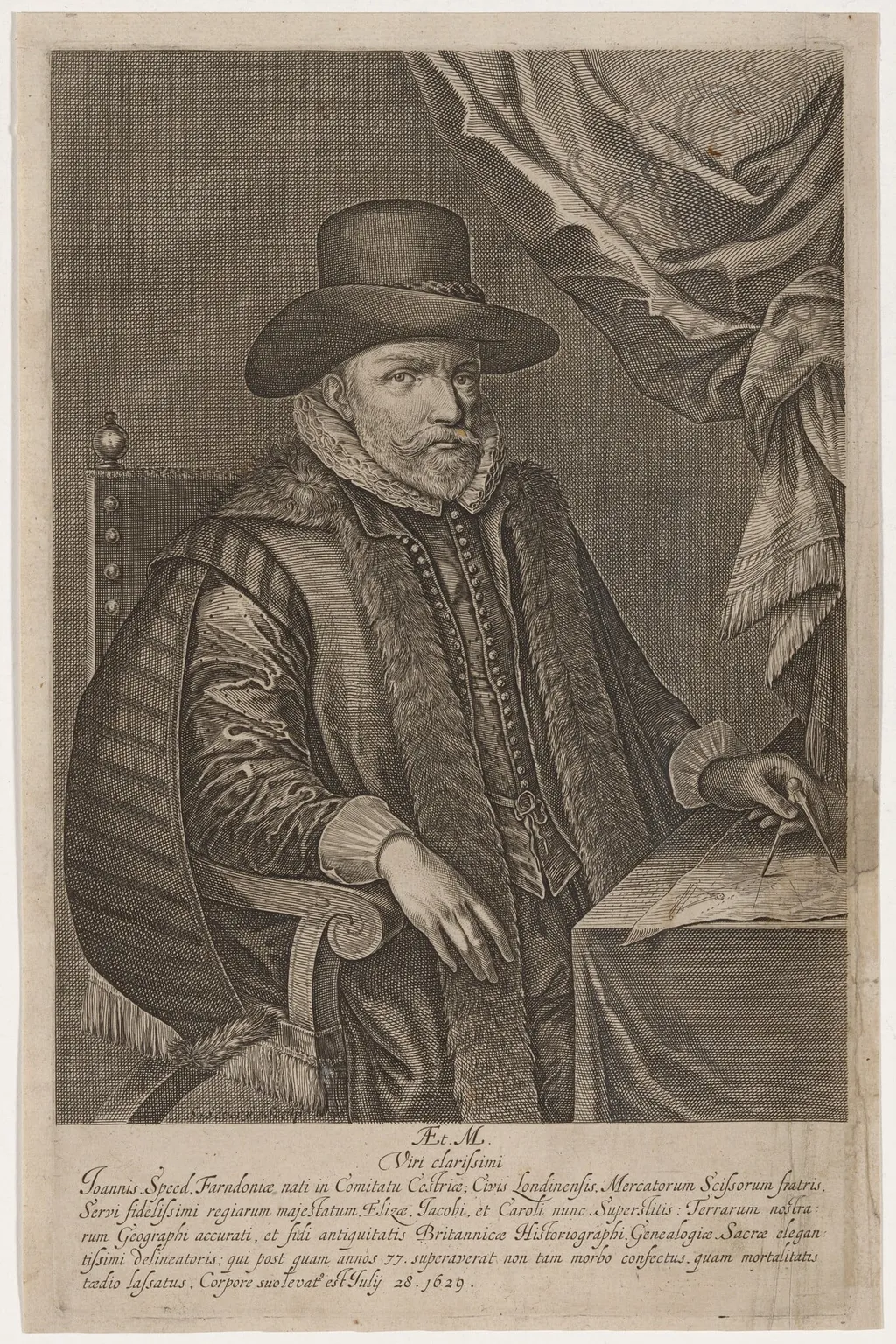
John Speed is an ink print by the Baroque artist Salomon Savery. It dates from 1632 and is held in the collection of the National Gallery of Art.
About this work
Overview
The composition balances stillness with subtle narrative elements, reflecting the era’s preference for intellectual portraiture.
Created in 1632 by Salomon Savery, this black-and-white engraving depicts John Speed, an English cartographer and antiquarian. The portrait is rendered in fine linear detail, characteristic of early 17th-century printmaking. It presents Speed in formal attire, with a wide-brimmed hat and ruffled collar, against a softly suggested interior setting. The composition balances stillness with subtle narrative elements, reflecting the era’s preference for intellectual portraiture.
Subject & Meaning
John Speed is shown holding a rolled document, likely referencing his cartographic work, while his other hand rests gently on his chest—a gesture suggesting contemplation or authority. The map on the wall behind him reinforces his identity as a scholar of geography. A small bird on a perch adds a quiet symbolic touch, possibly alluding to vigilance or the transmission of knowledge. The portrait emphasizes intellect over grandeur, aligning with the values of early modern English scholarship.
Technique & Style
Savery employed fine, controlled engraving lines to model form and texture, creating depth through cross-hatching and delicate tonal gradations. The curtain and architectural details are rendered with precision, suggesting spatial depth without overt perspective. The bird and map are rendered with minimal but effective detail, guiding the viewer’s eye. This method was standard for portrait prints of the period, prioritizing clarity and craftsmanship over dramatic effect.
History & Provenance
The engraving was produced in 1632, during Speed’s lifetime, likely as part of a broader effort to document notable English figures. It was probably circulated among scholars and patrons interested in geography and antiquarian studies. No definitive record of its early ownership exists, but its survival suggests it was valued within intellectual circles. The print remains a rare visual record of Speed’s appearance, as few contemporary portraits of him survive.
Context
In early 17th-century England, engraved portraits served both commemorative and informational purposes, especially for figures in science and literature. Speed’s work as a mapmaker placed him among a growing class of public intellectuals. This portrait reflects a trend of depicting scholars with tools of their trade—maps, books, or instruments—rather than symbols of nobility. The quiet, domestic setting aligns with Protestant ideals of modesty and diligence.
Legacy
Savery’s engraving endures as one of the few reliable visual representations of John Speed. It has been reproduced in historical texts on cartography and English antiquarianism, contributing to his posthumous recognition. While not widely known outside academic circles, the print remains a key artifact for understanding how scholars were visually represented in the early modern period, bridging art and intellectual history.
Artist & collection

![James I, King of England [top half], by Simon van de Passe](https://artifactworldgallery.com/img/simon-van-de-passe--james-i-king-of-england-top-half--6310c3c902e313b9-w320.webp)
![James I, King of England [top half], by Simon van de Passe](https://artifactworldgallery.com/img/simon-van-de-passe--james-i-king-of-england-top-half--2627f50172001474-w320.webp)