Artwork
Scena Cinei celei de Taină se desfășoară într-un interior sugerat de elemente arhitectonice, coloane, candelabru, candele. În centrul icoanei este Mântuitorul Iisus Hristos binecuvântând mâncarea, la masă, alături de ucenici și apostoli. Cu brațul stâng îl ține lipit de piept pe Ioan cel iubit. Pe masă sunt așezate un potir pentru vin și tacâmuri și farfurioare mici.Personajele au chipurile expresive, veșmintele personajelor și faldurile feței de masă, cât și draperiile sunt pictate cu măiestrie de pictor. Veșmintele sunt predominant roșii. Cromatica este armonioasă și echilibrată, pornindu-se gradual dinspre exterior înspre interior, de la albastru spre alb, ajungându-se la albul luminos al mesei celor dăruite. Compoziția este încadrată de elemente de arhitectură, coloane, arcade, creându-se, astfel, intimitatea Cinei celei de Taină. Totul este concentric, strângându-se în jurul Potirului. Elemente de arhitectură se întrezăresc printre cele 5 coloane. Se întrezărește o cruce formată din axa verticală Potirul și candela și cea orizontală - brațele Îmbrățișării Mântuitorului - Dragostea jertfelnică atotcuprinzătoare. Icoana este a lui Savu Moga, din Arpașu de Sus, Țara Făgărașului. Icoana este datată 1877. Inscripția din româno-chirilică se traduce Cina cea de Taină.
Scena Cinei celei de Taină se desfășoară într-un interior sugerat de elemente arhitectonice, coloane, candelabru, candele. În centrul icoanei este Mântuitorul Iisus Hristos binecuvântând mâncarea, la masă, alături de ucenici și apostoli. Cu brațul stâng îl ține lipit de piept pe Ioan cel iubit. Pe masă sunt așezate un potir pentru vin și tacâmuri și farfurioare mici.Personajele au chipurile expresive, veșmintele personajelor și faldurile feței de masă, cât și draperiile sunt pictate cu măiestrie de pictor. Veșmintele sunt predominant roșii. Cromatica este armonioasă și echilibrată, pornindu-se gradual dinspre exterior înspre interior, de la albastru spre alb, ajungându-se la albul luminos al mesei celor dăruite. Compoziția este încadrată de elemente de arhitectură, coloane, arcade, creându-se, astfel, intimitatea Cinei celei de Taină. Totul este concentric, strângându-se în jurul Potirului. Elemente de arhitectură se întrezăresc printre cele 5 coloane. Se întrezărește o cruce formată din axa verticală Potirul și candela și cea orizontală - brațele Îmbrățișării Mântuitorului - Dragostea jertfelnică atotcuprinzătoare. Icoana este a lui Savu Moga, din Arpașu de Sus, Țara Făgărașului. Icoana este datată 1877. Inscripția din româno-chirilică se traduce Cina cea de Taină. is a print by the Impressionist artist Savu Moga. It dates from 1877 and is held in the collection of the ASTRA National Museum Complex.
About this work
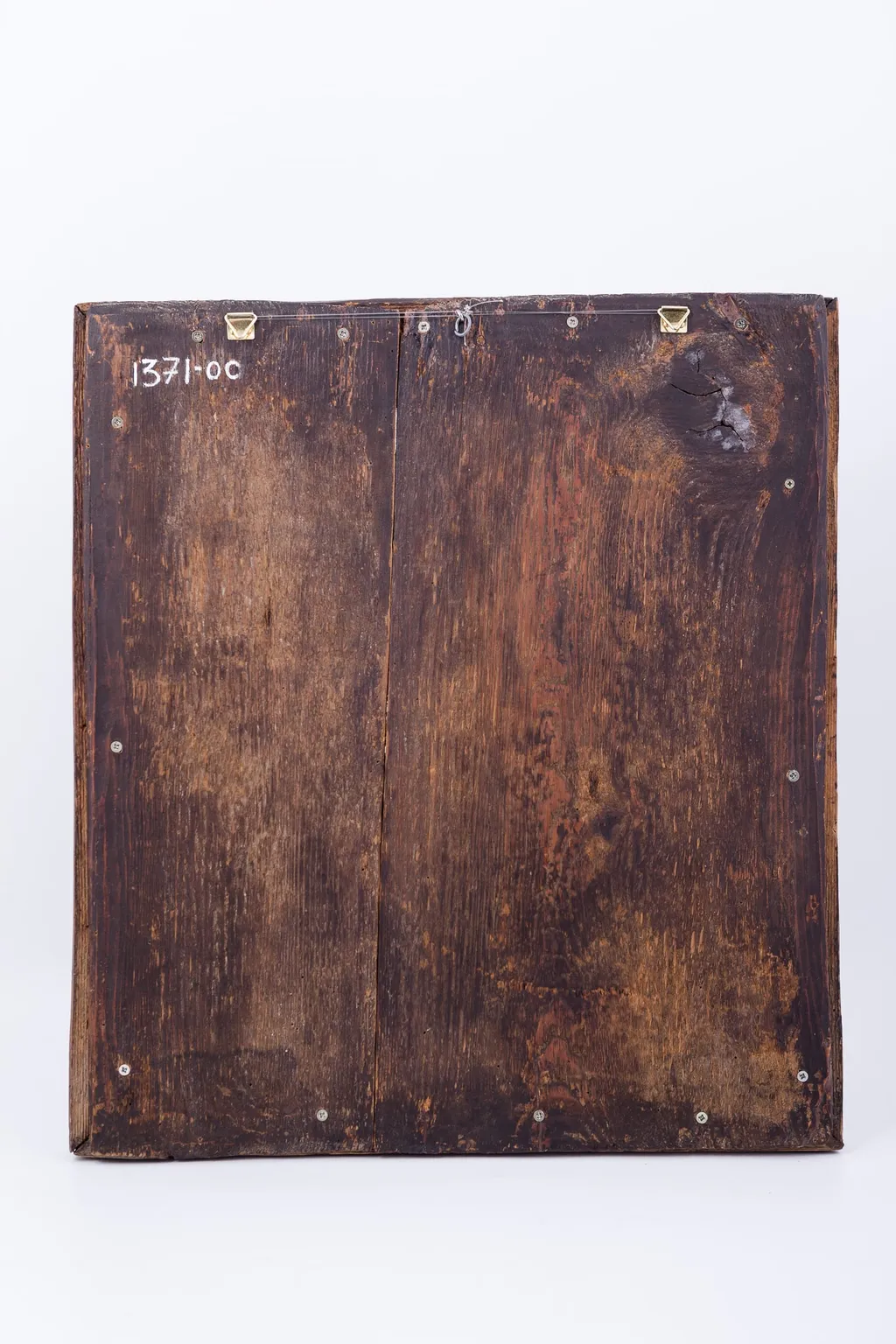
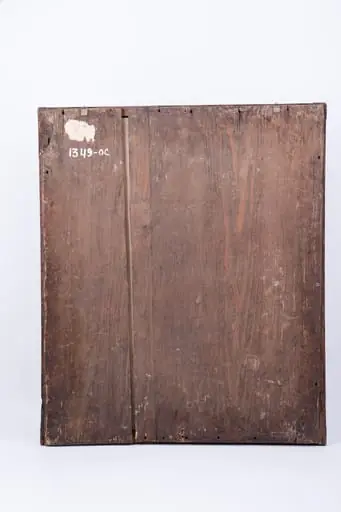
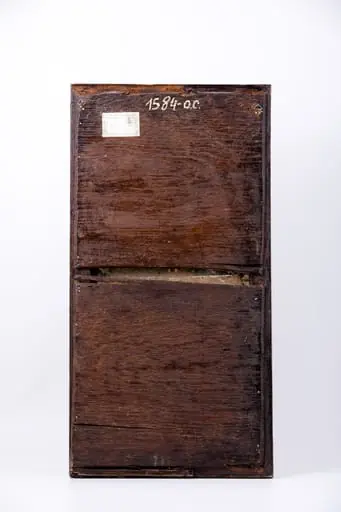
This is the back of a wooden panel. The wood is dark, weathered, and split in places. Metal clasps hold two sections together, and a small label reads "1371-00."
The painting on the front shows a religious scene with Jesus and his followers. The colors are mostly deep reds and soft blues, fading toward a bright center.
Look up Savu Moga next to see more of his work.
Overview
This icon, painted in 1877 by Savu Moga of Arpașu de Sus, depicts the Last Supper within a softly suggested architectural space.
This icon, painted in 1877 by Savu Moga of Arpașu de Sus, depicts the Last Supper within a softly suggested architectural space. Columns and arches frame the scene, enhancing its intimacy. The central figure of Christ blesses the meal, flanked by his disciples, with John the Beloved pressed close to his chest. A chalice, utensils, and small plates rest on the table, anchoring the sacred moment in tangible detail.
Subject & Meaning
The scene captures Christ’s final meal with his apostles, emphasizing spiritual unity and impending sacrifice. Christ’s embrace of John and the positioning of the chalice draw attention to the Eucharist as the heart of the event. The subtle formation of a cross—through the vertical line of the chalice and candle, and the horizontal line of Christ’s arms—hints at the crucifixion, linking the meal to redemption.
Technique & Style
Moga employs refined brushwork to render facial expressions and fabric folds with quiet precision. Robes are predominantly crimson, contrasting with cooler blues in the background that gradually lighten toward the luminous white of the table. The composition is tightly organized, with architectural elements guiding the eye inward, reinforcing the sacred focus on the chalice and Christ’s gesture.
History & Provenance
Created in 1877 in the region of Țara Făgărașului, the icon reflects local religious traditions and artisanal practices of the time. The original wooden panel, now partially split and secured with metal clasps, bears a small label reading '1371-00.' The inscription in Romanian Cyrillic confirms the subject as 'Cina cea de Taină,' aligning it with Orthodox liturgical imagery of the period.
Context
Painted during a period of cultural revival in Romanian religious art, the icon blends Byzantine conventions with emerging regional stylistic tendencies. Moga’s work responds to a broader movement to affirm Orthodox identity through visual piety, using familiar iconographic themes while incorporating naturalistic details like architectural depth and expressive faces, uncommon in earlier icons.
Legacy
Savu Moga’s icon stands as a representative example of late 19th-century Romanian ecclesiastical painting. Its careful balance of symbolism and subtle realism influenced local workshops and preserved devotional traditions during a time of modernization. Though not widely documented beyond its region, it remains a testament to the quiet persistence of sacred art in rural Transylvanian communities.
Artist & collection
Artist
Savu Moga painted religious icons in the folk style of 19th‑century Țara Făgărașului.

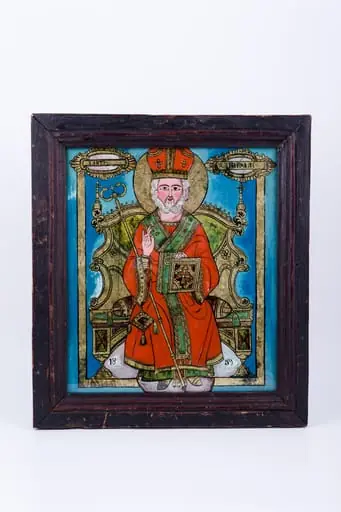 Sfântul Mare Ierarh Nicolae Făcătorul de minuni este redat central, așezat fiind pe un tron arhieresc, ținând în mâna stângă Sfânta Evanghelie închisă și binecuvântează cu mâna dreaptă. Veșmintele arhierești liturgice ale sfântului ierarh sunt într-o alternanță cromatică de roșu vermillon și verde spanac-avocado, kaki și galben-auriu. Epitrahilul, patrafirul este verde, cu patru cruci pe el, sacosul roșu, cu bordură galben-aurie. Poartă mithră și are aureolă. Ține în mâna stângă Sfânta Evanghelie închisă și binecuvântează. Întreaga tematică iconografică este încadrată de un chenar liniar auriu, cu un fond al icoanei albastru-gri. Inscripția din româno-chirilică se traduce Sf Nicolae. Icoana are o cromatică armonioasă și vie-luminoasă: roșu vermillon, roz, verde spanac-avocado, verde kaki, galben-auriu, alb, negru. Icoana este de Țara Făgărașului, este datată 1859 și este atribuită lui Savu Moga.
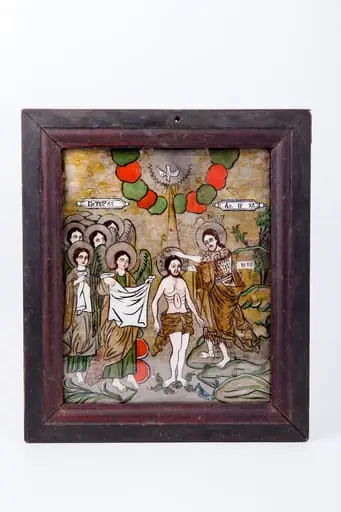
 Domnul Iisus Hristos primește Botezul, în râul Iordanului, din partea Sfântului Mare Prooroc și Înaintemergător Ioan Botezătorul, care se află în dreapta Mântuitorului. Mântuitorul este înfășurat cu o pânză de culoare brună-bronzie împrejurul șoldurilor și a coapselor. În stânga Lui, este un grup de îngeri evlavioși, care Îl așteaptă cu două ștergare albe gata să înveșmânteze Trupul Domnului. Sfântul Ioan Botezătorul este îmbrăcat cu o mantie brună-bronzie și un himation alb-brun sau o haină din păr de cămilă. Cerurile de culoare brun-gri-aurie sunt deschise și izvorăște o rază de lumină, pe care se pogoară porumbelul, simbolul Sfântului Duh, pe creștetul Mântuitorului. Mandorla de nouri rotunzi, care permite deschiderea Cerurilor au o alternanță cromatică de brun-acajou și verde. Cromatica este specifică Țării Făgărașului: auriu, verde kaki, bej, gri, ocru, brun-nisipiu, alb, negru. Inscripția din româno-chirilică se traduce Botezul IC XC Iisus Hristos. Icoana este datată 1866 și este atribuită lui Savu Moga, din Arpașu de Sus, Țara Făgărașului.
 Domnul Iisus Hristos primește Botezul, în râul Iordanului, din partea Sfântului Mare Prooroc și Înaintemergător Ioan Botezătorul, care se află în stânga Mântuitorului. Mântuitorul este înfășurat cu o pânză de culoare brună-bronzie împrejurul șoldurilor și a coapselor. În dreapta Lui, este un grup de îngeri evlavioși, care Îl așteaptă cu două ștergare albe gata să înveșmânteze Trupul Domnului. Sfântul Ioan Botezătorul este îmbrăcat cu o mantie brună-bronzie și un himation alb-brun sau o haină din păr de cămilă. Cerurile de culoare brun-gri-aurie sunt deschise și izvorăște o rază de lumină, pe care se pogoară porumbelul, simbolul Sfântului Duh, pe creștetul Mântuitorului. Mandorla de nouri rotunzi, care permite deschiderea Cerurilor au o alternanță cromatică de roșu-vermillon și verde. Cromatica este specifică Țării Făgărașului: auriu, roșu vermillon, verde kaki, bej, gri, ocru, brun-nisipiu, alb, negru. Inscripția din româno-chirilică se traduce Botezul IC XC Iisus Hristos Ioan. Icoana este datată 1868 și este atribuită lui Savu Moga, din Arpașu de Sus, Țara Făgărașului.
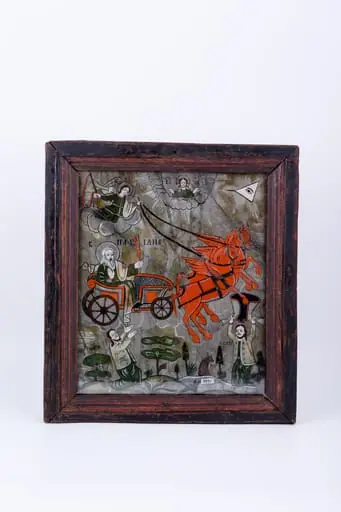 Icoana îl reprezintă pe Sfântul Mare Prooroc Ilie Tesviteanul, traversând Cerurile, în carul de foc, tras de doi cai roșii. Sfântul este îmbrăcat în straie brun-kaki și mantie brună-ocru și Îngerul din spate mână caii cu aripile roșii. Chipul Sfântului Ilie este unul ascetic, asemenea Sfântului Ioan Botezătorul. În registrul inferior sunt Sfântul Prooroc Elisei, ucenicul Sfântului Ilie, care prinde cojocul aruncat și un țăran plugar, care se ține de carul de foc al sfântului prooroc. Asemenea țăranului plugar, care ară pământul, așa și Sfântul Ilie Tesviteanul ară Cerurile cu carul de foc. În registrul superior este Dumnezeu-Tatăl, care binecuvântează și Îngerul care ține hățurile cailor. În colțul din dreapta este Ochiul Divin înscris în triunghiul Sfintei Treimi. Între registre există comunicare și interferență, atât semantică, cât și cromatică. Compoziția este amplă, dezvoltată pe registre și relații între personaje. Cromatica este armonioasă: roșu vermillon și sângeriu, verde kaki, verde mușchi-de-pădure, gri, nisipiu, ocru, bronziu, alb și negru. Inscripția din româno-chirilică se traduce IC XC Iisus Hristos Sf Proroc Ilie Elisei. Icoana aparține lui Savu Moga, din Arpașu de Sus, Țara Făgărașului. Icoana este datată 1859.
 Sfântul Mare Mucenic Haralambie, făcător-de-minuni și vindecător de boli, este cel mai bătrân mucenic din cei prăznuiți de creștini. Este cunoscut ca și făcător-de-minuni, vindecător de boli și ocrotitor al caselor familiilor creștine. Central este pictat Sfântul, îmbrăcat cu veșminte liturgice, arhierești, cu sacos verde kaki, felon brun, epitrahil orange, aureolă. Are barbă foarte lungă, fața palidă, ascetică și ochii blând-pătrunzători. În mâna stângă ține Sfânta Evanghelie închisă și cu aceeași mână ține în lanț ciuma, reprezentată antropomorfic - un schelet gri-cenușiu, antracit, cu coarne de diavol. Ciuma, simbolizând boala incurabilă și moartea, are coarne de diavol, fiind, totodată și păcatul, patima, aducătoare de moartea duhovnicească. Cu mâna dreaptă sfântul ierarh binecuvântează. Ciuma este călcată în picioare se Sfântul Haralambie, iar de sub scheletul antropomorfic-zoomorfic și diabolic, ies și fug trei oameni, salvați și vindecați de făcătorul de minuni și tămăduitorul de boli. În dreapta Sfântului sunt alte trei personaje care îi mulțumesc sfântului pentru ajutor. În registrul îndepărtat sunt elemente arhitectonice, cu o bogăție de detalii decorative. În registrul superior pe o mandorlă din nouri este Dumnezeu Binecuvântând și pe o altă mandorlă este Îngerul Arhanghel Gavriil așezând cununa de mucenicie pe capul Sfântului Haralambie. Fondul este cerul brun-gri. Întreaga compoziție iconografică este încadrată de un chenar decorativ geometrizant, pe laterale, ca două panglici late, cu ghirlande de flori mari, de culoare verde-gri-turcoaz. Inscripția din româno-chirilică se traduce IC XC Iisus Hristos Sfântul Mucenic Haralalmbie. Cromatica este frumoasă, deosebită și armonioasă: orange - roșu vermillon, verde spanac-avocado, verde kaki, gri, brun, bronziu, alb, negru. Icoana este datată 1875. Icoana este a lui Savu Moga, din Arpașu de Sus, Țara Făgărașului.
 Sfânn Ar
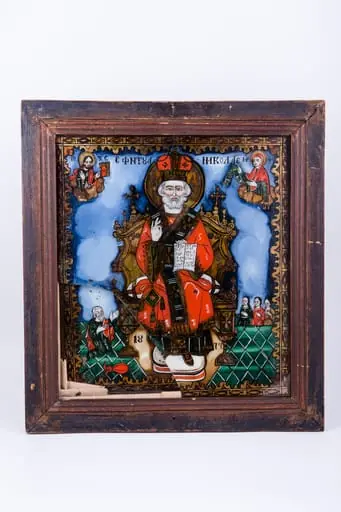 Sfântul Mare Ierarh Nicolae Făcătorul de minuni este redat central, fiind așezat pe un tron arhieresc, bogat ornamentat cu detalii arhitecturale, ținând în mâna stângă Sfânta Evanghelie închisă și binecuvântează cu mâna dreaptă. Veșmintele arhierești liturgice ale sfântului ierarh sunt într-o alternanță cromatică de roșu vermillon - verde - kaki - brun- bronziu. Epitrahilul, patrafirul este brun-kaki, cu patru cruci pe el, sacosul roșu vermillon. Poartă mithră și are aureolă. Ține în mâna stângă Sfânta Evanghelie deschisă și binecuvântează. În registrul superior îndepărtat sunt Dumnezeu-Tatăl și Maica Domnului, care binecuvântează și ocrotesc. Pe fondul albastru ceruleum în degrade cu albastru regal și alb, Mântuitorul și Maica Domnului au veșminte roșii și verzi. În registrul inferior sunt cele trei fete salvate de sfântul ierarh de la sărăcie și păcat și tatăl fetelor, care îngenuncheat, mulțumește pentru minunea și binefacerile primite. Inscripția din româno-chirilică se traduce Sf Nicolae ICXC Iisus Hristos MP Maica Domnului. Icoana are o cromatică puternic-vie, specifică Țării Oltului: roșu vermillon, verde, albastru ceruleum, gri, galben chihlimbar, alb, negru. Icoana este încadrată de un chenar decorativ geometrizant, format dintr-o dantelărie aurie. Icoana aparține lui Savu Moga, din Arpașu de Sus, Țara Făgărașului. Icoana este datată 1877.
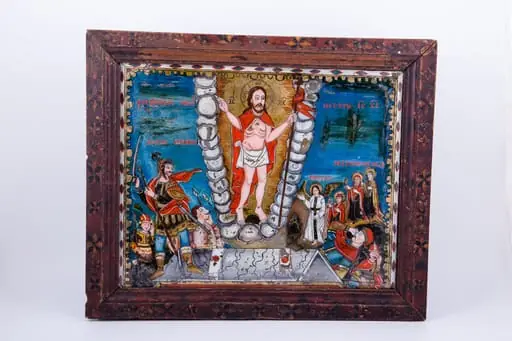 Învierea Domnului Iisus Hristos. Mântuitorul Iisus Hristos, ieșind din mormânt, Înviind, cu steagul biruinței în mâna stângă, zdrobește ușile iadului, cu mâna dreapta arătând și Binecuvântând. În stânga Mântuitorului este Îngerul Gavriil, care aducea Vestea Învierii Domnului. Îngerul a strigat…Vestea… și în urma lui vin cele trei femei mironosițe. Mântuitorul este înfășurat cu o mantie și roșie și o țesătură albă, în mijlocul coapselor și a mijlocului. Este pe o mandorlă de nouri albi, sugerându-se, astfel, deschiderea Cerurilor și poartă Lumina Învierii ca pe o mantie de aripi. Cei patru ostași adormiți sunt aruncați la marginea mormântului. Lateral dreapta Mântuitorului este sutașul Longhin, care a împuns Trupul Mântuitorului pe Cruce cu sulița în coastă, iar sângele și apa ce au izvorât au tămăduit ochii necredinței sutașului. Icoana aparține lui Savu Moga, din Arpașu de Sus, Țara Făgărașului. Are o cromatică vie: albastru regal, albastru ceruleum, roșu vermillon, roz, galben, roșu, roz, auriu. Inscripția în româno-chirilică se traduce Învierea Domnului Iisus Hristos Înviere Mironosițe Longhin sutașul.
 Trupul Mântuitorului Iisus Hristos este coborât de pe cruce de patru ucenici, învelit în giulgiul alb și primit de Maica Domnului și două femei mironosițe purtătoare mir. În partea dreaptă, alături de Maica Domnului este și ucenicul cei iubit, Ioan Teologul, care va fi Sfântul Apostol și Evanghelist Ioan, Teologul Iubirii. Compoziția este foarte simetrică, echilibrată. Petele de sânge de pe giulgiul alb, interiorul căptușit al maforiumului Maicii Domnului și scara, pe care se urcă ucenicii, sunt de culoare roșie. Veșmintele toate sunt verzi kaki, cu tonuri de bronz și olive-smarald. Cerul este albastru închis, ca de noapte de bleumarin. Inscripția în româno-chirilică este cu alb pe cerul ceruleum și se traduce Coborârea de pe cruce a Mântuitorului Iisus Hristos IC XC. Icoana este pictată la Lancrăm, Valea Sebeșului, având o cromatică fină, delicată, puternică, armonioasă: verde, kaki, olive, smarald, albastru ceruleum, gri, bronz, alb, negru, roșu.
 Maica Domnului este înveșmântată în cămașă femeiască tradițională, presupusă iie cu câmpuri verticale alternativ pictate cu roșu vermillon și verde, cu danteluță aurie la baza gâtului, cu maforion roșu vermillon, poartă coroniță de împărăteasă și aureolă. Maica Domnului are gâtul neacoperit cu veșmânt și pe sub maramă se observă părul șaten castaniu. Este mai puțin frecventă această atitudine vestimentară a Maicii Domnului, asemănătoare femeilor din vremea aceea. Icoana este de la Poiana Sibiului, pictată în manieră specifică Mărginimii Sibiului. Pruncul Iisus Hristos este înveșmântat în roșu vermillon și verde și auriu la gulerașul cămășii populare, cu coroană și aureolă. Pruncul Iisus o ține pe Maica Domnului cu mânuța pe după gât, într-o tandrețe mângâietoare, lipindu-și capetele, unul de celălalt. Este a atitudine a Maicii Domnului Eleusa. Fondul icoanei este cerul de culoarea albastru ultramarin. Întreaga icoană este încadrată de un chenar decorativ geometrizant și floral compact, un ușor baroc, de culoare brun-roșcat-verde. Cromatică: roșu vermillon, albastru, verde de China, auriu, ocru-brun-bronziu, alb, negru, roșu stacojiu, brun-roșcat. Icoana este aparte și prin compoziție și prin veșminte. Chipurile au o delicatețe și o tandrețe emoționante. Inscripția din româno-chirilică se traduce MP Maica Domnului IC XC Iisus Hristos.
 Dumnezeu-Fiul ține Crucea pe umărul drept, Dumnezeu-Tatăl are aureola triunghiulară, semn al Sfintei Treimi. Veșmintele sunt roșii vermillon cu albastru ultramarin. Deasupra este Sfântul Duh, sub forma porumbelului alb pogorât din Cerurile deschise, dintr-un soare roșu cu raze albastre, asemenea unei flori uriașe. Mandorla de nouri albi rotunzi este înlocuită, în această icoană, de soarele-floare, de unde se pogoară Sfântul Duh. În registrul superior, icoana este încadrată de un chenar decorativ format din elemente fitomorfe, ruje roșii cu frunze albastre bleumarin. În registrul inferior sunt mandorle de nouri rotunzi albi și albaștri bleuciel. Cromatica este armonioasă: roșu vermillon, albastru cobalt și bleumarin, bleu-ciel, ocru, gri, brun, bronziu, alb, negru. Este o icoană de Gherla, nuanțele de albastru sunt edificatoare. Ceea ce este atrăgător la această icoană este crochiul naiv de căsuță, desenată aproape ca de un copil, în centrul icoanei, asemenea unei chemări, deschideri și așteptări în Împărăția Cerurilor. Este o căsuță-fereastră, un petec de suflet luminos. Inscripția din româno-chirilică se traduce Sfânta Treime.
 Icoare a
 Icoaport