Artwork
Icoana îl reprezintă pe Sfântul Mare Prooroc Ilie Tesviteanul, traversând Cerurile, în carul de foc, tras de doi cai roșii. Sfântul este îmbrăcat în straie brun-kaki și mantie brună-ocru și Îngerul din spate mână caii cu aripile roșii. Chipul Sfântului Ilie este unul ascetic, asemenea Sfântului Ioan Botezătorul. În registrul inferior sunt Sfântul Prooroc Elisei, ucenicul Sfântului Ilie, care prinde cojocul aruncat și un țăran plugar, care se ține de carul de foc al sfântului prooroc. Asemenea țăranului plugar, care ară pământul, așa și Sfântul Ilie Tesviteanul ară Cerurile cu carul de foc. În registrul superior este Dumnezeu-Tatăl, care binecuvântează și Îngerul care ține hățurile cailor. În colțul din dreapta este Ochiul Divin înscris în triunghiul Sfintei Treimi. Între registre există comunicare și interferență, atât semantică, cât și cromatică. Compoziția este amplă, dezvoltată pe registre și relații între personaje. Cromatica este armonioasă: roșu vermillon și sângeriu, verde kaki, verde mușchi-de-pădure, gri, nisipiu, ocru, bronziu, alb și negru. Inscripția din româno-chirilică se traduce IC XC Iisus Hristos Sf Proroc Ilie Elisei. Icoana aparține lui Savu Moga, din Arpașu de Sus, Țara Făgărașului. Icoana este datată 1859.
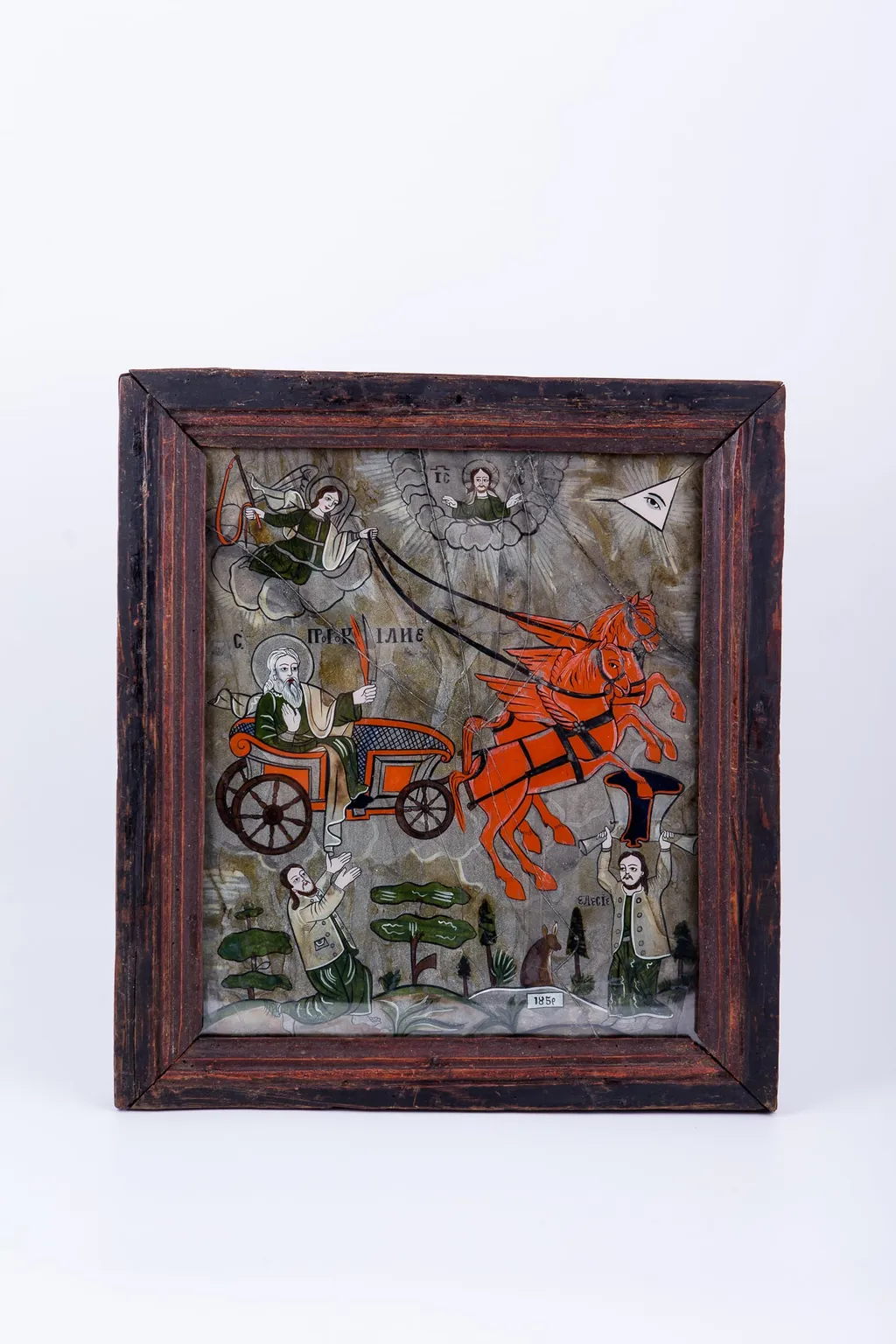
Icoana îl reprezintă pe Sfântul Mare Prooroc Ilie Tesviteanul, traversând Cerurile, în carul de foc, tras de doi cai roșii. Sfântul este îmbrăcat în straie brun-kaki și mantie brună-ocru și Îngerul din spate mână caii cu aripile roșii. Chipul Sfântului Ilie este unul ascetic, asemenea Sfântului Ioan Botezătorul. În registrul inferior sunt Sfântul Prooroc Elisei, ucenicul Sfântului Ilie, care prinde cojocul aruncat și un țăran plugar, care se ține de carul de foc al sfântului prooroc. Asemenea țăranului plugar, care ară pământul, așa și Sfântul Ilie Tesviteanul ară Cerurile cu carul de foc. În registrul superior este Dumnezeu-Tatăl, care binecuvântează și Îngerul care ține hățurile cailor. În colțul din dreapta este Ochiul Divin înscris în triunghiul Sfintei Treimi. Între registre există comunicare și interferență, atât semantică, cât și cromatică. Compoziția este amplă, dezvoltată pe registre și relații între personaje. Cromatica este armonioasă: roșu vermillon și sângeriu, verde kaki, verde mușchi-de-pădure, gri, nisipiu, ocru, bronziu, alb și negru. Inscripția din româno-chirilică se traduce IC XC Iisus Hristos Sf Proroc Ilie Elisei. Icoana aparține lui Savu Moga, din Arpașu de Sus, Țara Făgărașului. Icoana este datată 1859. is a drawing by the Impressionist artist Savu Moga. It dates from 1859 and is held in the collection of the ASTRA National Museum Complex.
About this work
Overview
The work reflects Orthodox theological themes through a local Transylvanian artistic tradition, blending spiritual narrative with regional visual language.
Painted in 1859 by Savu Moga of Arpașu de Sus, this icon depicts the biblical ascension of the Prophet Elijah, carried to heaven in a chariot of fire. The composition is structured in three horizontal registers, linking earthly and divine realms through symbolic figures, color, and gesture. The work reflects Orthodox theological themes through a local Transylvanian artistic tradition, blending spiritual narrative with regional visual language.
Subject & Meaning
Elijah, depicted with an ascetic face reminiscent of John the Baptist, is shown ascending in a fiery chariot drawn by red horses, symbolizing divine power and transition. Below, his disciple Elisha catches the mantle thrown from the chariot, signifying the transfer of prophetic authority. A plowman, clinging to the chariot’s path, mirrors Elijah’s role: just as the farmer tills the earth, Elijah furrows the heavens. Above, God the Father blesses the scene, while the Eye of Providence in a triangle affirms the Trinity’s presence.
Technique & Style
The icon employs a restrained palette of ochres, moss greens, grays, and vermilion reds to create harmony between earthly and celestial zones. Figures are rendered with linear precision, their forms defined by subtle modeling rather than deep shading. The horses’ wings and Elijah’s mantle are rendered in rich reds, contrasting with muted earth tones. Inscriptions in Romanian Cyrillic frame the scene, anchoring its liturgical purpose. The composition avoids perspective illusion, instead organizing space through layered registers that emphasize theological hierarchy.
History & Provenance
Created in 1859 by Savu Moga, a known iconographer from Arpașu de Sus in the Făgăraș region, the work belongs to a local tradition of religious painting that persisted in Transylvania despite broader cultural shifts. Its survival and detailed inscription suggest it was commissioned for a parish church or private chapel. The artist’s signature style—clear figuration, symbolic color use, and adherence to Byzantine models—aligns with regional practices of the mid-19th century.
Context
This icon emerged during a period of heightened religious identity in Transylvania, where Orthodox communities maintained distinct visual traditions amid Habsburg and Romanian national influences. The depiction of Elijah’s ascension, a common theme in Eastern Christian art, was adapted here with local figures—the plowman, the regional color choices—to ground the divine in everyday rural life. The inclusion of both Elisha and the plowman underscores a theological link between labor and spiritual inheritance.
Legacy
The icon stands as a testament to the endurance of Orthodox iconography in rural Transylvania well into the 19th century. Its synthesis of canonical subject matter with regional aesthetics offers insight into how local communities interpreted sacred narratives. Though not widely documented beyond its place of origin, it remains a representative example of a living tradition that resisted standardization, preserving both theological depth and artisanal autonomy.
Artist & collection
Artist
Savu Moga painted religious icons in the folk style of 19th‑century Țara Făgărașului.

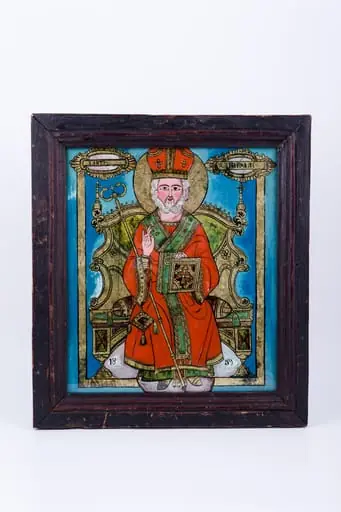 Sfântul Mare Ierarh Nicolae Făcătorul de minuni este redat central, așezat fiind pe un tron arhieresc, ținând în mâna stângă Sfânta Evanghelie închisă și binecuvântează cu mâna dreaptă. Veșmintele arhierești liturgice ale sfântului ierarh sunt într-o alternanță cromatică de roșu vermillon și verde spanac-avocado, kaki și galben-auriu. Epitrahilul, patrafirul este verde, cu patru cruci pe el, sacosul roșu, cu bordură galben-aurie. Poartă mithră și are aureolă. Ține în mâna stângă Sfânta Evanghelie închisă și binecuvântează. Întreaga tematică iconografică este încadrată de un chenar liniar auriu, cu un fond al icoanei albastru-gri. Inscripția din româno-chirilică se traduce Sf Nicolae. Icoana are o cromatică armonioasă și vie-luminoasă: roșu vermillon, roz, verde spanac-avocado, verde kaki, galben-auriu, alb, negru. Icoana este de Țara Făgărașului, este datată 1859 și este atribuită lui Savu Moga.
 Domnul Iisus Hristos primește Botezul, în râul Iordanului, din partea Sfântului Mare Prooroc și Înaintemergător Ioan Botezătorul, care se află în dreapta Mântuitorului. Mântuitorul este înfășurat cu o pânză de culoare brună-bronzie împrejurul șoldurilor și a coapselor. În stânga Lui, este un grup de îngeri evlavioși, care Îl așteaptă cu două ștergare albe gata să înveșmânteze Trupul Domnului. Sfântul Ioan Botezătorul este îmbrăcat cu o mantie brună-bronzie și un himation alb-brun sau o haină din păr de cămilă. Cerurile de culoare brun-gri-aurie sunt deschise și izvorăște o rază de lumină, pe care se pogoară porumbelul, simbolul Sfântului Duh, pe creștetul Mântuitorului. Mandorla de nouri rotunzi, care permite deschiderea Cerurilor au o alternanță cromatică de brun-acajou și verde. Cromatica este specifică Țării Făgărașului: auriu, verde kaki, bej, gri, ocru, brun-nisipiu, alb, negru. Inscripția din româno-chirilică se traduce Botezul IC XC Iisus Hristos. Icoana este datată 1866 și este atribuită lui Savu Moga, din Arpașu de Sus, Țara Făgărașului.
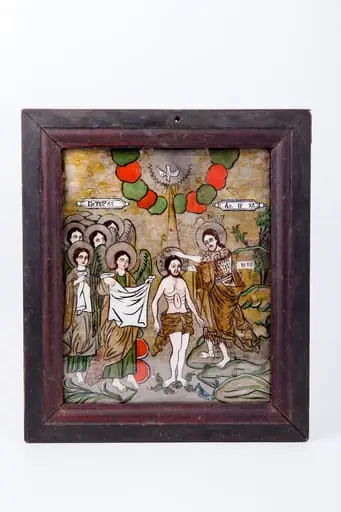 Domnul Iisus Hristos primește Botezul, în râul Iordanului, din partea Sfântului Mare Prooroc și Înaintemergător Ioan Botezătorul, care se află în stânga Mântuitorului. Mântuitorul este înfășurat cu o pânză de culoare brună-bronzie împrejurul șoldurilor și a coapselor. În dreapta Lui, este un grup de îngeri evlavioși, care Îl așteaptă cu două ștergare albe gata să înveșmânteze Trupul Domnului. Sfântul Ioan Botezătorul este îmbrăcat cu o mantie brună-bronzie și un himation alb-brun sau o haină din păr de cămilă. Cerurile de culoare brun-gri-aurie sunt deschise și izvorăște o rază de lumină, pe care se pogoară porumbelul, simbolul Sfântului Duh, pe creștetul Mântuitorului. Mandorla de nouri rotunzi, care permite deschiderea Cerurilor au o alternanță cromatică de roșu-vermillon și verde. Cromatica este specifică Țării Făgărașului: auriu, roșu vermillon, verde kaki, bej, gri, ocru, brun-nisipiu, alb, negru. Inscripția din româno-chirilică se traduce Botezul IC XC Iisus Hristos Ioan. Icoana este datată 1868 și este atribuită lui Savu Moga, din Arpașu de Sus, Țara Făgărașului.
 Sfântul Mare Mucenic Haralambie, făcător-de-minuni și vindecător de boli, este cel mai bătrân mucenic din cei prăznuiți de creștini. Este cunoscut ca și făcător-de-minuni, vindecător de boli și ocrotitor al caselor familiilor creștine. Central este pictat Sfântul, îmbrăcat cu veșminte liturgice, arhierești, cu sacos verde kaki, felon brun, epitrahil orange, aureolă. Are barbă foarte lungă, fața palidă, ascetică și ochii blând-pătrunzători. În mâna stângă ține Sfânta Evanghelie închisă și cu aceeași mână ține în lanț ciuma, reprezentată antropomorfic - un schelet gri-cenușiu, antracit, cu coarne de diavol. Ciuma, simbolizând boala incurabilă și moartea, are coarne de diavol, fiind, totodată și păcatul, patima, aducătoare de moartea duhovnicească. Cu mâna dreaptă sfântul ierarh binecuvântează. Ciuma este călcată în picioare se Sfântul Haralambie, iar de sub scheletul antropomorfic-zoomorfic și diabolic, ies și fug trei oameni, salvați și vindecați de făcătorul de minuni și tămăduitorul de boli. În dreapta Sfântului sunt alte trei personaje care îi mulțumesc sfântului pentru ajutor. În registrul îndepărtat sunt elemente arhitectonice, cu o bogăție de detalii decorative. În registrul superior pe o mandorlă din nouri este Dumnezeu Binecuvântând și pe o altă mandorlă este Îngerul Arhanghel Gavriil așezând cununa de mucenicie pe capul Sfântului Haralambie. Fondul este cerul brun-gri. Întreaga compoziție iconografică este încadrată de un chenar decorativ geometrizant, pe laterale, ca două panglici late, cu ghirlande de flori mari, de culoare verde-gri-turcoaz. Inscripția din româno-chirilică se traduce IC XC Iisus Hristos Sfântul Mucenic Haralalmbie. Cromatica este frumoasă, deosebită și armonioasă: orange - roșu vermillon, verde spanac-avocado, verde kaki, gri, brun, bronziu, alb, negru. Icoana este datată 1875. Icoana este a lui Savu Moga, din Arpașu de Sus, Țara Făgărașului.
 Sfânn Ar
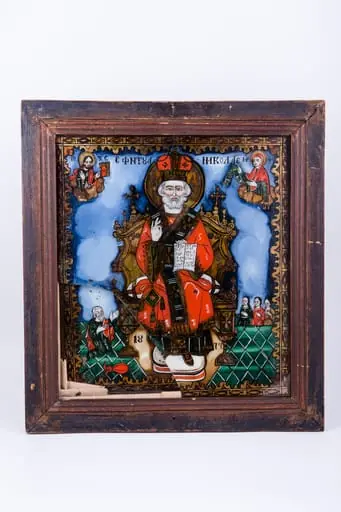 Sfântul Mare Ierarh Nicolae Făcătorul de minuni este redat central, fiind așezat pe un tron arhieresc, bogat ornamentat cu detalii arhitecturale, ținând în mâna stângă Sfânta Evanghelie închisă și binecuvântează cu mâna dreaptă. Veșmintele arhierești liturgice ale sfântului ierarh sunt într-o alternanță cromatică de roșu vermillon - verde - kaki - brun- bronziu. Epitrahilul, patrafirul este brun-kaki, cu patru cruci pe el, sacosul roșu vermillon. Poartă mithră și are aureolă. Ține în mâna stângă Sfânta Evanghelie deschisă și binecuvântează. În registrul superior îndepărtat sunt Dumnezeu-Tatăl și Maica Domnului, care binecuvântează și ocrotesc. Pe fondul albastru ceruleum în degrade cu albastru regal și alb, Mântuitorul și Maica Domnului au veșminte roșii și verzi. În registrul inferior sunt cele trei fete salvate de sfântul ierarh de la sărăcie și păcat și tatăl fetelor, care îngenuncheat, mulțumește pentru minunea și binefacerile primite. Inscripția din româno-chirilică se traduce Sf Nicolae ICXC Iisus Hristos MP Maica Domnului. Icoana are o cromatică puternic-vie, specifică Țării Oltului: roșu vermillon, verde, albastru ceruleum, gri, galben chihlimbar, alb, negru. Icoana este încadrată de un chenar decorativ geometrizant, format dintr-o dantelărie aurie. Icoana aparține lui Savu Moga, din Arpașu de Sus, Țara Făgărașului. Icoana este datată 1877.
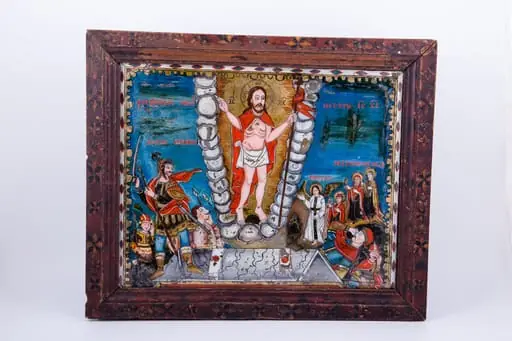 Învierea Domnului Iisus Hristos. Mântuitorul Iisus Hristos, ieșind din mormânt, Înviind, cu steagul biruinței în mâna stângă, zdrobește ușile iadului, cu mâna dreapta arătând și Binecuvântând. În stânga Mântuitorului este Îngerul Gavriil, care aducea Vestea Învierii Domnului. Îngerul a strigat…Vestea… și în urma lui vin cele trei femei mironosițe. Mântuitorul este înfășurat cu o mantie și roșie și o țesătură albă, în mijlocul coapselor și a mijlocului. Este pe o mandorlă de nouri albi, sugerându-se, astfel, deschiderea Cerurilor și poartă Lumina Învierii ca pe o mantie de aripi. Cei patru ostași adormiți sunt aruncați la marginea mormântului. Lateral dreapta Mântuitorului este sutașul Longhin, care a împuns Trupul Mântuitorului pe Cruce cu sulița în coastă, iar sângele și apa ce au izvorât au tămăduit ochii necredinței sutașului. Icoana aparține lui Savu Moga, din Arpașu de Sus, Țara Făgărașului. Are o cromatică vie: albastru regal, albastru ceruleum, roșu vermillon, roz, galben, roșu, roz, auriu. Inscripția în româno-chirilică se traduce Învierea Domnului Iisus Hristos Înviere Mironosițe Longhin sutașul.
 Maica Domnului Împărăteasă a Cerurilor, pe tron așezată, ține Pruncul Iisus Hristos, în brațe. Maica Domnului este îmbrăcată cu mantie cu maforion brun, cu interiorul căptușit cu verde închis. Poartă aureolă și coroniță roșie de împărăteasă. Pruncul Iisus Hristos este îmbrăcat cu gri și verde închis, are aureolă și binecuvântează cu mâna dreaptă. În registrul superior sunt ocrotitori și păzitori Sfinții Arhangheli Mihail și Gavriil, sprijinindu-se cu mâinile de cele două turnulețe - elemente decorativ geometrizante din structura arhitecturală a bogatului tron arhieresc al Maicii Domnului Împărăteasă. În registrul superior sunt Sfântul Mare Evanghelist Luca, cel care a pictat-o pentru prima dată pe Maica Domnului cu Pruncul Iisus Hristos. Sfântul Evanghelist Luca apare împreună cu simbolul reprezentativ - vițelul - Parabola Întoarcerii Fiului risipitor. În cealaltă parte este Sfântul Evanghelist Ioan, cu vulturul, asemenea căruia se înalță în zbor Cuvântul Dumnezeiesc, fiind Teologul Iubirii. Cromatica este armonioasă, caldă și luminoasă: roșu vermillon, verde spanac-avocado, ocru, brun, gri, alb, negru. Inscripția din româno-chirilică se traduce Maica Domnului MP Iisus Hristos IC XC. Icoana este încadrată de un chenar decorativ geometrizant, pe laterale, ca două panglici late, cu ghirlande de flori mari, de culoare verde-gri. Icoana este datată 1866. Icoana este a lui Savu Moga, din Arpașu de Sus, Țara Făgărașului.
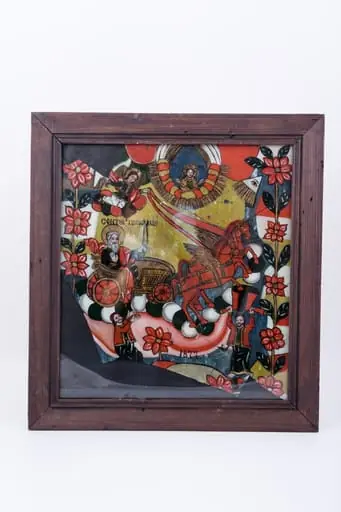 Icoana îl reprezintă pe Sfântul Mare Prooroc Ilie Tesviteanul, traversând Cerurile, în carul de foc, tras de doi cai roșii. Sfântul este îmbrăcat în straie brun-negre și mantie roșie și mână caii roșii cu aripi bronzii. Chipul Sfântului Ilie este unul ascetic, asemenea Sfântului Ioan Botezătorul. În registrul inferior sunt Sfântul Prooroc Elisei, ucenicul Sfântului Ilie, care prinde cojocul aruncat și un țăran plugar, care se ține de carul de foc al sfântului prooroc. Cele două registre paralele, cerul și pământul, sunt despărțite de un lanț din nouri albi-negrii, o mandorlă, care lasă Cerurile să se deschidă. Asemenea țăranului plugar, care ară pământul, așa și Sfântul Ilie Tesviteanul ară Cerurile cu carul de foc și biciul în mână. Cerurile albastru-întunecate, de apus de soare, au firicele roșiatice, iar câmpurile albastre au denivelări și movile roșiatice, astfel în registrul inferior, pământul este reprezentat pe straturi și benzi cromatice alternative de brun, kaki, roșu, albastru și alb. Întreaga narațiune este segmentată de lanțuri de nouri, mandorle mari sau mici, albe sau aurii. Inscripția din româno-chirilică se traduce Sfântul Prooroc Ilie. Compoziția este amplă, dezvoltată pe registre și relații între personaje. Compoziția este încadrată de un chenar fitomorf, format dintr-o ghirlandă de flori roșii, frunze negre. Cromatica este armonioasă: roșu vermillon, roz, albastru violaceu, gri, brun, cafeniu, verde kaki, negru, alb. Icoana aparține lui Matei Țimforea, Cârțișoara, Țara Făgărașului. Icoana este datată 1877.
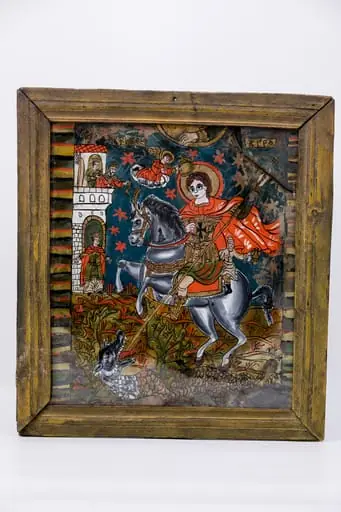 Sfântul Mare Mucenic Gheorghe este așezat călare pe un cal alb-gri, cu elemente de harnașament bronzii și șa roșie, omorând balaurul gri-gaben-verde cu creastă, solzi și coadă lungă, cu lancea, pe care o ține cu amândouă mâinile, înfingându-i-o animalului în gâtlej. În partea dreaptă a Sfântului Gheorghe, în registrul îndepărtat, este pictată domnița salvată și ocrotită de marele mucenic, cu mâinile ridicate, atât de teamă și spaimă, cât și de mulțumire către sfântul purtător de biruință. În registrul superior este Dumnezeu-Tatăl Binecuvântând cu mâna dintr-o deschidere a Cerurilor și un înger serafim care aduce Sfântului Gheorghe cununa de mucenic. În balconul castelului sunt două personaje cu cheile turnului în mână și pe șaua calului, în spatele Sfântului Mare Mucenic Gheorghe este un personaj foarte mic, îmbrăcat în haine arăbești, având în mână o candelă-amforă-cădelniță. Fondul icoanei este cerul albastru-gri-întunecat cu elemente astrale, stele roșii și câmpuri brune-kaki cu elemente vegetale roșii vermillon, în registrul inferior. Mantia Sfântulu Mucenic Purtător de Biruință este roșie-fluturândă având cămașa de cavaler cu zale și o cruce neagră de cavaler pe piept. Culoarea roșie este caracteristică mucenicilor și martirilor. Atât în dreapta, cât și în stânga sunt elemente de arhitectură, astfel spațializându-se narațiunea iconografică. Cromatica este armonioasă; roșu vermillon, albastru-gri întunecat, galben-ocru, verde văratic, verde brad, kaki, bronziu, alb și negru. Inscripția din româno-chirilică se traduce Sfântul Gheorghe. Icoana este din Țara Oltului. Icoana este mai rară, datorită diversității personajelor.
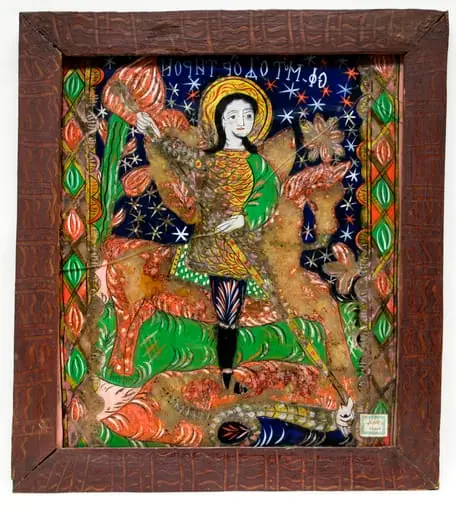 Icoana îl reprezintă pe sfântul mucenic Teodor Tiron . Sfântul, în centrul compoziției, călare pe cal , înfige o suliță lungă(ce marchează diagonala compoziției)în gura balaurului plasat inferior, dimensiuni reduse. Foarte asemănătoare cu reprezentarea sf Gheorghe, calul este roșu. Veșmintele sunt asemănătoare celor ale soldaților chezaro-crăiești, cizme înalte, negre, pantaloni bufanți cu motive fitomorfe, lorică, tunică scurtă, verde, mantie roșu-cărămiziu. Poziționarea neanatomică. trăsăturile butucănoase, ochii mari, negri, părul lung, negru închis lăsat pe umeri. Nimb cu decor fitomorf. Câmp albastru ultramarin cu decor floral(o floare pe o tulpină uriașă, două flori mai mici) și astral(steluțe albe și roșii). Chenar dublu pe laturile verticale(lanț vertical de romburi alternând cromatic) și semicercuri. Relief din benzi orizontale vălurite, diferite culori(verde, roșu, roz) Foiță de aur. Rama brun roșcat, decorată cu linii vălurite dispuse orizontal, întrerupte ritmic de linii drepte transversale. În colțul din stânga jos o etichetă cu numele Prof Gusti, bătut la mașină. Suportul pictural crăpat, stratul pictural exfoliat, temă rară.
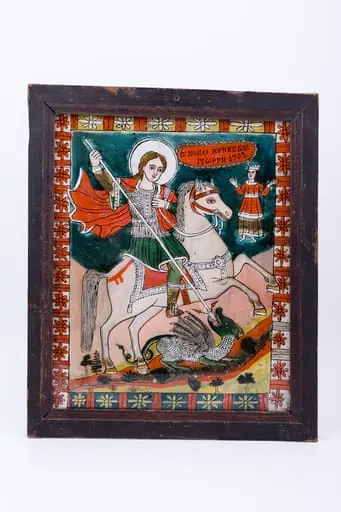 Sfântul Mare Mucenic Gheorghe este așezat călare pe un cal alb, omorând balaurul brun cu lancea, pe care o ține în amândouă mâinile. Balaurul este pictat cu brun-nisipiu, având solzi și coarne. În partea stângă a Sfântului Gheorghe este pictată domnița salvată și ocrotită de marele mucenic. Fondul este turcoaz, în registrul superior și roz- verde-ocru în cel inferior, în centrul icoanei ușor întrepătrundu-se toate culorile. Mantia Sfântului Mucenic Purtător de Biruință este roșie, având pantalonii albi și cămașa de zale de cavaler gri. Cromatica este armonioasă; roșu vermillon, roz, turcoaz, ocru, galben, alb și negru. Inscripția din româno-chirilică se traduce Sf Mare Mucenic Gheorghe. Icoana este rafinată prin acuratețea desenului, compoziția echilibrată și armonia cromatică, Icoana este datată 1902. Icoana este pictată de Matei Țimforea, din Cârțișoara, Țara Făgărașului.
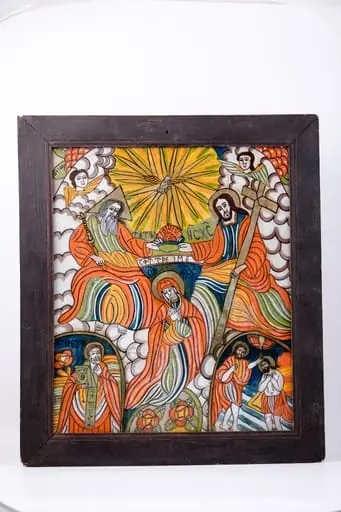 Icoana reprezintă Sfânta Treime și Încoronarea Maicii Domnului central și secundar Botezul Domnului și Sfântul Apostol Petru. Dumnezeu-Tatăl are sceptrul Împărăției Cerurilor, asemenea unui crin de bronz și Dumnezeu-Fiul are Crucea pe umăr. Maica Domnului este ridicată în timpul de rugăciune și ascultare, smerenie și primire de bunăvoie. Dumnezeu-Tatăl, Dumnezeu-Fiul și Maica Domnului sunt înveșmântați în roșu vermillon-orange, alb și albastru bleu-ciel și verde. În registrul îndepărtat superior este cerul albastru, Dumnezeu-Fiul ține pe brațul stâng Crucea, iar Maica Domnului are mâinile împreunate în cruce pe piept. Dumnezeu-Tatăl și Dumnezeu-Fiul așează împreună coroana de împărăteasă a Cerurilor pe capul Fecioarei Maria. În registrul superior, printr-o mandorlă de nouri și un disc de raze solare, deschizându-se cerurile, se coboară Sfântul Duh, sub forma unui porumbel, pe un mănunchi de raze de lumină. Maica Domnului este încoronată ca Împărăteasa Cerurilor de către Dumnezeu-Tatăl și Dumneteu-Fiul. În colțurile superioare stânga-dreapta sunt 2 îngeri serafimi. În registrul inferior, în câte două medalioane ovoidale sunt Botezul Domnului Iisus Hristos și Sfântul Apostol Petru, având Cheile Împărăției Cerurilor. Sunt două tematici iconografice secundare, dar care completează armonios și simetric tematica centrală. Inscripția din româno-chirilică se traduce IC XC Iisus Hristos Tatăl MP Maica Domnului Sfânta Treime Botezul Sf Petru. Cromatica este luminoasă și armonioasă: roșu vermillon, albastru bleu-ciel, galben, alb, auriu, negru. Trăsăturile chipurilor sunt rafinat desenate. Fondul icoanei este cerul albastru ultramarin decorat de mandorle de nouri rotunzi albi-bej-crem, văzduhul fiind bogat în Duhul Sfânt. Este o icoană de Țara Oltului.
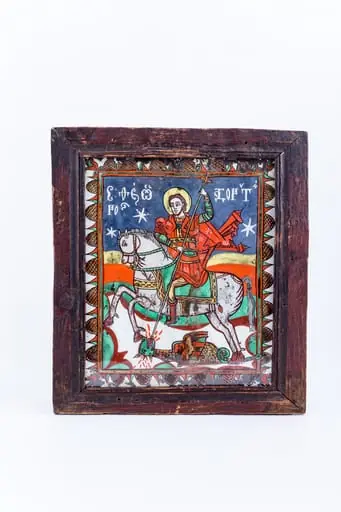 Sfântul Mare Mucenic Teodor Tiron este așezat călare pe un cal alb, omorând balaurul brun cu lancea, pe care o ține în amândouă mâinile. Balaurul este pictat cu brun-acajou, roșu vermillon și verde absint, cu solzi, cu foc și sânge ieșind din răcnetul lui. Fondul este albastru, în registrul superior și galben-ocru și roșu vermillon în cel inferior, în centrul icoanei ușor întrepătrându-se toate culorile. Câmpurile de culori sunt paralele, arătându-se inclusiv și tricolorul românesc ca și fundal de spațiu geografic al narațiunii. Mantia Sfântului Mucenic militar este roșie, având pantalonii galbeni, strecurați în cizmele roșii de cavaler. Ceea ce este specific icoanelor de Valea Sebeșului sunt și floricelele albe foarte mici, de pe veșmântul roșu al mucenicului militar. Cerul albastru ceruleum este împodobit cu stele albe mari, element caracteristic mai mult Țării Făgărașului și Țării Oltului. Fiind o icoană de Valea Sebeșului, cu influențe din Făgăraș, imaginea picturală este armonioasă, cu un desen simplu, curat, tușele de culoare sunt mai mari, raportate la dimensiunile lucrării. Cromatica este armonioasă; roșu vermillon, albastru ceruleum, galben-ocru, verde-absint, brun-roșcat acajou, alb și negru. Pe fondul cerului albastru ceruleum este inscripția în chirilică Sf Teodor Tiron. Icoana este rafinată prin acuratețea desenului, compoziția echilibrată și armonia cromatică, impactul vizual fiind puternic prin alăturarea verde-absint, alb, acajou. Întreaga tematică iconografică este încadrată de un chenar decorativ fitomorf, incluzând și motivul ghindei și a conului de brad.
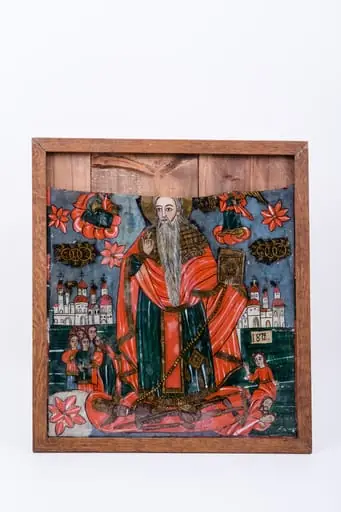 Sfântul Mare Mucenic Haralambie, făcător-de-minuni și vindecător de boli, este cel mai bătrân mucenic din cei prăznuiți de creștini. Este cunoscut ca și făcător-de-minuni, vindecător de boli și ocrotitor al caselor familiilor creștine. Central este pictat Sfântul, îmbrăcat cu veșminte liturgice, arhierești, cu sacos verde-turcoaz, mantie și epitrahil roșu vermillon, omofor cu broderie bronzie, cu mithră și aureolă. Cu mâna dreaptă binecuvântează și cu mâna stângă ține în lanț ciuma, reprezentată antropomorfic și zoomorfic - un animal cu solzi, labe cu gheare și cap de diavol, cu trăsături umane. Ciuma, simbolizând boala incurabilă și moartea, are coarne de diavol, fiind, totodată și păcatul, patima, aducătoare de moartea duhovnicească. Sfântul Haralambie este încadrat de elemente arhitectonice, ziduri de cetate, biserici, case, coloane cu boltă. Icoana se înscrie, ca și realizare artistică în Țara Făgărașului, fiind pictată de Matei Țimforea, datată 1872. În registrul inferior, sunt mai multe personaje: 8 în partea dreaptă a sfântului și 3 în stânga, ieșind vindecați, prin minunile sfântului, de sub puterea diabolică a bolii.Cromatica este armonioasă; roșu vermillon, bronziu, verde turcoaz, gri albăstrui. În registrul superior, este Dumnezeu-Tatăl binecuvântând și un înger punând cununa de mucenicie pe capul sfântului vindecător. Fondul este în registrul superior gri-violaceu-albăstrui, iar în cel inferior verde-turcoaz. Icoana este spartă în registrul superior.
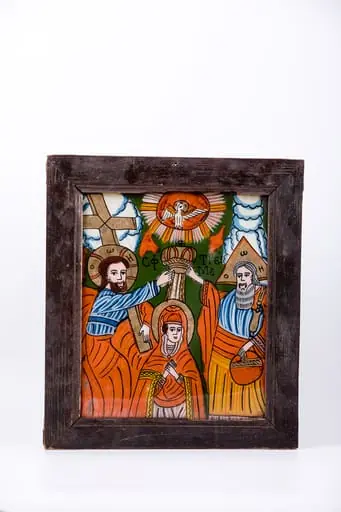 Icoana reprezintă Sfânta Treime - Sfânta Troiță și Încoronarea Maicii Domnului. Dumnezeu-Tatăl are sceptrul Împărăției Cerurilor și globul pământesc sprijinit pe genunchii părintești și Dumnezeu-Fiul are Crucea pe umărul stâng. Maica Domnului este ridicată în timpul de rugăciune și ascultare, smerenie și primire de bunăvoie. Dumnezeu-Tatăl, Dumnezeu-Fiul și Maica Domnului sunt înveșmântați în roșu vermillon-orange, alb, galben și albastru bleu-ciel. În registrul îndepărtat superior este cerul albastru, Dumnezeu-Fiul ține pe brațul stâng Crucea, iar Maica Domnului are mâinile împreunate în cruce pe piept. Dumnezeu-Tatăl și Dumnezeu-Fiul așează împreună coroana de împărăteasă a Cerurilor pe capul Fecioarei Maria. În registrul superior, printr-o mandorlă de nouri și un disc roșu de raze solare, deschizându-se cerurile, se coboară Sfântul Duh, sub forma unui porumbel, pe un mănunchi de raze de lumină. Maica Domnului este încoronată ca Împărăteasa Cerurilor de către Dumnezeu-Tatăl și Dumnezeu-Fiul. În registrul superior, icoana este încadrată de nori albi-albaștri bleu-ciel. Inscripția din româno-chirilică se traduce Sf Treime. Cromatica este luminoasă și armonioasă: roșu vermillon, orange, albastru bleu-ciel, verde văratic, galben, alb, auriu, negru. Trăsăturile chipurilor sunt rafinat desenate. Fondul icoanei este văzduhul verde-văratic, decorat de mandorle de nouri rotunzi albi-albaștri. Este o icoană de Țara Oltului.
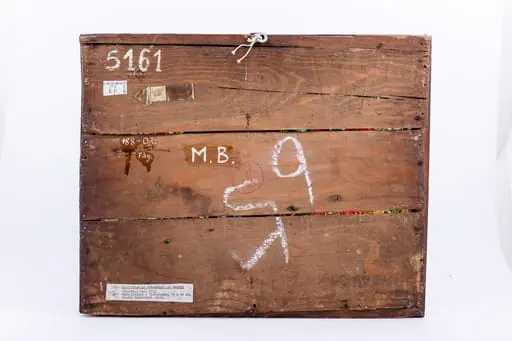 Sfântul Mare Ierarh Nicolae Făcătorul de minuni este redat șezând pe tron arhieresc, ținând cu mâna stângă Sfânta Evanghelie pe genuchi și binecuvântând cu mâna dreaptă. Veșmintele arhierești liturgice ale sfântului ierarh sunt într-o alternanță cromatică de roșu vermillon-verde-olive, bej, albastru bleu-ciel-alb. Epitrahilul, patrafirul este olive, cu opt cruci pe el. Poartă mithră și are aureolă. Sfântul ierarh este așezat pe un tron foarte frumos și bogat ornamentat decorativ geometric, în nuanțe de verde olive și bej, sprijindu-și picioarele pe un piedestal de pardoseală de biserică, format dintr-un caroiaj mărunt de alb-negru. Pe tron este și o pernă rulou olive. În registrul superior, deasupra sfântului ierarh, sunt Dumnezeu-Tatăl Binecuvântând și Maica Domnului ocrotind, din două mandorle de nouri rotunzi albi. În cea de-a doua parte a icoanei sunt Sfinții Arhangheli Mihail și Gavriil sunt reprezentați împreună, fiind mai-marii voievozi ai oștilor cerești. Sfântul Arhanghel Mihail, numit slujitorul Legii, are sabia și balanța de măsurat faptele bune și rele, iar Sfântul Arhanghel Gavriil, îngerul aducător de dar și bunavestire, poartă sabia și Potirul. Veșmintele sunt asemănătoare: tunică roșie-vermillon, pantaloni bleu-ciel și aripile de îngeri verzi. Inscripția din româno-chirilică se traduce Sfântul Nicolae IC XC Iisus Hristos MP Maica Domnului Soborul mai-marilor Voievozi Mihail și Gavriil. Fondul icoanei este negru cu micuțe petale de floricele albe, roșii și verzi. Cromatica armonioasă este alcătuită din: negru, roșu-vermillon, verde olive, bej, albastru bleu-ciel, alb. Icoana este de Țara Făgărașului. Se remarcă inscripția foarte frumos scrisă, o caligrafie artistică și estetică. Icoana este pictată de Matei Țimforea Purcărea, din Cârțișoara.
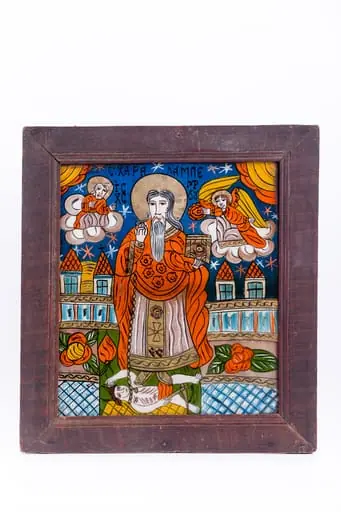 Sfântul Haralambie este cunoscut ca și făcător-de-minuni, vindecător de boli și ocrotitor al caselor familiilor creștine. Central este pictat Sfântul, îmbrăcat cu veșminte liturgice, arhierești, cu sacos roșu vermillon și bej-rozaliu, cu elemente decorative florale brune și epitrahil brun-stacojiu-roz, cu trei cruci și aureolă. Cu mâna dreaptă binecuvântează și cu mâna stângă ține Sfânta Evanghelie închisă. Tot cu mâna dreaptă, binecuvântând, ține și în lanț ciuma, reprezentată antropomorfic și zoomorfic - o vietate goală și diavol, cu trăsături umane. Ciuma, simbolizând boala incurabilă și moartea, are coarne de diavol, fiind, totodată și păcatul, patima, aducătoare de moartea duhovnicească. Fondul este cerul albastru cobalt strălucitor de senin, cu elemente decorative astrale - stele albe și roșii. Compoziția iconografică este îmbelșugat-echilibrată cu elemente de arhitectură. În registrul superior sunt Dumnezeu-Tatăl Binecuvântând și Îngerul păzitor, cu aripile galbene de lumină, ocrotind, fiind pe mandorle de nouri albi-crem-bej. Cromatica este armonioasă și luminoasă: roșu vermillon, brun-rozaliu, albastru cobalt și blau-ciel, verde spanac-avocado, kaki, cafeniu, galben-ocru, alb, negru. Icoana este de Țara Oltului. Inscripția din româno-chirilică se traduce Sfântul Haralambie IC XC MP Iisus Hristos Maica Domnului. Chiar dacă în inscripție scrie MP Maica Domnului este pictat Sfântul Înger ocrotind.