Artwork
The Hanging
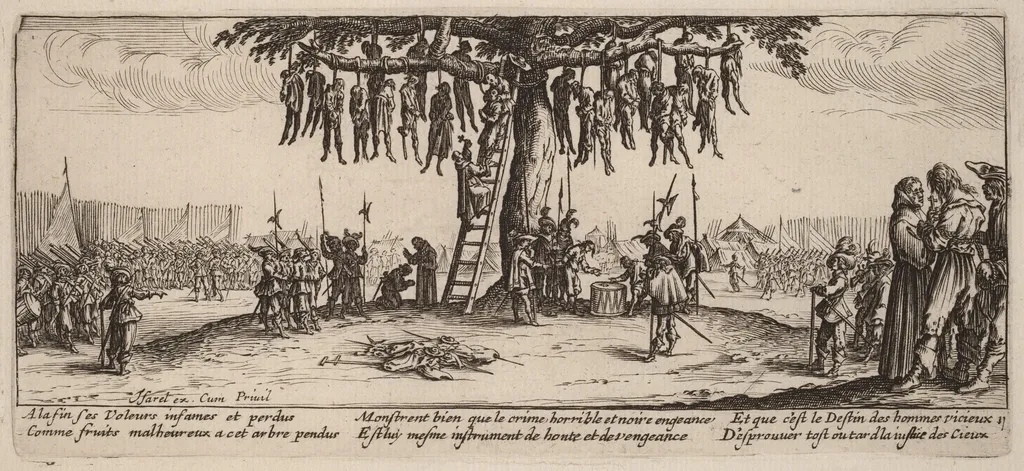
The Hanging is an ink print by the Baroque artist Gerrit van Schagen. It dates from 1642 and is held in the collection of the National Gallery of Art.
About this work
Overview
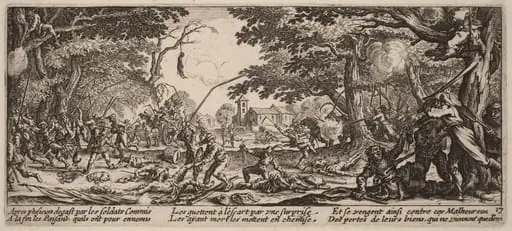
Created in 1642 by Gerrit van Schagen, this print combines etching and engraving on laid paper to depict a grim public execution.
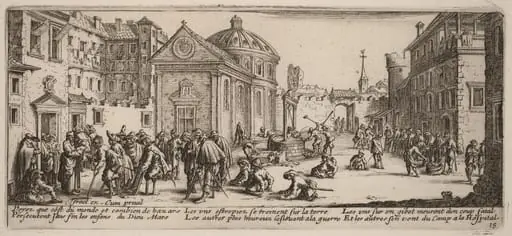
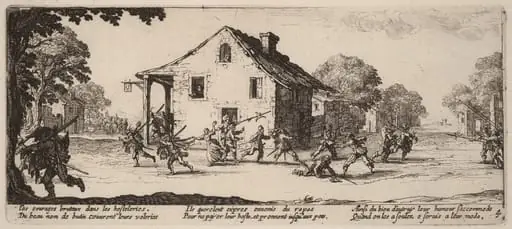
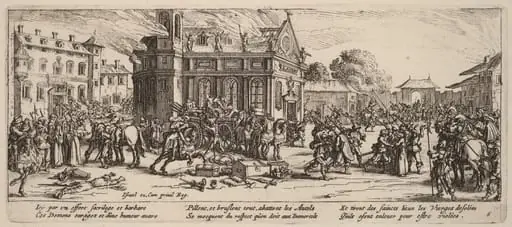
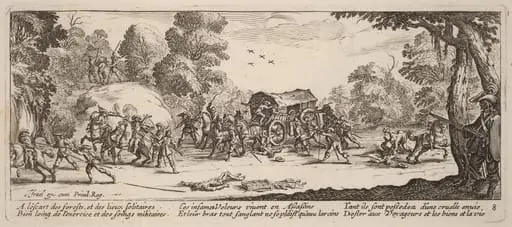
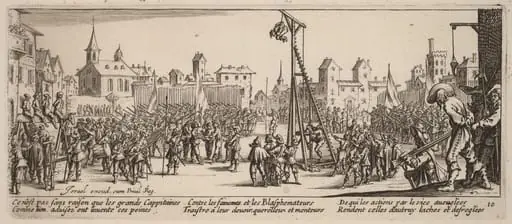
Created in 1642 by Gerrit van Schagen, this print combines etching and engraving on laid paper to depict a grim public execution. The composition centers on a tree laden with suspended bodies, surrounded by a tense crowd and armed soldiers. A ladder leans against the trunk, suggesting recent additions to the scene. Below the image, Latin text invokes divine retribution against the wicked, framing the violence as moral judgment.
Subject & Meaning
The scene portrays a mass hanging, likely referencing biblical or contemporary judicial executions. The presence of robed figures pointing toward the bodies implies moral commentary, possibly clerical or civic authorities affirming the punishment. The chaotic crowd and stormy sky amplify the gravity of the moment, while the Latin inscription explicitly links the spectacle to divine justice, reinforcing the theme of retribution.
Technique & Style
Van Schagen employed fine, incised lines typical of engraving to render sharp contrasts and dense textures. The tree’s gnarled branches, the soldiers’ spears, and the scattered debris on the ground are rendered with precise, angular strokes. The stormy sky is suggested through hatched shadows, while the figures’ gestures and postures convey urgency and dread. The technique heightens the emotional intensity without relying on color.
History & Provenance
The print was produced in the Dutch Republic during a period when public executions were common and often documented in print. Van Schagen, active in Amsterdam, specialized in graphic works with moral or historical themes. This piece likely circulated among educated audiences familiar with biblical parallels and civic order. No early provenance is recorded, but its survival suggests it was preserved as a specimen of graphic art or moral instruction.
Context
In mid-17th century Holland, prints like this served both as news and moral allegory. Public hangings were spectacles, and artists frequently depicted them to reflect societal values. The use of Latin text aligns with scholarly traditions, while the graphic detail echoes contemporary engravings of biblical punishments. The work reflects a culture where visual media reinforced legal and religious authority.
Legacy
Though not widely reproduced today, the print exemplifies the Dutch tradition of using graphic art to explore themes of justice and punishment. Van Schagen’s work contributes to a broader corpus of early modern prints that documented social order through violent imagery. Its technical precision and thematic clarity place it within a lineage of didactic printmaking, influencing later artists who sought to convey moral narratives through line and composition.
Artist & collection