Artwork
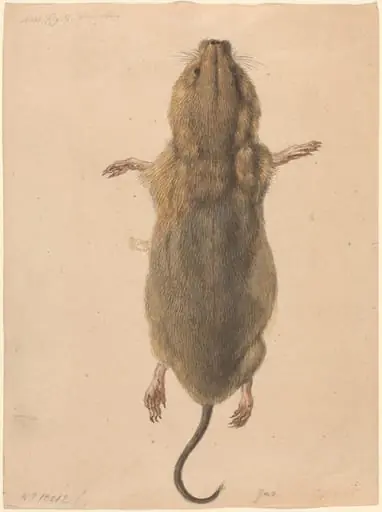
A Field Mouse, from Below
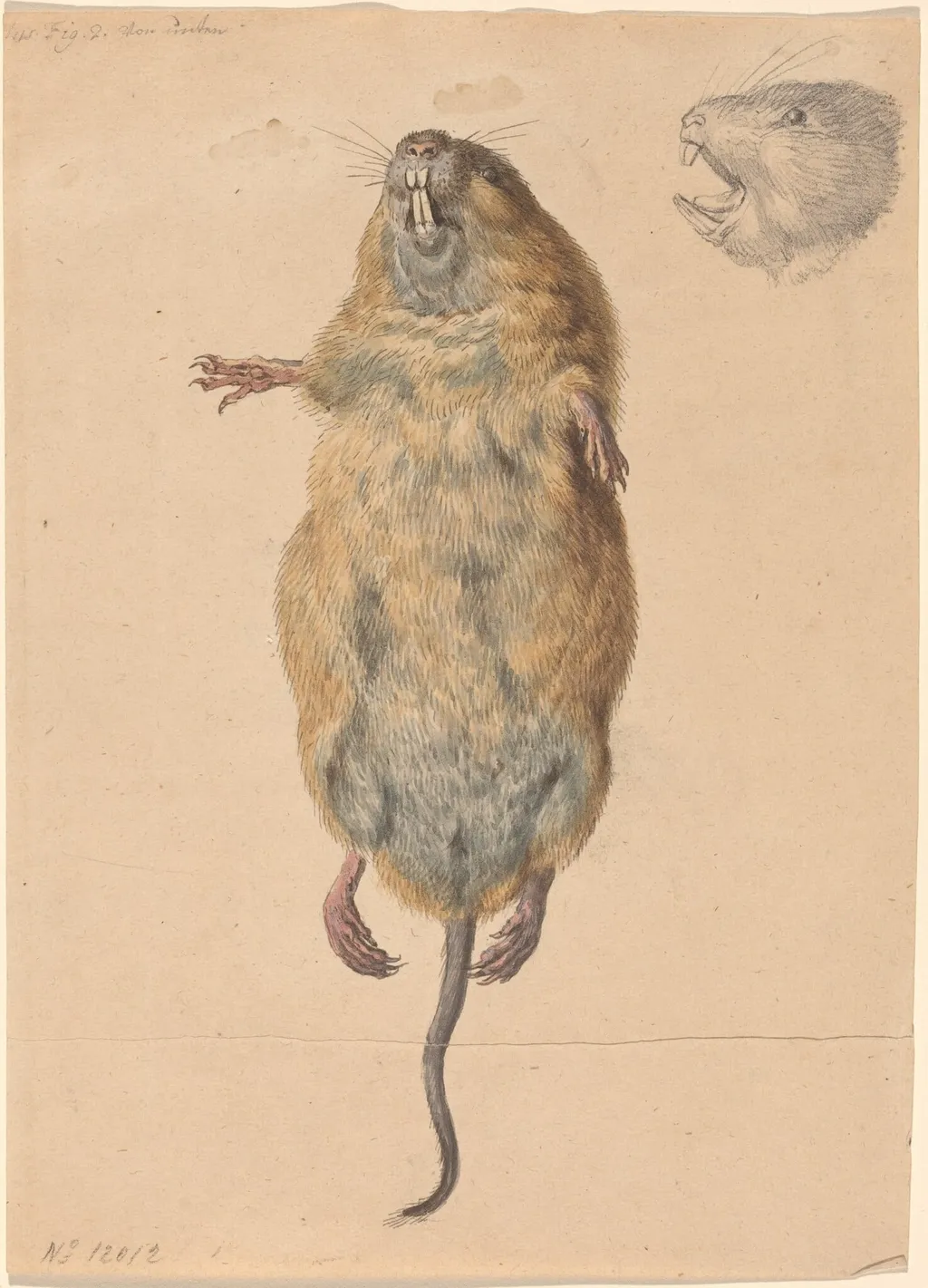
A Field Mouse, from Below is a graphite drawing by the Baroque artist Johann Rudolph Schellenberg. It dates from 1775 and is held in the collection of the National Gallery of Art.
About this work
Overview
Created around 1775, this watercolor drawing by Johann Rudolph Schellenberg depicts a field mouse viewed from beneath.
Created around 1775, this watercolor drawing by Johann Rudolph Schellenberg depicts a field mouse viewed from beneath. Executed in graphite, black ink, and watercolor on wove paper, the work is part of a series of observational studies. The composition emphasizes anatomical detail and unusual perspective, suggesting the artist’s intent to document the creature’s form with scientific precision rather than decorative intent.
Subject & Meaning
The mouse is shown inverted, its belly exposed, tail dangling, and mouth slightly agape as if mid-squeak. This perspective, uncommon in natural history art, invites close inspection of the animal’s delicate features—claws, whiskers, and fur texture. The inclusion of a secondary sketch on the page indicates the artist’s methodical approach, using multiple angles to understand the creature’s structure, possibly for educational or taxonomic purposes.
Technique & Style
Schellenberg employed fine graphite lines to outline the mouse’s form, then layered translucent watercolor washes to suggest the soft gradations of its fur. Black ink defined sharp details like claws and the tip of the tail. The paper’s texture subtly enhances the tactile quality of the rendering. The restrained palette of browns and grays, combined with precise linework, reflects an empirical aesthetic common in 18th-century naturalist illustration.
History & Provenance
The drawing is attributed to Schellenberg’s period of active study in the 1770s, when he produced numerous animal sketches for scientific documentation. Its survival suggests it was preserved within a personal or institutional collection of natural history materials. No public record of early ownership exists, but its condition and medium align with other known works from his sketchbooks held in Swiss archives.
Context
In late 18th-century Europe, detailed animal studies were increasingly valued in natural philosophy. Schellenberg’s work reflects the influence of Linnaean taxonomy and the growing interest in accurate visual records of fauna. Unlike ornamental illustrations, his drawings prioritized anatomical truth, often depicting subjects from unconventional angles to capture structural complexity absent in traditional portrayals.
Legacy
Schellenberg’s field mouse study exemplifies the quiet rigor of pre-modern naturalist drawing. Though not widely exhibited, such works contributed to the foundation of biological illustration. Their emphasis on direct observation and multiple viewpoints influenced later scientific artists who sought to represent living organisms with both accuracy and sensitivity to form.
Artist & collection