Artwork
The Archangel Gabriel
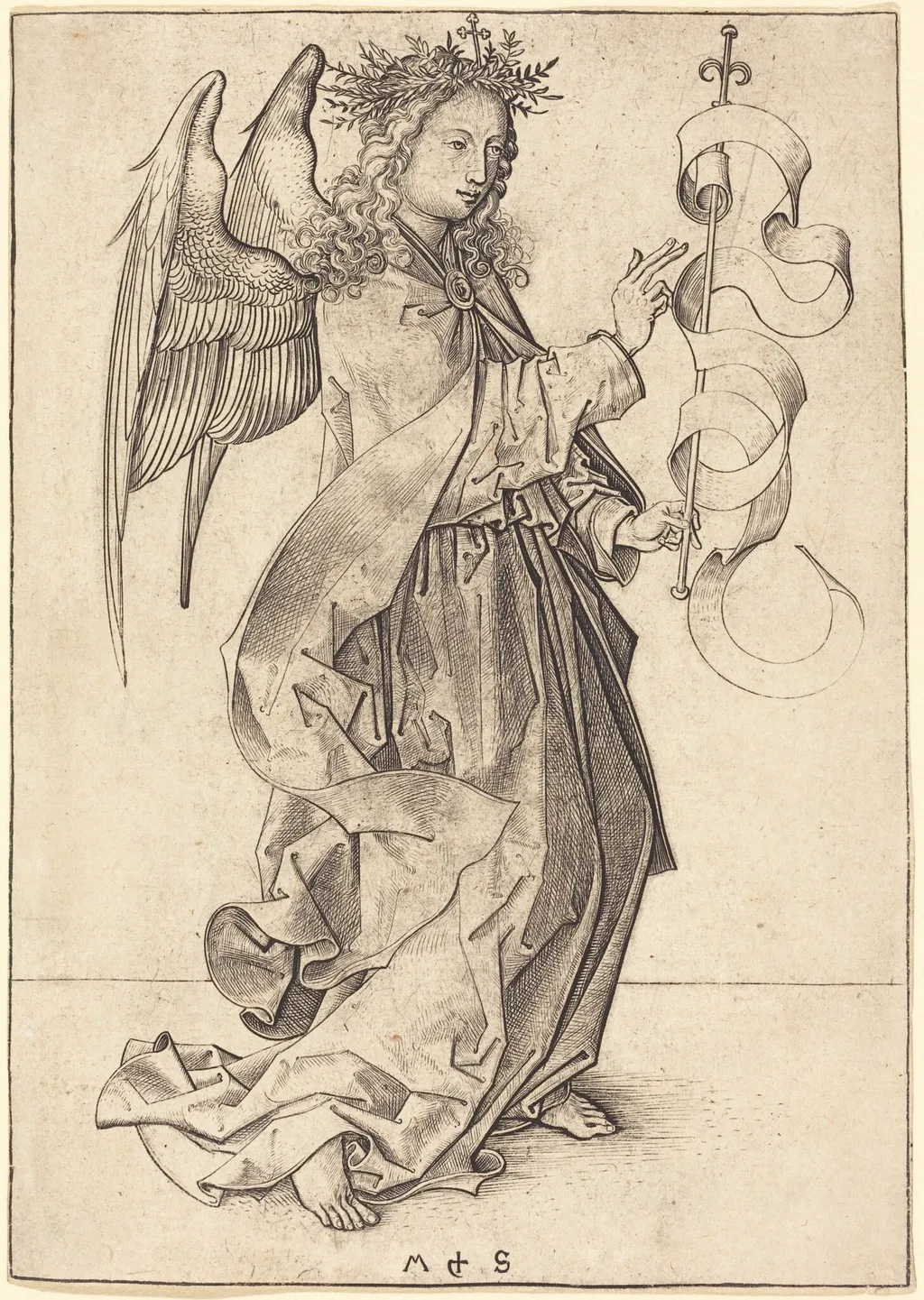
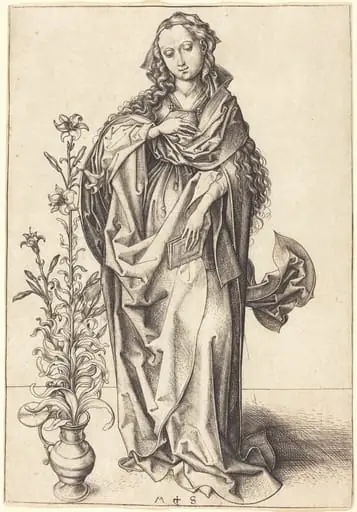
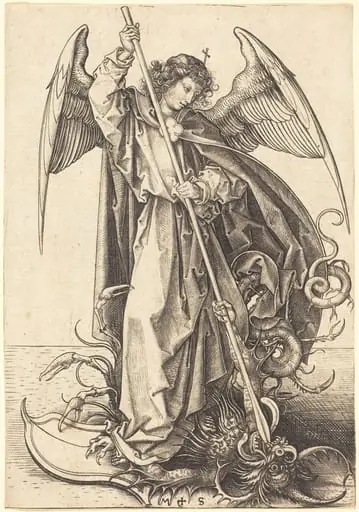
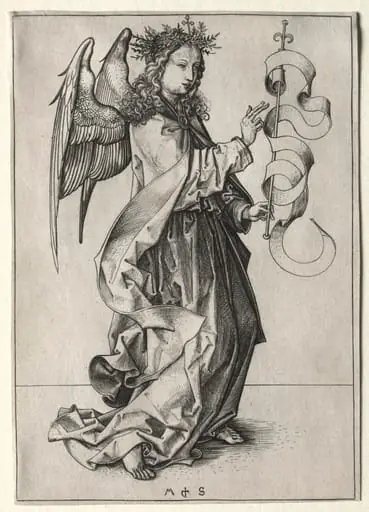
The Archangel Gabriel is an ink print by the Renaissance artist Martin Schongauer. It dates from 1490 and is held in the collection of the Library of Congress.
About this work
Overview
The work stands as a testament to his technical command of the engraving process, where metal plates were incised to produce detailed impressions on paper.
Created around 1490, this engraving by Martin Schongauer depicts the Archangel Gabriel in a moment of quiet reverence. As one of the most accomplished printmakers north of the Alps, Schongauer used fine, controlled lines to render intricate detail across the figure’s robes, wings, and crown. The work stands as a testament to his technical command of the engraving process, where metal plates were incised to produce detailed impressions on paper.
Subject & Meaning
The Archangel Gabriel is shown kneeling, one hand raised in gesture, the other holding a staff topped with a spiral form. His crowned head, adorned with leafy foliage, and flowing garments suggest divine presence rather than earthly royalty. The downward gaze and composed posture convey solemnity, aligning with traditional iconography of Gabriel as the messenger of the Annunciation, though the specific biblical moment is not explicitly illustrated.
Technique & Style
Schongauer employed precise engraving tools to carve fine lines into a copper plate, creating depth through cross-hatching and varied line weight. The texture of feathers, fabric folds, and hair emerges from the density and direction of these incised marks. The resulting print achieves a sculptural quality, with light and shadow modeled in ink rather than pigment, showcasing the engraver’s ability to simulate volume and materiality on a flat surface.
History & Provenance
Schongauer, born in Colmar around 1450, produced engravings that circulated widely across Europe during the late 15th century. While the exact early ownership of this print is undocumented, its survival in multiple impressions indicates significant demand. His prints were collected by artists and patrons alike, influencing later engravers in Germany and the Netherlands before the rise of Dürer.
Context
In the decades before the Reformation, religious imagery in print form became increasingly accessible. Schongauer’s work emerged within a flourishing Northern European tradition that valued devotional clarity and meticulous detail. His engravings bridged the gap between manuscript illumination and mass-produced imagery, serving both private devotion and artistic study among contemporaries.
Legacy
Schongauer’s technical innovations in engraving set a standard for later Northern Renaissance printmakers. His ability to render complex forms with linear precision influenced Albrecht Dürer and others who followed. Though few of his paintings survive, his engravings endured as models of craftsmanship, ensuring his reputation as a pivotal figure in the evolution of printmaking as a serious artistic medium.
Artist & collection

Artist
Martin Schongauer, also known as Martin Schön or Hübsch Martin by his contemporaries, was an Alsatian engraver and painter.