Artwork
Huntsmen with Hounds and a Crouching Hare [recto]
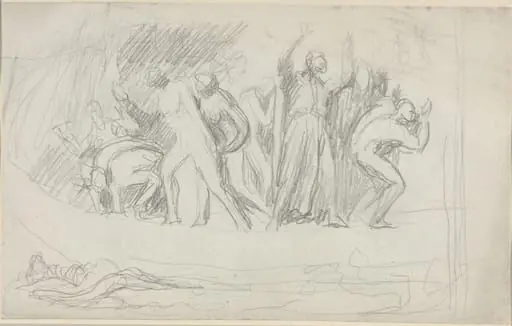
![Huntsmen with Hounds and a Crouching Hare [recto], by James Seymour, graphite, 1727](https://artifactworldgallery.com/img/james-seymour--huntsmen-with-hounds-and-a-crouching-hare-recto--e2b42c7824fe6842-w1024.webp)
Huntsmen with Hounds and a Crouching Hare [recto] is a graphite drawing by the Baroque artist James Seymour. It dates from 1727 and is held in the collection of the National Gallery of Art.
About this work
Overview
The composition captures a fleeting hunting episode: riders on horseback, foot hunters, their hounds, and a hare poised low in the foreground.
James Seymour’s 1727 drawing, *Huntsmen with Hounds and a Crouching Hare*, is executed in graphite on laid paper. The composition captures a fleeting hunting episode: riders on horseback, foot hunters, their hounds, and a hare poised low in the foreground. The work is rendered with swift, gestural lines that emphasize movement rather than detailed rendering, presenting the scene as a momentary observation rather than a finished illustration.
Subject & Meaning
The image records a traditional English chase, a popular pastime among the gentry in the early eighteenth century. By placing the hare crouched near the viewer, Seymour foregrounds the tension between predator and prey, while the scattered hunters and dogs suggest a collective pursuit, reflecting contemporary ideals of sport, camaraderie, and mastery over the countryside.
Technique & Style
Seymour employs loose graphite strokes on laid paper, allowing the paper’s texture to contribute to the visual effect. The drawing lacks background detail; instead, the artist uses broad, light lines to suggest forms and motion. This rapid, almost sketch‑like approach aligns with the practice of on‑site drawing, where speed was essential to capture the immediacy of a scene.
History & Provenance
Born in London in 1702, Seymour was the son of an amateur artist and dealer who facilitated his exposure to the works of leading painters through the Virtuosi Club of St. Luke. The drawing reflects his early career focus on equestrian and sporting subjects, a niche that later defined his reputation. Its provenance traces back to private collections before entering a public holding in the late twentieth century.
Context
The early eighteenth century saw a rise in outdoor sketching among English artists, driven by a growing interest in naturalistic observation. Seymour’s drawing exemplifies this trend, prioritising the capture of dynamic action over the polished finish typical of studio work. The piece also resonates with the broader Baroque emphasis on movement and dramatic tension, albeit in a more restrained, documentary manner.
Artist & collection
Artist
James Seymour (1702–1752) was an English painter, widely recognized for his equestrian art.

![Mounted Horsemen [verso], by James Seymour](https://artifactworldgallery.com/img/james-seymour--mounted-horsemen-verso--7e115ac519b61a2c-w320.webp)
 Sheet of Sketches
 Passengers for Rhine Steamer (verso)
 Five drawings of figures and dogs
 Long Island, New York
 Wild West, Buffalo Bill
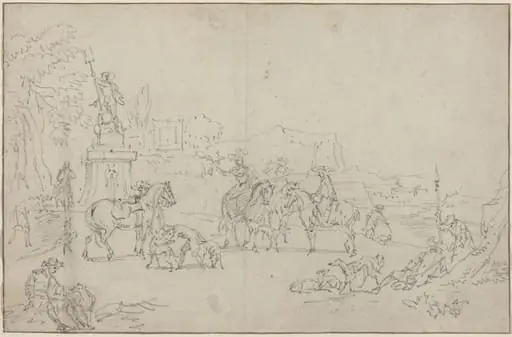 An Elegant Hunting Party Resting by a Fountain
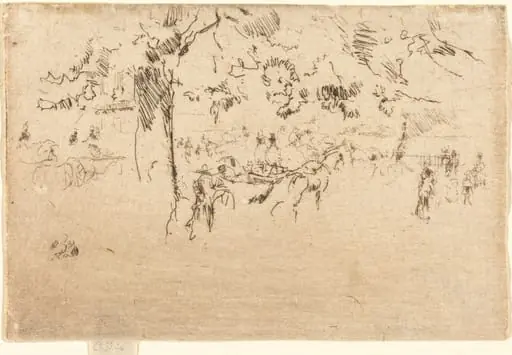 Saint James's Park
 Bucking Horse
![Skirmish Involving a Wagon Train [verso], by Winslow Homer](https://artifactworldgallery.com/img/winslow-homer--skirmish-involving-a-wagon-train-verso--6ee57b18fcbda7d4-w320.webp) Skirmish Involving a Wagon Train [verso]
Skirmish Involving a Wagon Train [verso]![Figures in a Landscape [recto], by Thomas Barker](https://artifactworldgallery.com/img/thomas-barker--figures-in-a-landscape-recto--389a2c7e3e861324-w320.webp) Figures in a Landscape [recto]
Figures in a Landscape [recto] Chinese men surrounding a basket
 Study for "The Deluge"