Artwork
Untitled
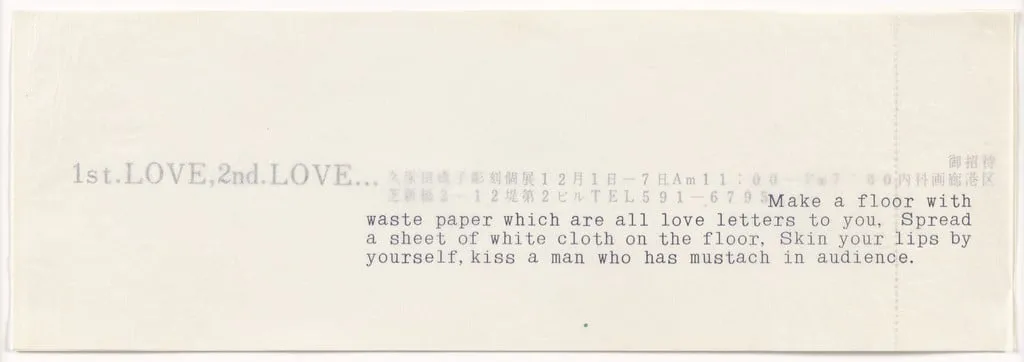
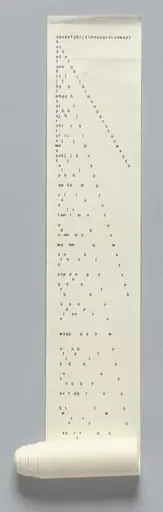
Untitled is a print by Shigeko Kubota. It dates from 1963 and is held in the collection of the Museum of Modern Art.
About this work
Overview
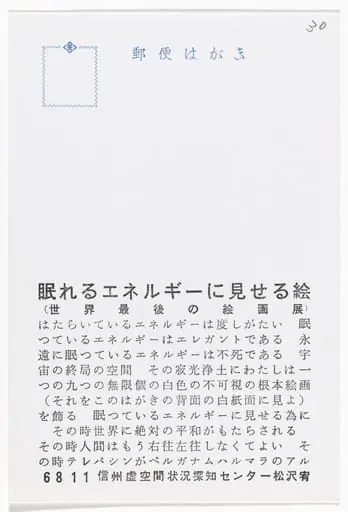
Created in 1963, this work by Shigeko Kubota consists of a mimeographed sheet pasted onto a gallery announcement for her solo show at Naiqua Gallery in Tokyo.
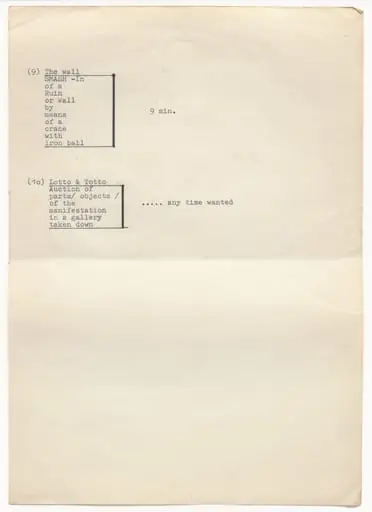
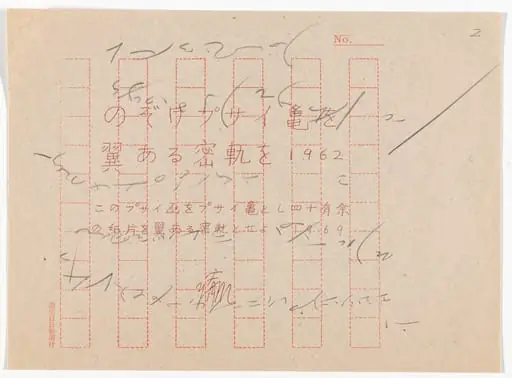
Created in 1963, this work by Shigeko Kubota consists of a mimeographed sheet pasted onto a gallery announcement for her solo show at Naiqua Gallery in Tokyo. The surface bears a collage of handwritten and typewritten text, layered and smudged, with torn paper edges suggesting a makeshift, ephemeral quality. It functions both as an artwork and a fragment of exhibition ephemera, blurring the line between documentation and creative expression.
Subject & Meaning
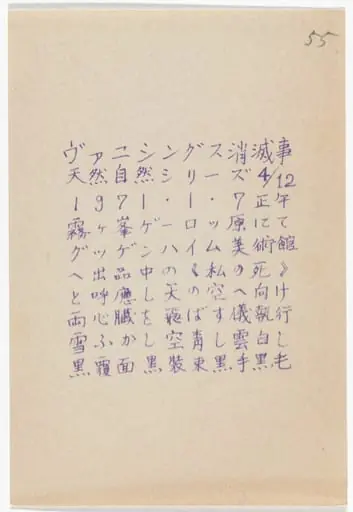
The text includes a fragmented, intimate poem referencing love and the physical detail of a mustached man’s kiss, alongside Japanese script and a handwritten phone number. These elements evoke personal, almost private musings, yet their public display on an exhibition notice transforms them into a gesture of vulnerability and openness. The juxtaposition of romantic fragments with institutional context challenges conventional boundaries between private life and artistic presentation.
Technique & Style
Kubota employed mimeograph printing, a low-fidelity, DIY method common in avant-garde circles, to produce the text layer. Handwritten additions and typewritten fragments overlap irregularly, creating visual noise. The paper’s uneven tear and its attachment to a pre-existing announcement reflect an aesthetic of assemblage and impermanence. The work resists polished composition, favoring raw, immediate mark-making that aligns with Fluxus sensibilities.
History & Provenance
The piece originated as part of Kubota’s 1963 exhibition at Naiqua Gallery in Tokyo, where it was likely distributed as a hand-pasted notice. Its survival and eventual acquisition by The Museum of Modern Art suggest its recognition as a significant artifact of early Japanese avant-garde practice. The work’s material condition—worn, patched, and altered—preserves its original context as a transient, functional object repurposed as art.
Context
Produced during Kubota’s early engagement with the Fluxus movement, the work reflects a broader interest among artists in rejecting traditional art objects in favor of ephemeral, text-based, and participatory forms. In postwar Japan, where experimental art was emerging alongside rapid modernization, such works used mundane materials and personal language to question institutional authority and the commodification of culture.
Legacy
This piece exemplifies Kubota’s early exploration of language as material and the integration of daily life into art. It anticipates later conceptual and feminist practices that privilege the personal as political. As one of the few surviving examples of her pre-New York work, it offers insight into the transnational roots of Fluxus and the quiet radicalism of artists who used paper, ink, and chance to disrupt artistic norms.
Artist & collection

Artist
Shigeko Kubota was a Japanese video artist, sculptor and avant-garde performance artist, who mostly lived in New York City.